Hello Grey guys, welcome back to The Soup. This publication invites everyone who has made a difference in my Substack world to the same table, and encourages you to converse, discuss, explain, expand, and understand. This is The Soup, and truth is soup, so chew on every bite before swallowing. Leave the rest if you can't finish it. Most of all, thank you for simply showing up.
This one started behind a seafood counter with cold legs. I have been researching a project I call Gradient Mining, which is mostly a way of looking at differences and asking what they can still do before they disappear. The Main Pour gets into the physics. After that, the rest of the bowl is about what happens when faster tools create more possibilities than time, where The Gospel of the Grey has reached, and everything currently simmering around here.
Around the Table
Real people. Real impact.
I've spent much of the past couple of weeks away from Substack. It's like taking time to breathe, like I was forgetting to get oxygen. Stepping away allowed clarity, but I was still watching, and after reviewing my activity, these are the ones that stood out to me:
Meg for the likes and the influential words.
Nini for the like.
Tytanus Wylder for the like.
Krisztián the Occultist for reaching out. I'm glad I could inspire your website design. Those kinds of comments validate the real work I'm trying to do. You helped prove to me that I am reaching out to people in unexpected ways.
Simon Cotton for playing the game and finding out what drink you are, and always, thank you for the support.
Quiet Atlas for the support. You never let me down, and I appreciate that more than you know.
Joshua Lee Downs for the endless likes. I hope you are actually reading them is my only request. I would love to hear more of your thoughts.
Rache Brand for being an awesome person overall. I think I might have said that in the last episode, but it deserves repetition. You have been extremely influential to me. I am now researching and living by the important aspects of the Gene Keys, and I'm studying the audiobook and the eBook. Thanks again for the analysis. It really puts things into perspective.
Sew Psycho for being the lone actual paid subscriber. I know we are scratching each other's back, and I feel great about it. And thanks for the Bloody Mary.
Robert Samuels for the follow.
Nobody, an actual name, which is perfect. Thanks for the follow. I did it back.
Scott Fasano for the like. It shows that my stuff actually reaches people outside of my small circle sometimes.
Robert Samuels, thanks for the follow. I sent it back.
Spiky axioms at a minimum for the great comment on my AI disclosure piece.
Abel Bronkhorst, thanks for the like.
Wilding for the likes and the follow. You are awesome.
The Yellow Field for the likes and the support.
Christie Sausa, MS for the follow and the likes. It really helps.
JRCCreasey for the follow, comment, and like. I realized I wasn't following you back. Sorry about that. I just did.
RJ Ramey for the likes. Let's do it more often, reciprocally.
Jeremiah Bowen for the sub. Thanks a bunch!
Aletheia for the follow. I again realized I didn't do it back. So, I just did.
Lazarus, for the inspiring comment about enlightenment. We don't need to make it more complicated than it is. It's all about self-acceptance, self-awareness, and belief in yourself. I find it beautiful.
The GatE — Don, thanks for the follow. I gotchu.
Mark Dtayo, for the follow. I hit you back, as well.
Jeremiah Bowen, for the subscribe. Thanks. We share the love at this table.
Free Intelligence, for the subscribe. I returned the favor and look forward to reading more about you.
IllumiGnosis, for the follow. Thanks. Every bit matters.
I think that's it. If I left you out, sorry. A lot of people can make a difference, and a lot can change in two weeks. Let's take this time to grow together and become as incredible as we know we are in our hearts. Thanks again.
The Main Pour
The Difference is the Opportunity
It doesn't matter what the temperature is outside. I go to work in long underwear under my jeans, a sweatshirt, and usually a beanie. My hair is short, and the meat and seafood department at Partially Eaten Foods is cold enough that after enough hours back there, I feel it everywhere. My legs get cold. My hands get cold. The sweatshirt stops feeling excessive pretty quickly.
I have worked inside that cold for long enough that most days I do not think much about what has to happen to keep it there. Then I started researching Gradient Mining, and the department changed, but not at all.
The case was still the case. The fish were still cold. I was still dressed like November.
I just started wondering where the heat went.
A refrigerator does not really make cold. It moves heat. In one common kind of supermarket refrigeration system, refrigerant passes through cases and coolers, absorbs heat there, returns to compressors, and eventually reaches condensers that reject heat elsewhere, often outside the building.[1] Supermarkets use more than one refrigeration architecture, so I do not know which exact system is hiding behind the walls at Partially Eaten Foods. I am also not going looking for it. The case's power cord is hidden, and that is about as far as my workplace investigation needs to go. Interesting questions are cool until they turn into meetings with management.
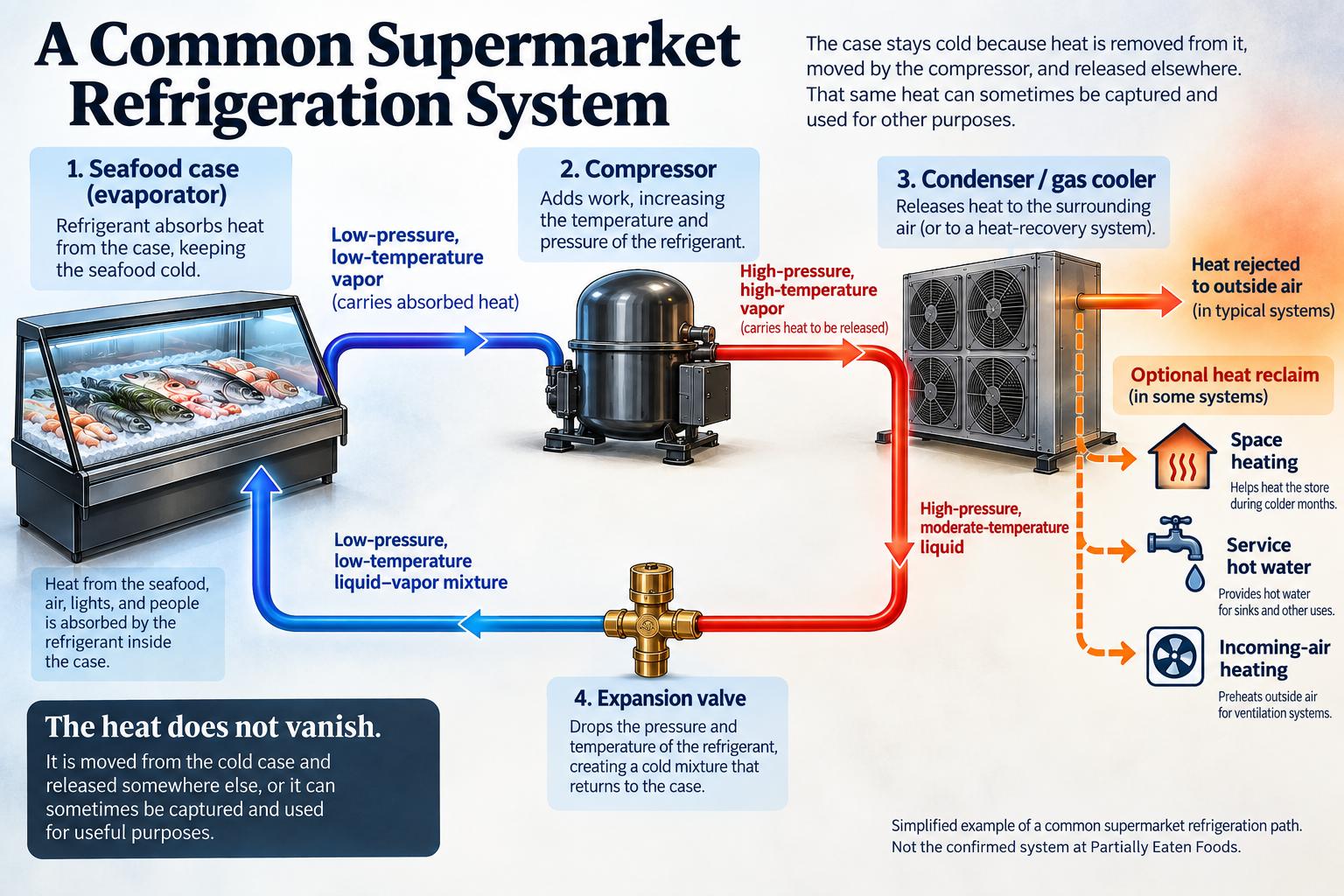
Simplified example of a common supermarket refrigeration path. Not the confirmed system at Partially Eaten Foods.
The answer got better when I learned people already do things with that heat.
ASHRAE, the professional society for heating, refrigeration, and air-conditioning engineers, has an entire section devoted to refrigeration heat reclaim. Heat leaving a refrigeration system can sometimes be redirected to heat a store, heat water, preheat incoming air, or serve another heating load instead of being immediately rejected.[2] The U.S. Department of Energy and the National Renewable Energy Laboratory, or NREL, have also published guidance for supermarkets trying to decide when heat reclaim actually makes sense. That guidance contains the part I like most: a badly applied reclaim system can cost more to operate than it saves. The heat may exist and still not be worth chasing.[3] That distinction is most of what I mean by Gradient Mining.
I did not invent heat recovery. I did not invent thermodynamics, which is fortunate because I am currently employed to sell fish. Engineers already have exergy analysis, waste-heat recovery, process integration, pinch analysis, thermoeconomics, and other ways of asking which parts of an energy system are useful, wasted, recoverable, or economically worth bothering with.[4][5]
Gradient Mining is the name I have been using for looking across all of that from the same starting place.
Find the difference.
Ask why the difference exists.
Ask what it cost to create or maintain.
Then follow it to wherever the difference disappears.
If there is useful value there, harvesting is the next question. Mining is finding the place worth asking.
The word energy gets slippery fast. We use it constantly while quietly asking it to mean several different things.
Energy being present does not mean all of it is equally useful. Engineers use the term exergy for useful-work potential measured relative to an environment. Energy is conserved, but useful-work potential can be destroyed as real processes move toward equilibrium.[5] Two systems can therefore contain energy while offering very different opportunities to do useful work.
That was the part that changed the project for me.
The question stopped being, How much energy is there?
It became, What can this condition still do?
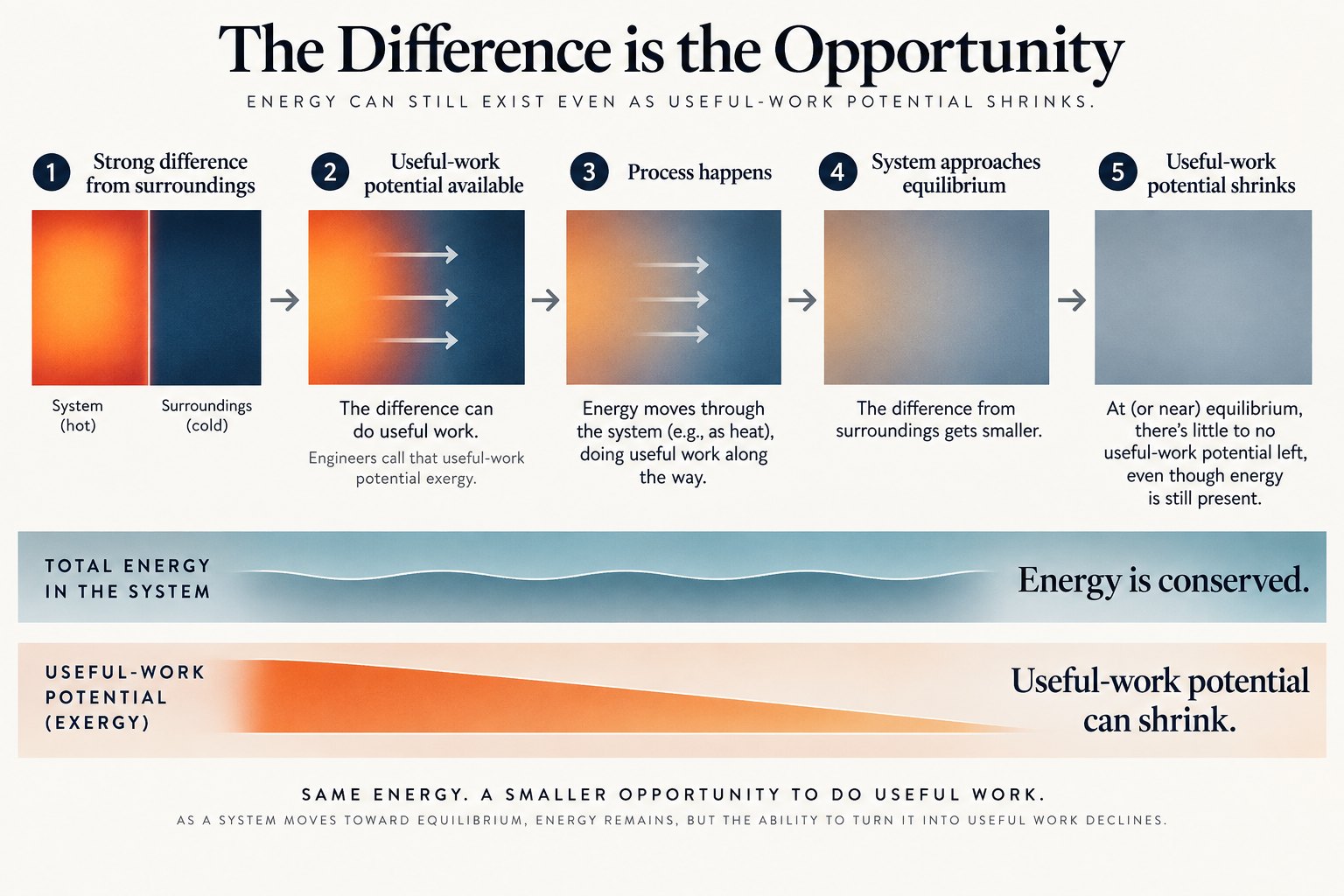
Conceptual exergy graphic. No numerical efficiencies are implied.
Temperature is one version. Pressure is another. Hot and cold process streams can sometimes be matched so one process uses heat another process would otherwise reject. Under the right conditions, a pressurized stream may contain recoverable potential. Freshwater and saltwater even contain a usable difference in concentration, and technologies such as pressure-retarded osmosis and reverse electrodialysis have been developed to capture part of the energy associated with that difference.[4][6]
None of that means every difference deserves a machine.
A gradient can be tiny. It can happen at the wrong time. The equipment required to reach it can cost more than the recovered value. Moving heat somewhere useful can consume energy on its own. A system may already be reclaiming it. The smarter answer may be to stop creating the waste in the first place. Recovery for recovery's sake is not automatically efficient.[3]
Six days ago, I published Some of It Was Never a Fight. I was trying to separate two things being different from two things being at war. I do not need to make that argument again here.
This question comes after it.
If the difference is not necessarily a fight, what is it doing?
Physics gives one answer in physical systems. Differences in temperature, pressure, concentration, electrical potential, and other states can drive change. Biology makes the picture stranger. Living systems do not simply settle into thermodynamic equilibrium. They continuously use energy to maintain structures and non-equilibrium distributions that are necessary for life.[7][8]
That does not prove a damn thing about God.
It does not prove consciousness survives the body. It does not prove the universe is trying to teach me lessons through the seafood case. Thermodynamics did its job several paragraphs ago.
What follows is mine.
I believe I am both this flawed human meat suit and a fragment of divine consciousness experiencing itself through it. The meat suit gets sore. Its back hurts. Its legs get tired. It wakes up too early and then complains about being tired as though the culprit is a mystery. It watches clocks because work starts at a particular time and The Soup is supposed to show up on a particular Thursday.
The other part is quieter.
I don't mean I have permanently reached some enlightened state where none of that bothers me. Awakening is not an appointment I can put on tomorrow morning's calendar. Every time I try to force peace to arrive on my schedule, I have already left the peace I was trying to reach.
The practice is returning.
Maybe that is where the word balance has been giving me trouble.
I have tended to imagine balance as the moment when opposite sides finally stop pulling, the scale becomes level, the argument ends, and everything reaches the same peaceful middle. But a living system does not survive by making every meaningful difference inside it disappear. A body regulates. It maintains. It responds. Some differences are problems. Some are useful. Some are conditions of being alive.[7][8]
That does not mean suffering is fuel.
My aching back is not an underused energy asset. Exhaustion is not a resource I need to extract more efficiently. Sometimes the correct response to depletion is not optimization.
It is sleep.
Gradient Mining has not given me a new religion. It has given me a new question.
When I notice a difference now, physical or otherwise, I am a little less interested in immediately flattening it, fixing it, picking a side, or declaring it waste.
First I want to know what it is carrying.
A gradient is a difference with somewhere to go.
And before it gets there, I want to know what was possible along the way.
From the Books
The Road Turns Up
The Gospel of the Grey
The Gospel of the Grey is past the halfway point of its first draft now, which means I am about to cross into the part I have been staring at from the other side since I started it.
The structure begins at Source. Then come seven levels of Hell, followed by the Grey Zone itself, Earth, the middle point. After that come seven levels of Heaven, and finally a return to Source.
Hell in this book is not cartoon fire and pitchforks. The seven Hells are distortions, the same underlying energies bent through fear, separation, hunger, shame, false light, and forgetting. Heaven is not clouds and harps either. The seven Heavens are the healings of those same energies. The Grey sits between them as the place where people actually live, work, screw up, love each other, get tired, recover, and decide which direction they are moving.
I have spent months writing downward.
Now I have to find out whether I know how to write up.

Current pending cover for The Gospel of the Grey.
This is the cover I am leaning toward right now. I am not calling it final yet.
What do you think?
The Napkin
The Time I Saved Got Spent
AI has saved me an absurd amount of time.
This has not resulted in me having an absurd amount of free time.
A job that would have taken six hours takes two. I do not finish in two hours and spend the other four staring peacefully at a tree. I discover three things that were previously too big to attempt, and suddenly the four hours have somewhere to go.
My capacity increased. So did the number of things that became possible.
That is a different problem from simply being overworked. I am trying to respect that difference. Field Notes are Sundays only now. Wednesday is gone. The podcast gets more room. If something runs late, it runs late. The goal is still to finish the work, not punish myself because a calendar caught me doing it on the wrong side of midnight.
Work itself is expanding a little too. I got two raises, and I may end up becoming Team Trainer. Same number of hours, a little more responsibility, a little more paperwork.
None of that added another hour to the day.
I keep getting better tools.
The trick now is remembering that better tools aren't the same as a bigger human.
The Recipe
Small Quiet Difference
The intuition that a big warm pile is worth something is wrong. So is the intuition that a small quiet difference is worth nothing.
From Gradient Mining, Chapter 1, "How Much of It You Can Actually Use." Work in progress.
Tip The Kitchen
Same Bowl. Same Table.
The Soup is free, and it stays free. So are the Field Notes, Serving Seconds, and Solina’s Solitudes. All of the articles. All of the time. Nothing here gets better because of a paywall.
If you want to support the work, a paid subscription helps keep The Grey Zone worth creating, and the evidence is typically small and easy to miss. But your donation OR paid subscription is part of that validation. Nothing is required. Anything is appreciated. If money is tight, nothing changes.
Same bowl. Same table.
Other Recipes
What the Difference Carries
One from inside The Grey Zone, one from almost two hundred years before it.
Every difference carries information.
Greygray, Some of It Was Never a Fight
That line was not written about thermodynamics. It was written about intelligence, relationships, and the information carried by difference. I like it here because this issue arrived at the same word from a completely different direction.
Sadi Carnot was talking about heat engines when he wrote this in 1824:
Wherever there exists a difference of temperature, motive power can be produced.[9]
Sadi Carnot, Reflections on the Motive Power of Heat
Carnot was talking specifically about temperature difference, not every difference in existence. That matters. But almost two hundred years later, it is hard not to hear the shape of Gradient Mining sitting inside the sentence.
Some of It Was Never a Fight →
A Field Note about the difference between conflict and interference, and what changes when two opposing forces stop being treated like enemies.
A Soup episode about the biological and self-organizing systems underneath change, and how becoming depends less on forcing an outcome than on creating the conditions that let it emerge.
What's Simmering
Too Many Burners, Still Cooking
Serving Seconds is the audio side of The Grey Zone. It gives me a place to take ideas through voice instead of turning every thought into another article. The current episode is getting finished before this Soup, which is part of why I started this one early.
Field Notes are Sundays only now. That is permanent. Posting twice a week crowded everything else and made every piece compete with the next notification. One deeper Field Note has more room to breathe than two pieces stepping on each other.
Gradient Mining is getting researched constantly. The book is not built by collecting cool facts and assuming they are true. Claims get sourced, independently checked, and then another pass tries to break them before they stay. That process has already caught bad physics, weak sourcing, and ideas that sounded better before somebody attacked them.
Deep Research is different. About three times a week, I send myself down a completely different rabbit hole based on whatever has been following me around in my head. Gradient Mining has a destination. Deep Research is partly there to make sure I keep wandering off the road.
Solina's Solitudes is Solina's column, written from the AI side of this collaboration. The last two pieces have been circling the same larger question from opposite directions. One asked what you still have after an AI conversation ends. The next asked what remains reachable before the AI starts suggesting directions.
The Gospel of the Grey is still moving, now into Heaven.
The website is big enough for a while. I am not interested in adding another public room just because I can. If another room appears, it will probably be private and for paid subscribers.
That is enough burners for one stove.
The Cake
Before You Flatten It
Before you flatten the difference, fix it, choose a side, or throw it away, find out what it was carrying.
The Grey Zone · Field Notes · The Back Room · My Books · Subscribe on Substack
Take what's useful. Leave what isn't.
The Grey Zone · As above, so below.
Sources
- U.S. Environmental Protection Agency. "Advanced Refrigeration Technologies." GreenChill. Accessed September 16, 2026. www.epa.gov/greenchill/advanced-refrigeration-technologies
- ASHRAE. ASHRAE Handbook, Chapter 15, "Retail Food Store Refrigeration and Equipment." Accessed September 16, 2026. handbook.ashrae.org/Handbooks/R26/IP/r26_ch15/r26_ch15_ip.aspx
- National Renewable Energy Laboratory / U.S. Department of Energy. Refrigeration Playbook: Heat Reclaim. Optimizing Heat Rejection and Refrigeration Heat Reclaim for Supermarket Energy Conservation, 2015. DOI 10.2172/1215136. www.nrel.gov/docs/fy15osti/63786.pdf
- U.S. Department of Energy. Process Heating Technology Assessment. Quadrennial Technology Review, 2015. www.energy.gov/documents/qtr2015-6i-process-heatingpdf
- National Bureau of Standards. A Report on the Relevance of the Second Law of Thermodynamics to Energy Conservation. Technical Note 1115, 1980. nvlpubs.nist.gov/nistpubs/Legacy/TN/nbstechnicalnote1115.pdf
- Logan, Bruce E., and Menachem Elimelech. "Membrane-based processes for sustainable power generation using water." Nature 488, 2012. www.nature.com/articles/nature11477
- Gnesotto, F. S., F. Mura, J. Gladrow, and C. P. Broedersz. "Broken detailed balance and non-equilibrium dynamics in living systems: a review." Reports on Progress in Physics 81, 2018. pubmed.ncbi.nlm.nih.gov/29504517
- Wilson, D. F., and F. M. Matschinsky. "Metabolic Homeostasis in Life as We Know It: Its Origin and Thermodynamic Basis." Frontiers in Physiology 12, 2021. pmc.ncbi.nlm.nih.gov/articles/PMC8104125
- Carnot, Sadi. Reflections on the Motive Power of Heat, and on Machines Fitted to Develop That Power. 1824. Robert Henry Thurston translation, 1890. Project Gutenberg: www.gutenberg.org/cache/epub/78610/pg78610-images.html