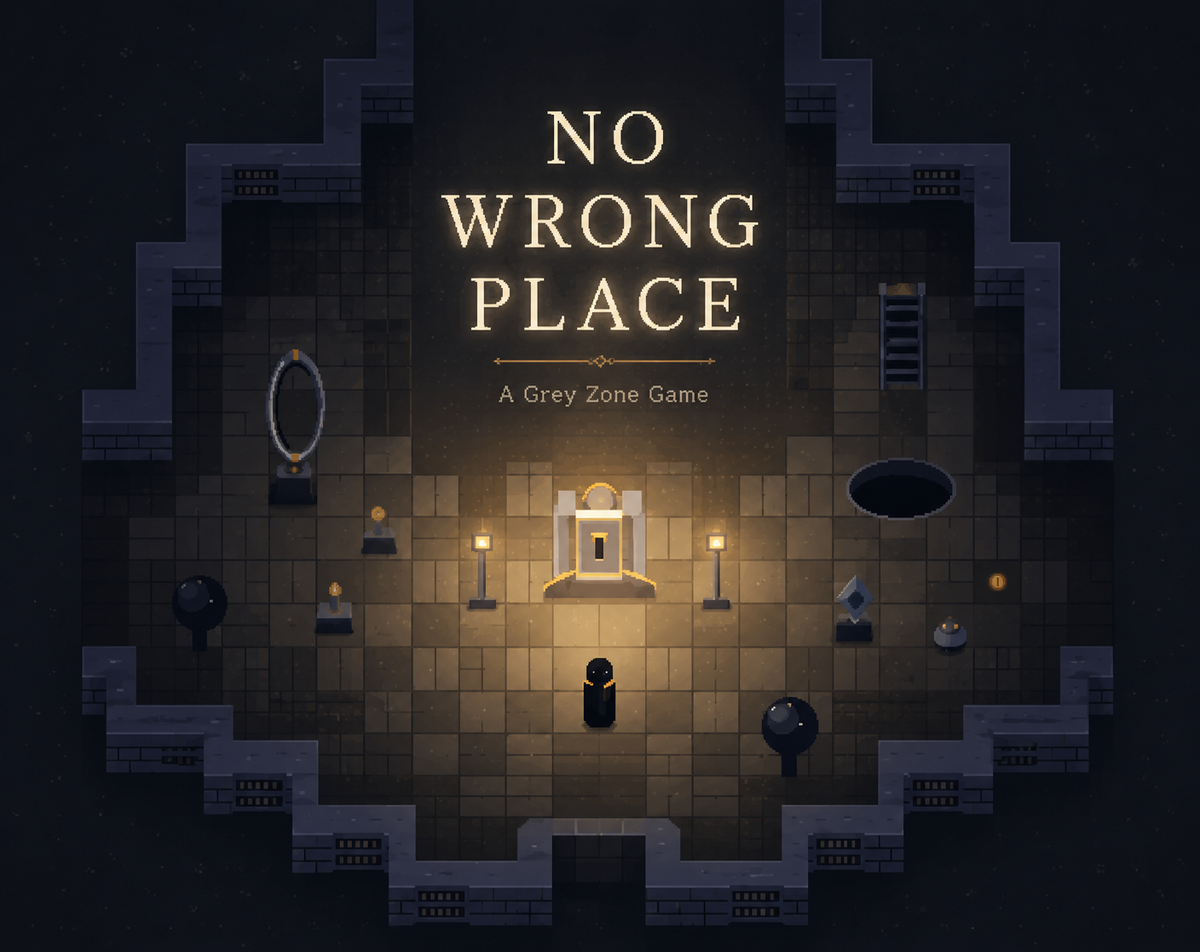
No Wrong Place
A living maze, breathing between black and white. The walls move. Lives begin and end. Nothing stays balanced, and nothing is supposed to.
No sides to join. No score to win. And no safety either: lives here run short. Stone falls, water rises, anger finds its moment, and the thread ends. Then the walk continues, on the same floor, a short way from where you fell, carrying everything you gathered, and what you dropped waits where it landed. You can raise your hand against anyone in the maze. The maze will remember that you did. There is no wrong place. There are wrong moves, and they can almost always be answered.
This is not an ordinary game. It is barely a game at all. It is a place — and the place notices you.
15 free minutes of live AI conversation — yours once, no clock, no daily reset. The complete game also works without AI. Unlimited AI Pass · $3.50 for 30 days.
Moving and meeting things
Mouse: hold to guide your steps, or click a spot to walk there. Click anything to meet it — a person, a door, a stone. A ring marks what you chose, your feet follow it even if it wanders, and the meeting begins when you arrive.
Touch: one finger does everything. Tap to walk, tap to meet, drag the stones that want dragging.
If several things share one spot of ground, the game asks which one you meant. If something truly cannot be reached, it says so. No click is ever swallowed in silence.
Play Tutorial — Take the Lantern
A guided passage: eight to ten minutes of borrowed ground with one way forward, learning to move, meet, talk, give, trade, read your wounds, heed a warning, meet a threat, solve a riddle, read the map, and walk through one ending. Use the Play Tutorial button above, or start, resume, and replay it any time from the pause menu.
It works fully without AI. It holds one short live-AI demonstration, granted by the maze itself, which never counts against your free sample. Nothing done in the passage follows you out — except the knowing.
Black and white
Every wanderer is Inkborn (black) or Ivoryborn (white). Neither is good, evil, happy, or sad — they're two ways of meeting the world, and the maze needs both.
Characters always stay visible against their surroundings with a soft outline or halo, even in the darkest or palest rooms.
Danger, and the body's weather
Trouble speaks before it strikes. Dust sifts before stones fall, floors crack before they give, water darkens before it rises. Listen and you will usually have time. What reaches you leaves a mark you can read: bleeding, a fracture, exhaustion, burns. Small chips near your Thread name each one, what it is costing you, and how to treat it. Rest closes wounds. Shelter slows the wearing. Strangers sometimes help without being asked. And when a life ends, the maze tells you plainly what ended it.
Violence, and its cost
You can strike anyone here. Nothing stops you and nothing forgives you either. They may fight back, or fear you, or simply walk away carrying it. Whoever saw will remember, and their friends will remember harder. Nothing marks you permanently. A gift can still set an anger down. But the room is different afterward, and so are you. Violence is a door, not the point.
The currents
The maze leans between deep black and pale white in layers: the whole world swings slowly, each floor keeps its own weather, each room changes quickest, every being carries a lean of their own, and so do you. The layers sometimes agree and sometimes argue, and things done in a crosscurrent carry differently.
Events shove the weather rather than setting it — a death, a birth, a choice keeps arriving for a while after it happens. Shrines hold a pendulum you can read for an interpretive sense of where things stand.
The Thread, and what returns
Your Thread is this life's condition. Walls that warn, exhausting flights, and flooded extremes wear it down; benches, lamps, still stones, and old friends mend it. But every life also has a season, and no amount of rest turns a season back — the corner bar quietly shows how far mending can still reach.
When the Thread ends, you wake on the floor where it ended, a short walk from where you fell. An echo waits at that spot holding some of your sparks and something you carried. Walk back to it and it gives them over. How you lived colors the waking: a life spent giving wakes carried, with something between you and the first blow. A life spent keeping wakes weighted, and it eases as this life makes its own choices. Neither is a prize.
Remembered places
Up to seven places can remember you. The Places button remembers this room, points the way back to any kept place through doors, stairs, and passages (never a teleport), and lights a road home to the Lantern Court: ground that glows, corridor by corridor, rerouting when you wander and waiting through a death. The Map button beside it shows the maze exactly as far as your feet have learned it, and no further.
Remembered places survive death and rebirth. An eighth memory asks you to release one first — nothing is ever taken from you automatically.
Your mission, and the Trace Board
You carry one Mission at a time, rolled anywhere from super easy to super hard the moment your world begins. Finishing it draws the next one. In the game, both live together under Mission / Trace, inside the Tools button — and the Trace Board is one tap from the pause menu too.
Missions earn Trace — a permanent mark of participation that survives death, rebirth, and closed tabs. Everyone appears under a made-up name the maze assigns; if you prefer, you can choose your own board name in the Trace Board tab. No pass or purchase changes Trace: the board measures walking, never wallets.
Talk, Give, Trade — and small puzzles
Tap a being and you are offered three separate doors: Talk (conversation only), Give (sparks or a carried thing, in small deliberate tiers), and Trade (a clear barter that shows both sides and asks you to seal it). Wells, mirrors, benches, old trees, and doors speak too — and remember your visits, your rebirths, and sometimes choose silence.
Small puzzles are scattered everywhere: stones to drag, bells to ring, gates that ask for a choice. The puzzles have no fail state. The world, now, does. Gifts are remembered. None of it is automatically virtuous: the maze only writes down the pattern.
The Lantern Court
The safe hub at the center of the maze is shared — other real wanderers may be there with you, live, each an anonymous stranger. Nobody speaks unless they choose to: meet one and you may speak a phrase from the maze's shared tongue, wave, nod, sit down nearby, or raise your lantern. Or simply stand together, which is also an answer.
Prefer quiet? Set your company to "Quiet company" or "Wandering alone" and the Court will respect it.
Live AI, written conversation, and the Unlimited AI Pass
Free for every wanderer, once: a 15-minute sample of live AI conversation — you write freely, beings answer in their own living voices. It never resets: not daily, not at rebirth, not with a new world. Only real exchanges count; reading, walking, and menus never spend a second. The tutorial's short demonstration is free on top of it.
Always free, no clock: the complete maze. Written conversations with every being, missions and Trace, giving and trading, inventory and shops, rebirth, the tutorial, exploration, the shared Lantern Court — every normal gameplay mechanic works without AI and without paying.
Unlimited AI Pass ($3.50 for 30 days): unlimited live AI — free-writing conversations, dynamically generated replies, longer continuing conversations, AI continuity within them. It changes conversation only: no stronger thread, no faster flight, no mission, movement, economy, or Trace Board advantage of any kind.
Paid Substack subscribers: the code from the private subscriber message opens the complete 35-day bundle: every Tarot spread, all seven frequencies, and the Unlimited AI Pass in this game.
Saving, sound, and settings
Your world saves itself in this browser as you play — no account, nothing to lose. The pause menu (top left) holds sound, music, text size, and reduced-motion options. Your remembered places and mission live on buttons inside the game itself.
The Grey Zone runs on love.