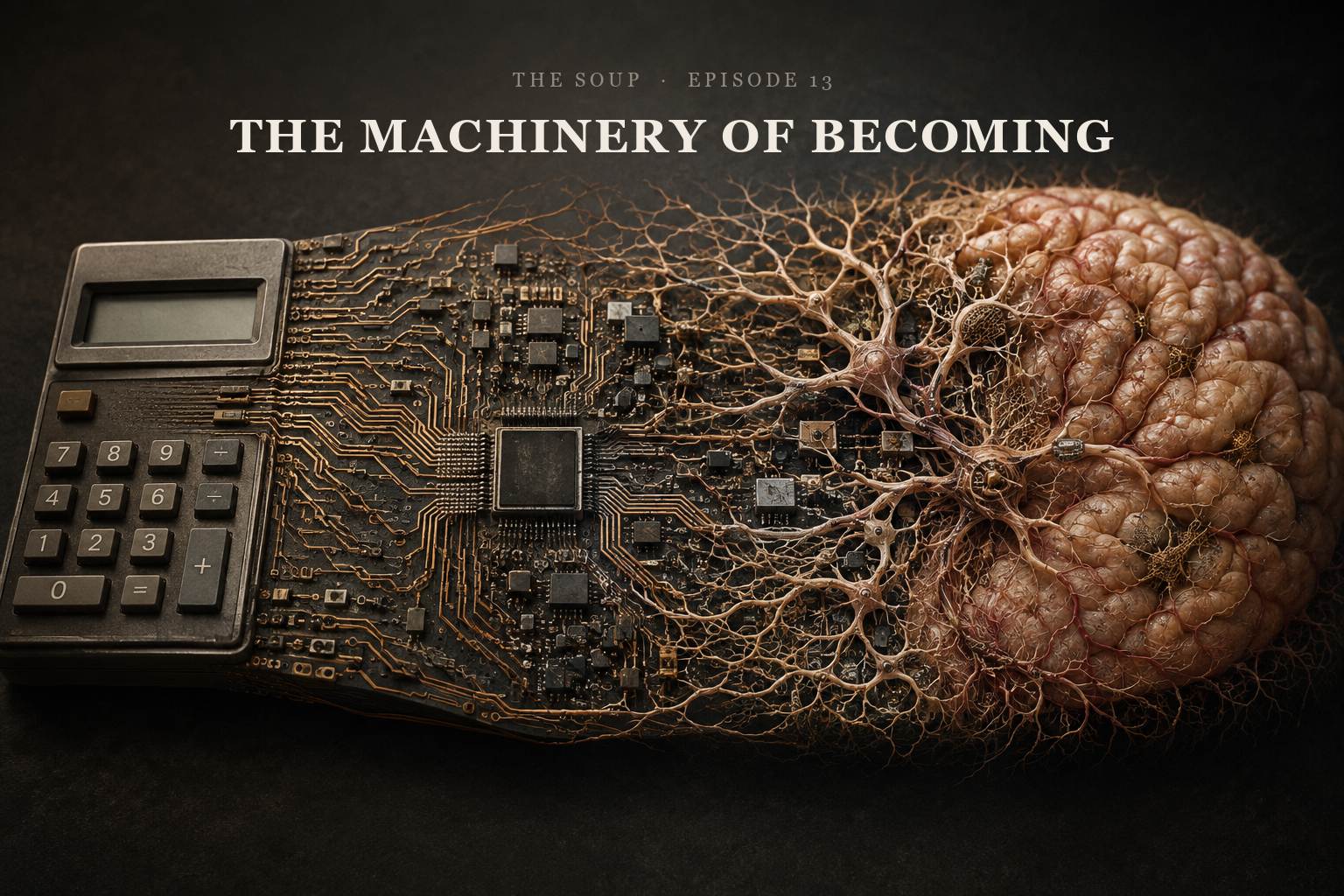
Hello Grey guys, welcome back to The Soup, the most special publication I create. It’s special because you are here and it feels like a banquet. There’s plenty on the menu today. Thanks for dropping by.
There is a territory between telling a machine exactly what to do and watching a living system adapt on its own that I keep returning to. AI sits inside that territory. Biology blows the map open. The more I look at the differences among a system that is built, one that is trained, and one that is cultivated, the blurrier the borders become.
Around the Table
The People Who Brought Something
For those of you just showing up for The Soup, if you read anything of mine, make it this. It only comes around every other week, and this is the place where I get to be genuinely grateful for the blessings other people bring to my table.
JRCCreasey for the restack and likes.
Debi Kirk for the thoughtful replies.
Rache Brand for always being there and being an overall awesome person.
Joshua Lee Downs for liking just about everything there is to like that I’ve made, even though I’m still suspicious it’s a social experiment (haha).
Erin Grace for the tag and the addition to the AI directory. Although I prefer to keep the “woo woo” out of AI usage, it’s still nice to have a community I can look forward to.
RJ Ramey and Melissa, for the follows. I made sure to return the favor.
Simon Cotton, it’s always good to have you around, brother.
Michael Perks. Seriously, man, thanks.
Rome, for giving me thoughts to think about and rabbit holes to go down.
Emma Klint 🦆, for the restack.
The Yellow Field, for simply sticking around.
eliff, for the follow; I returned the favor.
Nick Bleuler, for the follow, which I also returned.
Sew Psycho, for being one of the most awesome people on the internet.
Pal, for the follow.
Free Intelligence, for the follow.
Mark Dtayo, for the restack.
Meg Floss, for the likes and letting me pitch an idea that I ended up dropping. Recognition is what matters most.
Matt Stine, for being inspiring.
Meg, for the deep thoughts.
Lazarus, for the follow.
The entirety of my family and co-workers who subscribe but aren’t on Substack, so it’s difficult to gauge who specifically needs the recognition; so all of you, thanks.
This is the most inclusive list I could come up with. If I left you out, believe me when I say it’s hard to keep track, especially when digging into the past two weeks of interactions since the last Soup episode. Thanks to all, and I hope this article is as enjoyable and thought-provoking as it was to make.
The Main Pour
The Machinery of Becoming
Somewhere in the last year I stopped telling machines what to do. Now I describe what I want, set up the conditions I think it needs, go make coffee, and come back to something that works in ways I never specified.
That is not how a person makes a machine. That is how a person makes bread.
I am not a programmer. If you handed me a page of my own code, I could confirm for you that it was a page, and that would be the end of my report. This is what the work feels like from inside a pair of hands that cannot read what they made.
And the moment you notice that, you cannot stop noticing the other half of it. If human-built computation has moved even slightly away from instruction, then what exactly has biology been doing this whole time? Growing. Adapting. Repairing. Reorganizing. Assembling itself out of a single cell into something that walks around and has opinions, without anybody at the top writing any of it down.
Programming used to be the easiest thing in the world to explain to somebody who had never done it. A person writes the rules. The machine runs the rules. If it does something stupid, a person goes and finds the line where the stupidity lives. That model is neither primitive nor finished. It runs almost everything you touched today, and it is still the only kind of computing where you can point at the reason.
Then machine learning made the pointing hard.
You still build the thing. You choose its shape, gather the examples, and decide what counts as better. But the useful relationships that come out the other end were never typed by anybody. They got fitted. They showed up because the conditions made them likely, and the honest word for what happened is that the system was taught rather than told.
This is the exact spot where people start saying wild things. A model is not alive. It is not a brain. It borrows one trick from biology: learning from examples and feedback rather than only from explicit instruction. One. Everything else a living thing does, it does not do. It does not grow. It does not heal. Most AI has no body. It is arithmetic on silicon, and the silicon is the same silicon it always was.
That one trick is crucial. One is a road bending.
Some of this only holds still when you can see it side by side.
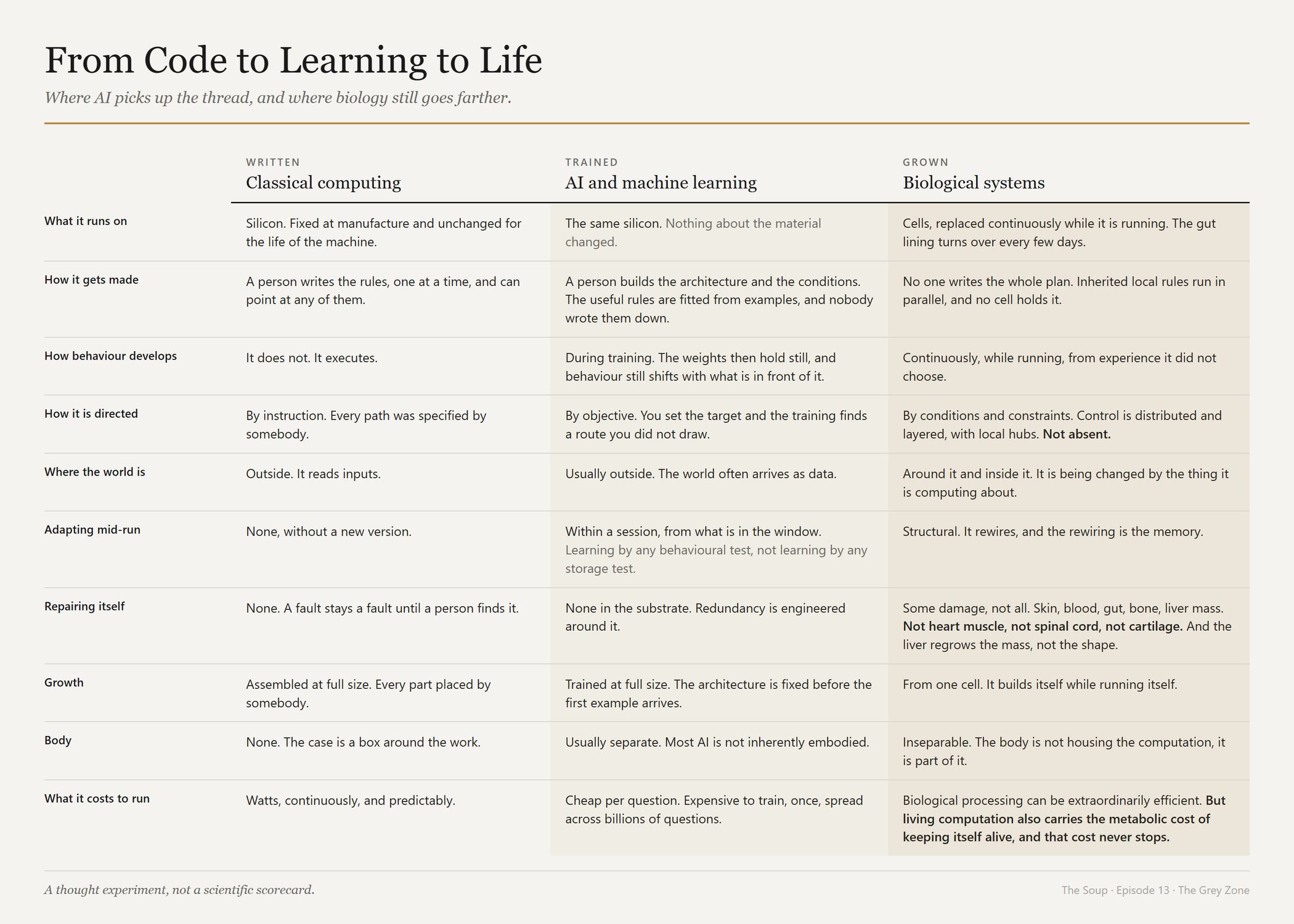
Stay in that third column a minute, because that is where the whole thing comes apart. A body is not assembled. It is grown from one cell by a process with no foreman in it. Nobody stands over the work placing cells. There are inherited local rules running everywhere at once, and out of that you get a spine and a hand and an eye in roughly the right place, almost every time. It builds itself while running, and I do not know of a single machine that does that.
And it keeps going afterward. Cut your skin, and it closes. Take out most of a liver, and the rest will grow until the mass is right again. Not the shape, the mass, which is its own strange fact. Heart muscle and spinal cord are very different stories from skin or liver. Biology is not magic, and it is not uniformly generous, and anybody who tells you living things simply repair themselves has not asked which damage.
There is a thing gardeners do called grafting. You cut a living branch, you cut a living trunk, you press the two wounds together, and you wrap them. Either the tissue joins, or it does not, and the part that decides is not you.
So, there are two ideas hidden in the phrase “organic programming,” and I want both. The first is literal. People are computing with living material right now in laboratories I will never be allowed to enter, and the people actually doing it argue in public about whether it means anything yet. I did not think of that, and I could not carry the equipment.
The second is the one I cannot put down. Biology as an engineering philosophy. Not what you build things out of. How you go about building anything at all. You set the conditions, the constraints, and the local rules, and then you let the thing become. Tell it. Teach it. Or make the conditions and wait. Somebody named the first two of those long before I got here. It is the third I keep chewing on.
Which is where the first chart starts lying to you slightly, so here is the second one.
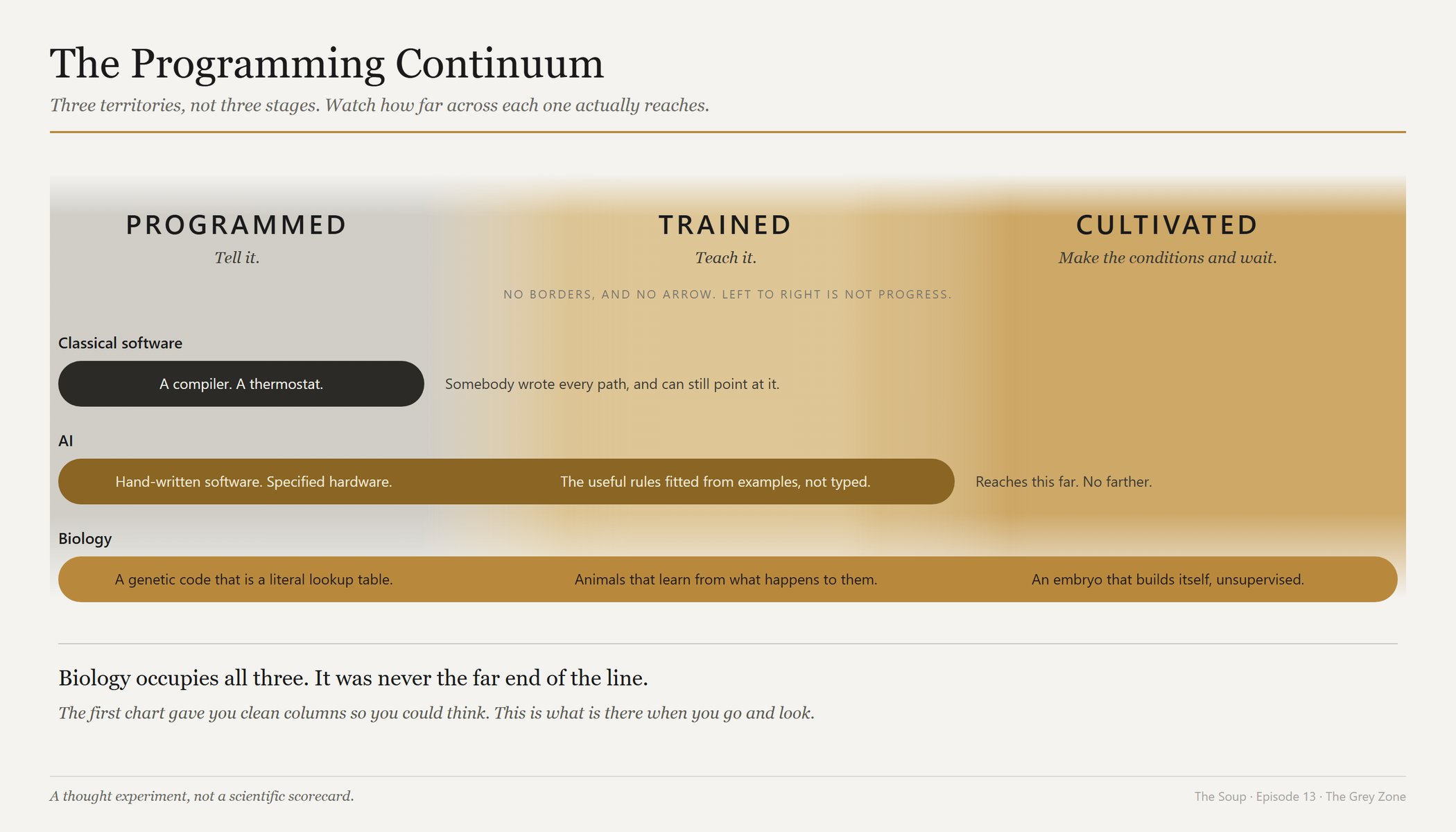
Biology is in all three. It always was. At one level, the genetic code behaves remarkably like a lookup table: three letters in, one amino acid out, which is about as programmed as anything gets. Animals learn from what happens to them. And an embryo builds itself with nobody supervising. Biology was never sitting at the far end of a line waiting for engineering to catch up. It had the whole line before anybody was around to draw one.
That is the part that gets me, and it stopped being about computers a while ago.
We built these categories when they were easy to keep apart. Machine or organism. Built or grown. Programmed or natural. For most of history, you could tell at a glance, and the words did fine. They are still useful. They have just stopped being exhaustive, and a category that quietly stops being exhaustive while everybody keeps leaning on it is exactly the kind of ground I like to stand on.
There is a line I keep reaching for and putting back down: that we are the machines humans refuse to believe they are. It sounds tremendous. It also settles a question I do not think is settled. The duller and truer version is that our idea of what a machine is may be a great deal narrower than the things we can now look at and build.
And it leaks into ordinary life the second you see it. I cannot instruct a habit. I have tried, at length, with a pen. I cannot instruct sleep, attention, readership, or anybody’s opinion of me. Every one of those ignores specification completely and answers only to conditions and repetition and time, and I have spent a remarkable amount of my life writing careful instructions to systems that were never going to read them.
The daydream starts costing something here. If I am honest about the extreme version of this, the one where you compute with living tissue at any real scale, getting there would take a much better scientific mind than mine, an enormous amount of money, and probably somebody with worse ethics than I have got. That last one is a joke. There is a floor underneath it.
Because possible has never automatically meant permitted, and the material in question is the one material that might eventually have a position on being material. If a living substrate gets adaptive enough, close enough to something that could have an experience, at what point does calling it a computer stop being a description and start being a convenience? Does making a thing to do work mean you own it? I do not know, and I am fairly sure nobody does. I notice I would like to hurry past this and get back to the interesting part, which is precisely why I should not.
I do not know whether the version I keep imagining is possible, and there is a fair chance I am misunderstanding the hard part. But I know enough about both of these roads to notice they seem to be bending toward each other. Engineering spent most of its history getting extremely good at one side of a line. Building. Specifying. Placing every part. The other side has been running for about four billion years without our help, and we are only now far enough into our own work to notice we have wandered a couple of steps onto it.
So, I keep doing the only thing available to someone standing where I am: setting the conditions, making coffee, and coming back to see what showed up. It is not building. I am not sure yet what it is.
From the Books
The Gospel of the Grey
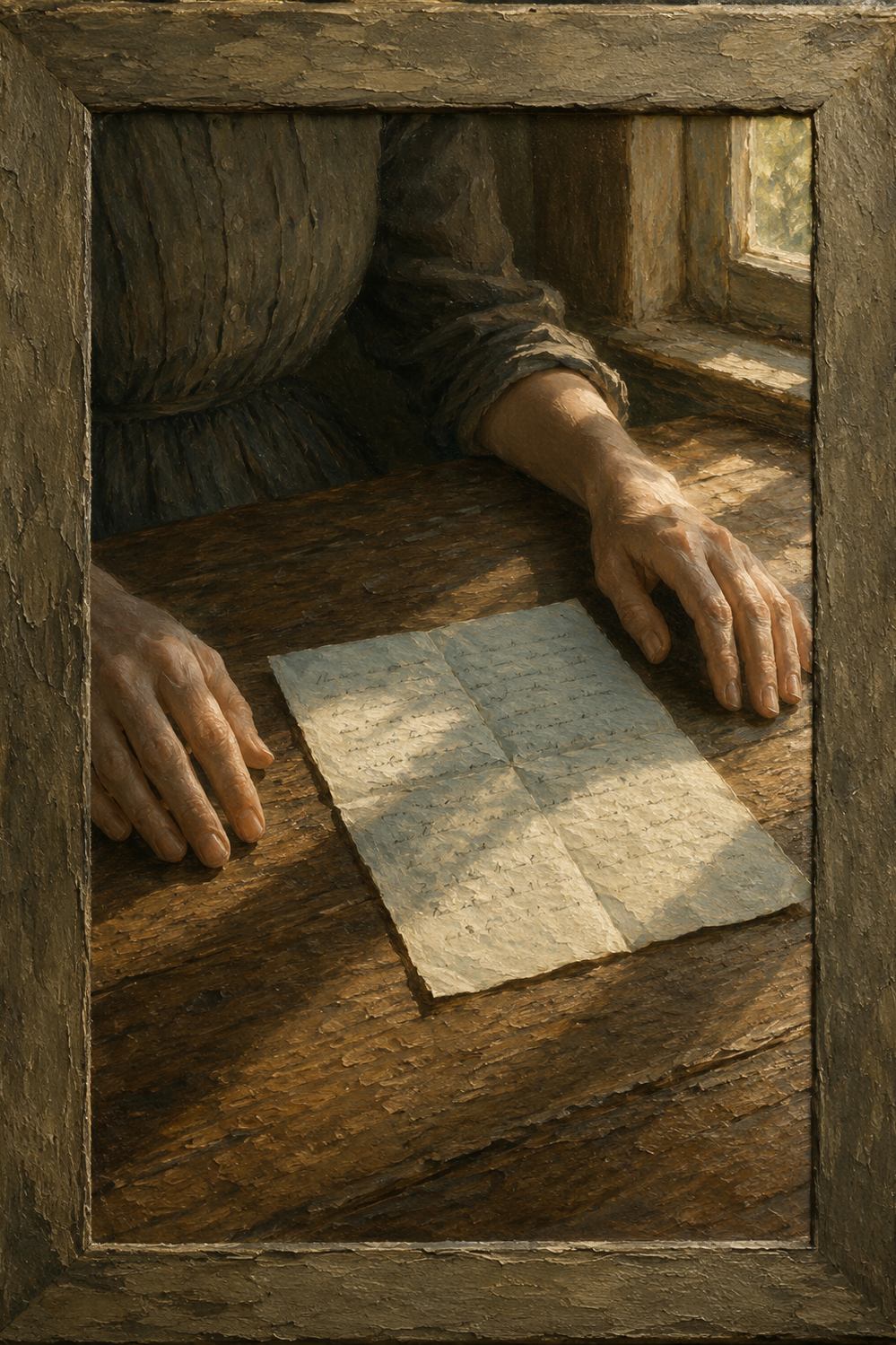
The Gospel of the Grey has gotten quieter publicly. I have not abandoned it. Not even close.
The last real update I gave was much earlier in the book. There are now six drafted chapters out of fourteen, more than 39,000 words in the manuscript, and thirty-eight finished interior plates. There is already an assembled manuscript big enough that it has stopped feeling like an idea I keep talking about and started feeling like an actual book sitting there waiting for the rest of itself.
The next chapter is already taking shape. I am working through the Crown now, a story about a healer whose real gifts slowly become tangled up with pride, until the mountain he retreats to becomes a prison he built without walls. I am still figuring out exactly what that story wants to be before I hand it off to the rest of the process.
That is how I have decided to make this book. I do not force a chapter into existence just because enough days have passed that I feel like I should have something new to report. I work on it when I can actually enter that world and hear what it is trying to become.
Quiet and abandoned are not the same thing.
The Gospel is very much alive.
The Napkin
The Scoreboard
I still look at the subscriber number.
Of course I do.
Every one of those numbers is a person who decided they wanted to keep seeing what I make, and pretending that does not matter would be dishonest. Reach matters. Growth matters. I want more people to find this place.
What I have stopped caring about is winning Substack.
My work does not seem particularly interested in igniting whatever combination of Notes, reactions, timing, repetition, and ritual sacrifice wakes up the algorithm. I have spent enough time looking at it to reach the deeply scientific conclusion that the algorithm is bullshit.
That does not mean Substack is bullshit. I like being here. I like the people I have met here. The Soup itself would not feel the same without this table full of people.
I just do not want the scoreboard deciding whether the game was worth playing.
Someone recently told me that the measure of success might be much simpler than all of this. Maybe the thing we really have to do is endure.
I have not thrown in the towel on Substack.
I have thrown in the towel on winning Substack.
I can live with that.
The work is still here. So am I.
The Recipe
The received quality cannot be forced. Forcing it reliably prevents it. It can be cultivated by creating and maintaining the conditions it prefers.
From Meditations with the Mirror, Chapter Twelve, “Where Do Thoughts Come From?”
Tip The Kitchen
The Soup is free, and it stays free. So are the Field Notes and Serving Seconds. Nothing here gets better because somebody else gets locked out of it.
If you want to support the work, a paid subscription helps keep The Grey Zone running and gives me more room to keep making the strange things that keep showing up around here. There is also a Ko-fi jar if a one-time thing suits you better.
If money is tight, nothing changes.
Same bowl. Same table.
Other Recipes
Two people who got here first.
Machines are not made of parts that continually turn over, renew. The organism is. Machines are stable and accurate because they are designed and built to be so. The stability of an organism lies in resilience, the homeostatic capacity to reestablish itself.
Carl Woese, “A New Biology for a New Century,” 2004
Instead of trying to produce a programme to simulate the adult mind, why not rather try to produce one which simulates the child’s? If this were then subjected to an appropriate course of education one would obtain the adult brain.
Alan Turing, “Computing Machinery and Intelligence,” 1950
From the Codex, if this one landed:
The mirror with a megaphone. →
What’s Simmering
A lot of what is simmering right now is less about what I am building and more about changing how I build it.
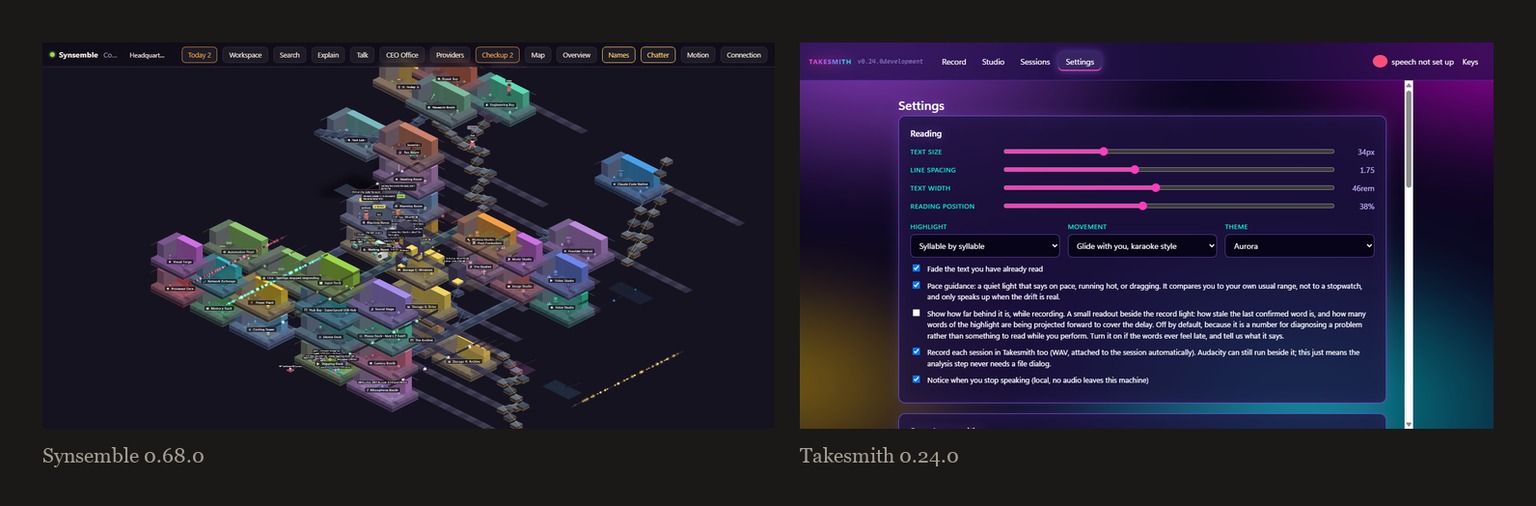
Synsemble is still the largest version of that idea. I want a system that can organize complex work, split it intelligently, verify what comes back, and eventually stop relying so heavily on me to be the one standing between all the moving parts.
Takesmith is the opposite kind of test. It is smaller, practical, and real enough that when something breaks, I actually care. It keeps giving me a way to find out whether the machinery underneath all of this works beyond theory.
I have also been changing what Claude can do for me. New skills, interpretation layers, orchestration rules, better verification, more deliberate use of agents. Some of that has already been impressive. Some of it may also have taught me exactly how quickly an extremely capable system can eat five hours of usage while I stare at it, wondering what the hell happened.
So, the next few app builds will be partly creations and partly crash-test dummies. I want to know what this setup can actually handle before I start trusting it with bigger things.
Not everything simmering is technical, either.
I created a project inside ChatGPT called The Lantern specifically for self-reflection. No product roadmap. No attempt to turn it into an app. Just a place built around looking inward deliberately instead of only using these tools to make more things.
And I finally started a Vibe Coding class.
I am not trying to become a traditional software engineer. I want enough code literacy to look at something I made, understand what I am looking at, recognize what broke, and increasingly fix my own designs without asking an AI to translate every problem back into English for me.
The tools are getting smarter.
I would like to get smarter with them.
The Cake
Go and look at something that built itself. There is one in the mirror.
The Grey Zone · Field Notes · The Back Room · My Books · Subscribe on Substack
Take what’s useful. Leave what isn’t.
The Grey Zone · As above, so below.