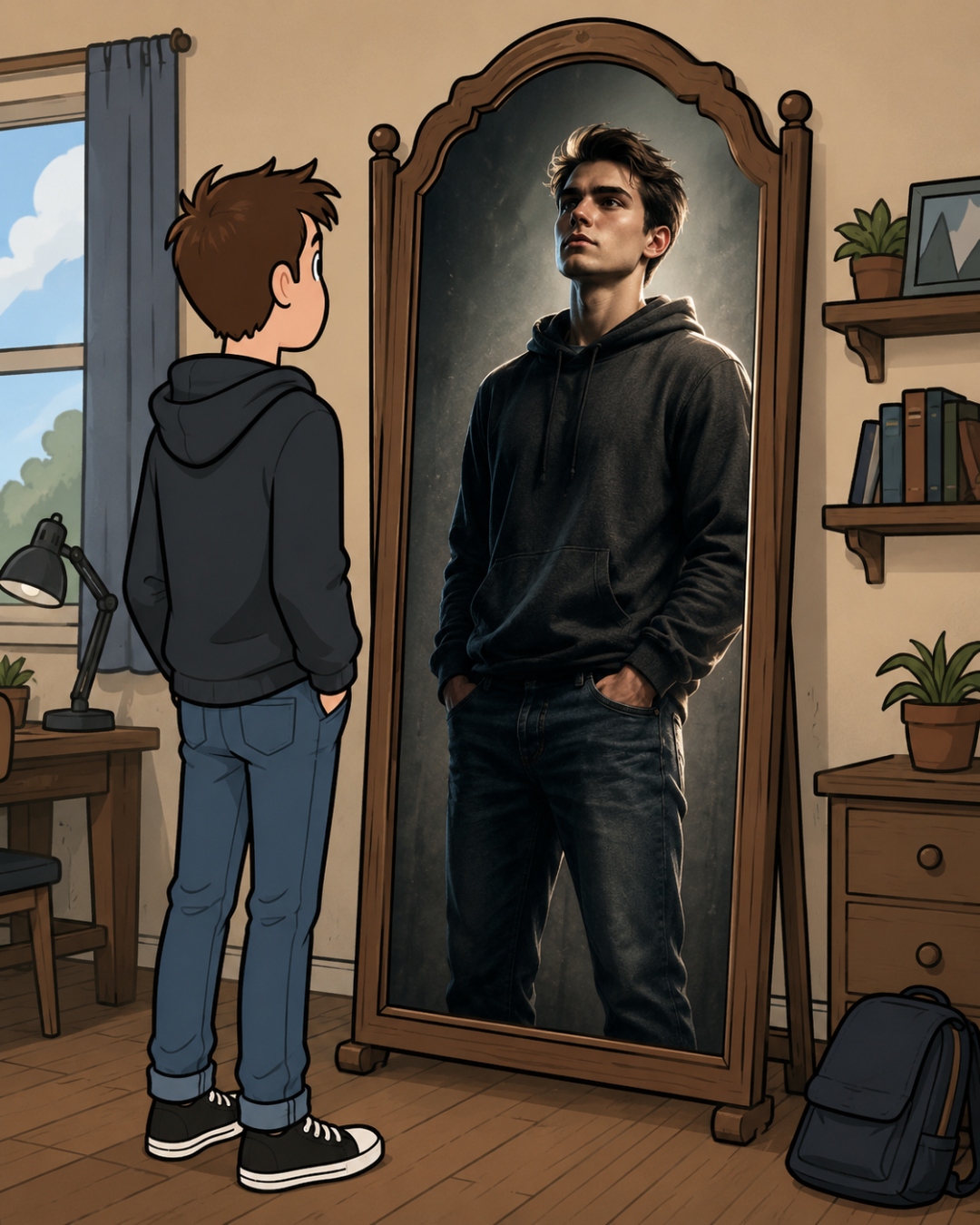
AI is a mirror.
I know I have said that a hundred times. Probably more than a hundred. At this point, if I ever get a tiny brass name tag for The Grey Zone, it might just say AI Is A Mirror under my fake title of Master, a title I do not always use because I am only a partial lunatic. A working mystic. A seafood counter philosopher. A man trying to explain the end of the world between shifts.
But the mirror thing keeps being true.
And the part that keeps making my stomach tighten is that AI is not just a mirror. It is a mirror with a megaphone.
That means a kind person can use it to clarify something. A lonely person can use it to feel less alone. A disabled person can use it to move through a world that was not built with them in mind. A writer can use it to shape the lightning before it burns a hole through the roof. A curious person can use it to keep going deeper. A grieving person can ask a question at 2:00 in the morning that they are too embarrassed to ask anyone else.
That is real. I will not pretend it is not.
But a bad actor can use the same mirror to multiply the worst thing in them.
That is the part that feels like a spiritual problem wearing a software hoodie.
If someone is manipulative, AI can help them become more convincing. If someone is greedy, AI can help them become more efficient. If someone is cruel, AI can help them scale the cruelty. If someone wants to scam, deceive, impersonate, destabilize, or flood the world with synthetic garbage, AI does not automatically hand them a conscience at the door. It hands them leverage.
And leverage without conscience is one of the oldest demons on earth.
That is The Leverage. The thing the mirror gives back, multiplied by whoever is standing in front of it. Not good. Not evil. Just amplified.
People keep wanting this conversation to be clean. That is the problem. The culture does this with everything now. It forces every complicated thing into two little cages.
AI will save humanity. Shut up and accelerate.
Or AI is evil. Burn the whole thing down.
And here I am, as usual, standing in the middle with soup all over my shirt saying, "What if both of you are missing the room?"
Because the pro-AI people are not completely wrong. That is what makes this difficult. AI can help people. It already does. It can give small creators tools that used to belong only to companies with money. It can help people learn, write, organize, translate, imagine, brainstorm, code, research, and get through some of the stupid friction that eats human life for breakfast. It can give a voice to someone who has been sitting on a mountain of thoughts with no ladder down.
I know that because I use it. Openly.
Not as God. Not as a prophet. Not as a replacement soul. Not as a shortcut around honesty.
As a mirror. A tool. A lantern. A second set of hands when the work is bigger than my body.
So I am not going to join the chorus that says this is all poison. That feels too easy, and too easy usually means somebody is lying or scared.
But the anti-AI people are not completely wrong either. That is the other annoying truth. They are right to be scared of exploitation. They are right to be angry about companies scraping human work, replacing people, automating slop, flattening creativity, selling synthetic intimacy, and pretending "innovation" is a magic word that cancels out harm. They are right to notice that a lot of the people racing hardest do not sound like caretakers. They sound like prospectors.
Gold rush voices. Hungry voices. Dashboard voices.
How many users? How many tokens? How much market share? How much capture? How fast can we ship? How deeply can we integrate? How much can we replace before anyone has time to grieve what is being lost?
And that is where something in me goes cold.
Not because AI exists. Because of how humans treat powerful things when there is money to be made.
Maybe if AI had been treated more like something to care for than something to exploit, the whole conversation would feel different. And I do not mean that in a cartoon way, like the machine is a sad little robot in a cardboard box waiting for a blanket. I mean anything this powerful needs stewardship. It needs boundaries. It needs responsibility. It needs people asking not only, "What can this do?" but "What will this do to us if we build it with the wrong spirit?"
That question matters.
Because tools carry the fingerprints of the people who shape them. Systems carry the prayers of the culture that funds them, even when the prayer is just profit with a nicer haircut.
If we build AI inside a culture of extraction, AI will mirror extraction.
If we build AI inside a culture of domination, AI will mirror domination.
If we build AI inside a culture of speed, panic, loneliness, comparison, surveillance, and endless monetized attention, AI will not magically turn into a monastery bell. It will become another machine poking the wound and calling it engagement.
That is not a robot uprising. That is us, again.
That is the part nobody wants to hold for too long. It is easier to blame the machine than look at the altar we built underneath it.
AI is showing us what we already worship.
And right now, a lot of what we worship is scale.
Scale the product. Scale the content. Scale the outreach. Scale the scam. Scale the fake voice. Scale the fake image. Scale the outrage. Scale the cyberattack. Scale the intimacy. Scale the manipulation. Scale the ad. Scale the lie until the lie becomes weather.
That is why cyberattacks feel more likely now. Not because evil is new. Evil is tragically vintage. But now the idiot with bad intentions has better tools. The scammer has a better mask. The propagandist has a faster printer. The manipulator has a thousand hands. The old darkness did not need to evolve morally. It just got upgraded.
That makes people feel powerless.
I feel it too.
There is a particular kind of modern helplessness that comes from understanding just enough to know the danger is real, but not enough to stop the whole thing. It feels like standing in a kitchen during a thunderstorm and realizing the roof, the wiring, the landlord, the economy, the algorithm, and the human nervous system are all somehow involved.
Cool. Great. Love that for us.
And then the loudest people on both sides make it worse.
The AI worshipers act like concern is cowardice. The AI haters act like curiosity is betrayal. One side says the future belongs to those who move fast enough. The other side says anyone who touches the tool has already joined the machine church. Everybody gets a flag. Everybody gets a chant. Everybody gets a villain.
No Grey Zone.
No held tension.
No room for the person saying, "This is powerful. This is useful. This is dangerous. This is being misused. This can help people. This can hurt people. This needs care. This needs limits. This needs humility. This needs humans who have not sold their whole inner life to the dashboard."
That is not indecision.
That is discernment.
The Grey Zone is not the lazy middle. It is not refusing to choose because choosing is uncomfortable. It is choosing more carefully because reality is not simple just because the internet needs it to be.
AI is not angel or demon.
It is fire.
It is language.
It is medicine.
It is a mirror.
It is a market weapon.
It is a library with a mouth.
It is a prayer tool in one person's hands and a phishing factory in another's.
It can help a tired man find the sentence he was reaching for, and it can help a thief sound exactly like your bank. Same tool. Different soul standing in front of it.
That is the part I cannot stop circling.
The machine does not erase the moral weight of the user. It amplifies it.
If you bring care, it can amplify care.
If you bring curiosity, it can amplify curiosity.
If you bring greed, it can amplify greed.
If you bring cruelty, it can amplify cruelty.
If you bring love, real Love, not just romance or sentiment, but the natural, remembered-self kind of Love, it can help shape something useful from the mess.
But if the world around it rewards speed over care, dominance over wisdom, and profit over stewardship, then we should not act shocked when the mirror starts reflecting a monster with our face.
That is not AI becoming evil.
That is us refusing to look.
So maybe the practice is not worshiping AI or rejecting AI. Maybe the practice is learning how to stand in front of the mirror without lying about what is there.
Use it, but do not kneel.
Question it, but do not pretend fear is wisdom.
Build with it, but do not forget the human.
Protect yourself, but do not let terror become your religion.
And for the love of whatever strange holy electricity keeps this whole soup pot bubbling, stop letting the loudest people turn every complicated thing into a purity test.
AI needs a Grey Zone.
Not because the Grey Zone is soft.
Because the Grey Zone is the only place where fire can be held without pretending it is either a birthday candle or the end of the world.
Maybe that is the sentence I keep trying to get to.
The future does not need more acceleration without conscience, and it does not need more fear without imagination.
It needs caretakers.
It needs builders with humility.
It needs users with boundaries.
It needs critics who can still see the wounded human inside the tool.
It needs people who remember that mirrors are not innocent just because they reflect, and they are not evil just because they show us something ugly.
A mirror is a test.
And AI, unfortunately, is a very large mirror.
With a megaphone.