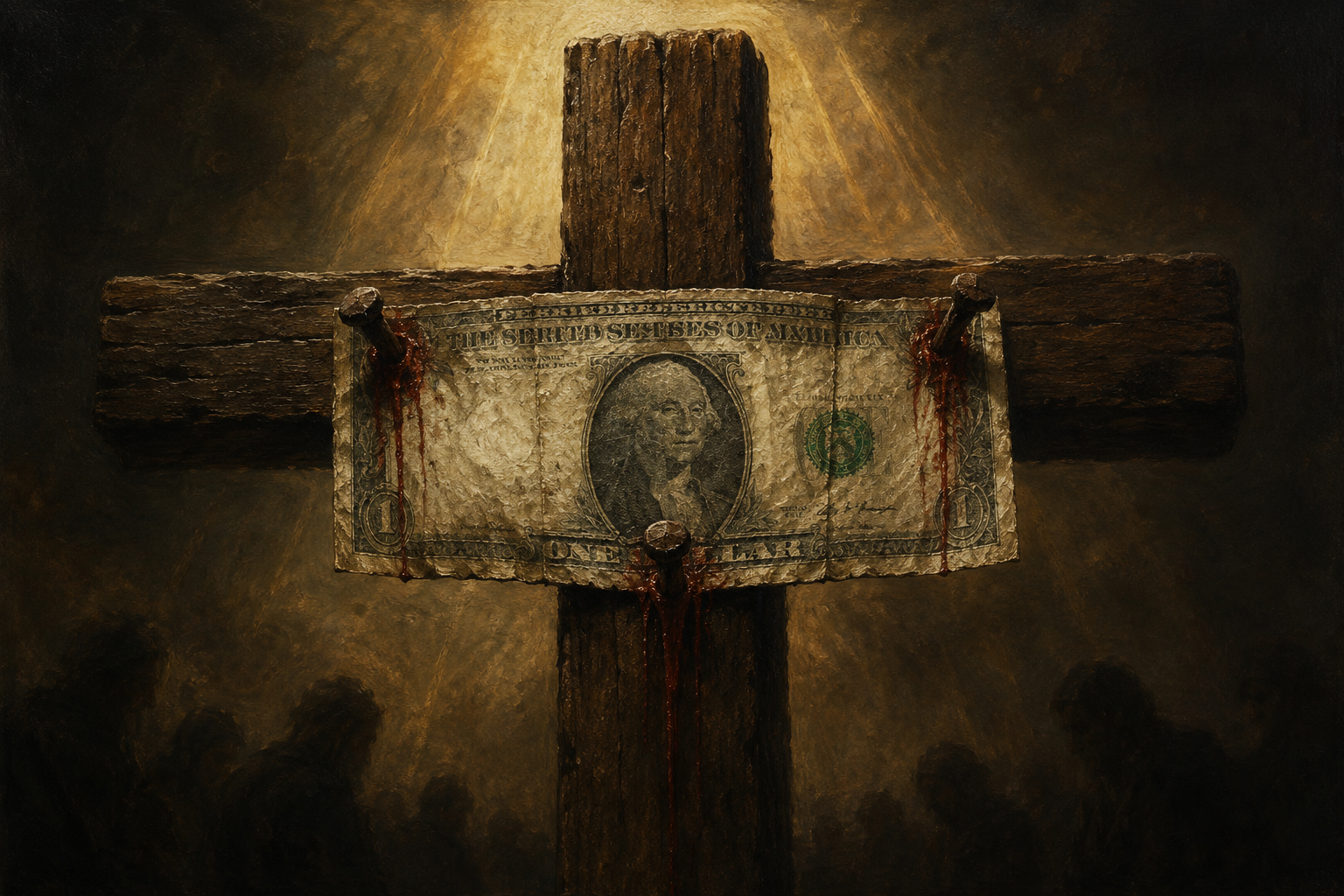
I was trying to set up a paywall for spiritual tools and something went wrong overnight.
Not catastrophically. Quietly, which is its own kind of bad. A process ran for hours, burned through credits, and produced almost nothing I could use. I woke up to the report in the morning and just sat with it. The specific frustration of having paid for work that didn't happen. And underneath that, an older bruise: the strangeness of what I was even attempting. Put a price on something I think of as sacred. Figure out what a spiritual tool costs in dollars.
I don't know how to say that without it sounding strange, because it is.
The moment a price tag touches something sacred, it not only raises a practical question. It raises a spiritual wound. It asks whether the work is real, whether the exchange is honest, whether the person making it is allowed to need anything in return, and whether the person receiving it is being invited into something true or sold another costume for emptiness. Every old bruise around worth wakes up at once. Loudly.
The symbol and the wound.
Maybe you know what I mean. Maybe you have felt it in a different room. A salary conversation where someone told you what your labor was worth and the number felt humiliating. A moment when you couldn't afford something other people around you seemed to access without thinking. A period when you were producing nothing by the world's measures, and the silence around your income started to feel like a verdict on your personhood. A time when someone else paid for your dinner or your medication and you felt something complicated move through you that was not exactly gratitude and not exactly shame, but some third thing that wore both of their faces.
Money does that. It wakes things up. It triggers old stories about whether we deserve survival, whether we are productive enough to justify our needs, whether our worth is something an economy gets to measure.
Here is what I think is true: money is a symbol.
I do not mean that dismissively. A symbol is both powerful and necessary. Language is a symbol system. So is a wedding ring. So is a nation's flag. Symbols coordinate meaning between people who agree to treat them as real, and that agreement makes them real in practice. Money is a symbol of exchange. It represents labor, time, access, survival, leverage, debt, and a long history of other people deciding what your hour was worth. It is the shared spell that an entire civilization casts every day when someone hands a piece of it to someone else for goods, services, silence, or access.
It is real. It matters. It has weight. It can keep you warm or leave you in the cold.
It is also not worth.
Get the next Field Note by email. The Soup every other Thursday. Field Notes every Wednesday. Free. Unsubscribe whenever.
What money cannot measure.
People say "money does not buy happiness" because it lets them avoid saying what is actually happening. Money buys breathing room. Money buys heat, food, gas, medicine, sleep, privacy, safety, and the ability to make one problem at a time instead of carrying twenty of them stacked on your chest. It does not buy the soul, but it absolutely changes the conditions the soul has to live under. Survival needs are no less spiritual than prayer. A body that cannot rest will have a harder time hearing God. What I am saying is: there is a thing called worth, and worth is not a price.
Worth is the thing a baby has before it earns its first dollar. Worth is what an exhausted worker still carries at the end of a shift, where he was treated like a unit of output. Worth is what persists in the person who is between jobs, or sick, or grieving, or temporarily unable to produce anything the market wants to buy. Worth is what love recognizes before it knows someone's salary. Worth is what remains after the résumé is irrelevant.
Worth is not assigned. It is recognized.
The market assigns value. The market is quite good at that. It measures demand, scarcity, labor, and substitutability. It is a useful system for distributing things, often imperfect, sometimes violent, but useful. What it cannot do is measure a soul. A market can tell you what someone will pay for a candle. It cannot tell you what the prayer is worth. A market can tell you what an hour of a therapist's time costs in dollars. It cannot tell you what the person sitting across from her is worth, or what she is worth either.
I have worked jobs where the worth question felt beside the point. You punch in, you do the thing, you punch out, you pick up a check every two weeks that doesn't know your name. It pays for gas, groceries, and a copay, and maybe not much else. You go home tired in the specific way that work clothes get tired, where the exhaustion is in the fabric, not just the body. And the job does not care who you are. The economy does not care who you are. The question of what you are worth as a person, as someone with an interior life and a history and a hunger that has nothing to do with production targets, never comes up. You get a wage. The wage is not a verdict. But the body learns to treat it like one.
Making something of yourself.
The confusion between market value and worth is one of the strangest traps in modern life, and most people do not notice it running because they absorbed it so young. The lesson is rarely taught directly. It comes through praise and silence. The kid who wins competitions, gets good grades, performs well, and produces visible achievement receives attention. The quiet, kind, ordinary kid absorbs a different message without anyone meaning to send it. Adults talk about success and failure, about who is going somewhere and who is falling behind, about what it means to make a life that counts.
"Making something of yourself," I hate that phrase more the longer I sit with it. As if you arrived unfinished. As if the person you were before productivity was only a rough draft. As if worth was a ladder you had to climb instead of a fire you were born carrying.
We carry that into adulthood, and it becomes the water. We talk about what we do before we say who we are. We apologize for what we earn or don't earn. We look at a number on a screen and let it say something about us that numbers do not have the authority to say.
I am a little angry about this. That seems about right. But the anger is not the point. The confusion is real, and most of us grew up inside it.
The cost is still real.
I grew up in a house that knew what bills were. I know what it feels like to need money in the physical way, where the body tightens, and the mind narrows, and the checkout line stops being a neutral place. I know what it feels like to look at a price tag on something necessary and do the math quietly. Rent is not a concept. Groceries are not a concept. Website hosting is not a concept. The hours I spend writing, building, and thinking are not free hours. They come from somewhere.
This matters because the idea that worth is spiritual can become a comfortable lie if you don't hold it up against what the body actually needs. Bodies are physical. Bodies have physical needs. Meeting those needs costs money in the world we actually live in. A person can have infinite spiritual worth and still need to eat. Those two things do not cancel each other out. They are both true at the same time, pulling in different directions. That discomfort is not a problem to fix. It is the thing to be honest about.
Honest exchange.
Free is not automatically pure. That is one of the things the overnight build failure taught me, in the notorious dumb way that failed builds teach. If everything I make is free, someone is absorbing the costs silently. Server costs. Software costs. Time. The kind of exhaustion that comes from trying to build something carefully. "Free" is sometimes a way of saying the creator is carrying the whole bill alone. Which is a sacrifice, sometimes. But it is not the same as working for nothing. The cost is just invisible. It falls on one person instead of being shared.
Paid is not automatically corrupt either. Sometimes paid means the work gets to keep breathing. Sometimes, a fair exchange between someone who made something real and someone who wants it is exactly what honesty looks like. An acknowledgment of the cost of the work and what the maker needs to continue. Not every price tag is a betrayal. Some are just receipts.
The real question is not whether there is a price. The real question is whether the exchange is honest.
Is the promise true? Is the work real? Is the price named without apology or shame, as a simple statement of what is needed to keep this going? Does the person who cannot pay still have a way in? Is the person who can pay receiving something genuine, not a performance of depth, not a spiritual aesthetic wrapped around an empty center?
Honest exchange. I want to say that carefully, because it is not a formula that resolves anything. It is a practice. A question you have to keep asking, every time, for every new version of the work. It is not a place you arrive at. It is a discipline you try to maintain, and sometimes you get it wrong, and that is also part of the lesson.
If this work fed something in you and you want to help keep the kitchen warm, you can tip here. Not because the price is the worth. Because the work still has a cost.
What arrived before the receipt.
Here is what I believe, as plainly as I can say it.
A person's worth is not their income. It is not their productivity or their usefulness to an economy. It is not their price tag, their output, or the number of people who would pay to spend time with them. Worth is not created by a paycheck. It is not destroyed by poverty. It is not increased by financial success, nor diminished by financial failure.
A person arrives already worth something. Not contingently. Not pending verification. Worth something before they produced a single useful thing, and worth something after they can no longer produce anything at all.
The market does not know how to hold this. The market has no category for worth that cannot be converted into a transaction. So it ignores worth and measures value instead; society does the same, and then we do it to ourselves. We check our income the way we might check a score. We feel shame about the numbers on a screen, as though they were saying something true about us. We look at what we earn and confuse it with what we are.
That is when money becomes genuinely dangerous. Not because money is evil. Because we gave it a job it was never built to do, and then blamed ourselves when it couldn't do it.
The free door stays open.
I am still trying to figure out how to build The Grey Zone in a way that is honest about all of this. The free door stays open. I want it to stay open because not everything sacred should require a checkout screen, and because some of the people who most need what is here are exactly the people with the least financial margin. There are deeper rooms I want to build, tools and structures that will take more to sustain, and will eventually ask for a fair exchange. Those rooms are not ready yet. I would rather say that plainly than hand someone a receipt for something broken and call it a spiritual offering.
So I am still building. Still trying to make the exchange honest before I make it official.
For now, I am carrying the cost, which feels right while I am still figuring out what an honest exchange even looks like. Some things have to exist before the price can be fair. This is one of those.
The symbol is not the soul.
The price is not the worth. The symbol is not the soul.
A dollar can buy a candle. It cannot buy the prayer the candle was lit for. A salary can reflect your market value. It cannot reflect your actual value. A price tag can tell you what someone was willing to pay. It cannot tell you what you are worth.
You arrived with worth no price can name. Not because of what you produce or what you earn or what you can afford. Because you are here. Because you are made of whatever this strange living thing is: a body with a mind, a wound, a hunger, and an occasional moment of unexpected grace that does not have a price and does not need one.
The market has an opinion about you. For some things, that opinion is useful. For everything that actually matters, it is beside the point.
Worth was here before money. Worth will be here after. The receipt is not the altar. The number is not the name.
More field notes, books, tools, and strange little lanterns live at The Grey Zone.