AI helped with this one, same as usual. It also took an honest look at how I operate, and I did not come out of it looking great.
That is roughly the episode. Before we get to the pour, there are a few people to name and one number I would rather be straight about than proud of. Then we can get into how I actually handle things, which is less impressive than it sounds and funnier than it should be.
Around the Table
Some names before the pour
We hit fifty subscribers. Fifty is a small room. It is also fifty people who handed over an email address for a newsletter about bullshit and geometry, and I know a good number of you by name. I would take this fifty over a bigger number that made me feel better about myself.
@Meg pulled up a chair this cycle and did not just sit in it. She left something on Truth Through a Filter more careful than the paragraph it was about, then handed a line of mine back on the static note and said she would not forget it. Getting your own sentence handed back is strange and good.
@Mike Goodwin read Who Do You Think Wrote This and wrote back that he would use his own discernment rather than defer to a third party, and that the numbers were irrelevant. That is the whole argument of that piece, answered by a reader in two sentences.
@Sew Psycho, @Rache Brand, and @Chelsea Roy showed up for Episode 10 and said so. @Sew Psycho now has a chart I made for them, which I consider a public service. You guys let me know if anyone else wants a chart made for them. The rest of you who keep showing up, comment or not, it lands on this side of the table.
Since the last bowl, four field notes went out: Truth Through a Filter, Who Do You Think Wrote This, I Had a Better Idea but It Got Lost in the Static, and Truth Is Soup. The Codex has all of them.
The Main Pour
How I Deal With Bullshit, Apparently
I asked for a flowchart of how I deal with bullshit.
Half serious. That is the honest percentage. Half of me wanted a stupid picture to look at for ten seconds, and the other half already suspected there was a shape in all of it and wanted to see whether the thing would hold still long enough for somebody to draw it.
What I was expecting was four boxes and an arrow. Something I could glance at, snort at, and close.
What came back had branches.
For those who prefer a more scientific explanation, I have documented the process.
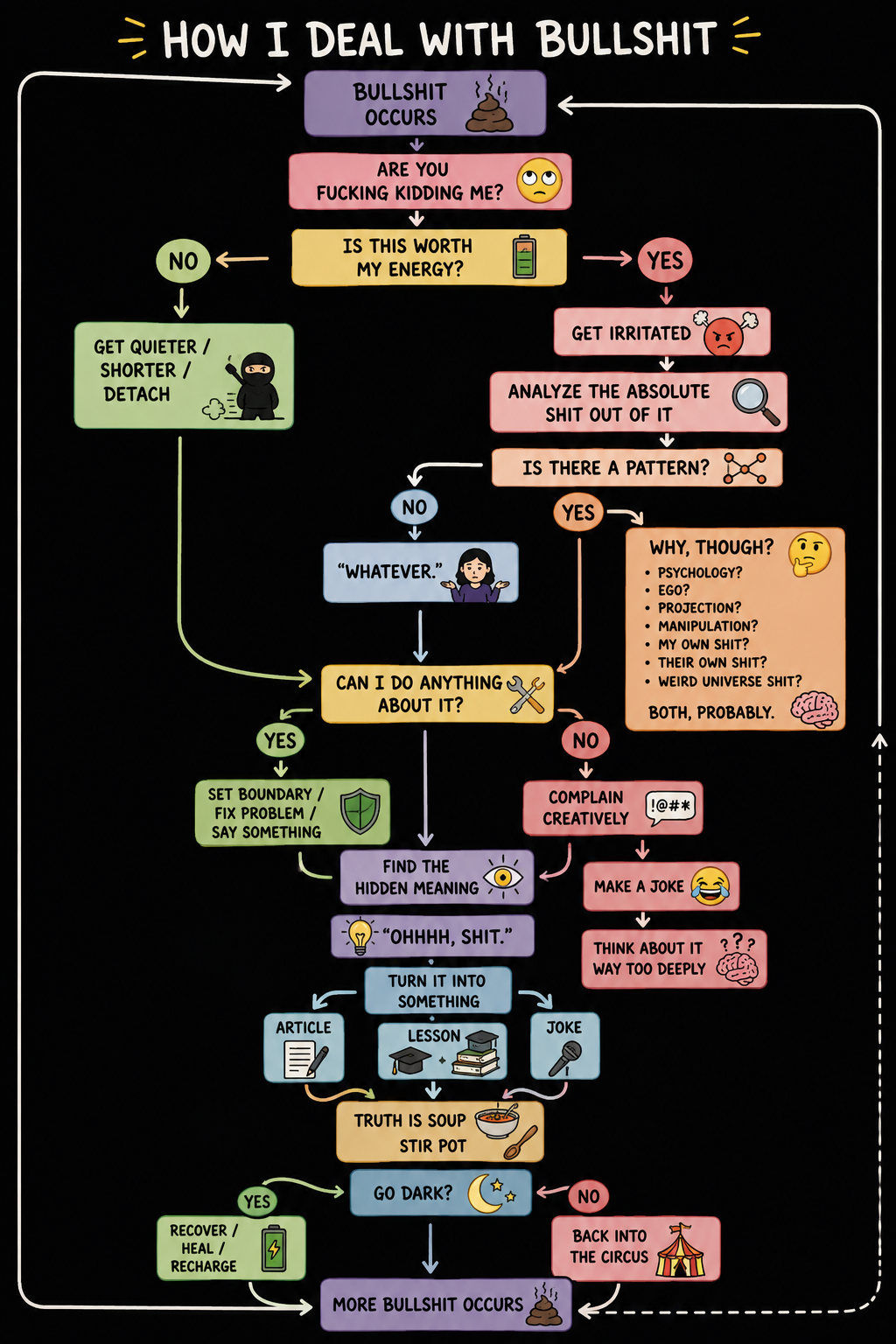
I read it and laughed. Because I do overthink pretty hard.
Every box in there is real. I do get irritated. I do analyze the absolute shit out of it. I go hunting for the pattern, and then I sit there working through whether it is psychology or ego or projection or somebody else's damage or my own, and the honest answer is usually both, which is also on the chart, because of course it is. Nothing in that picture got invented to make me look interesting.
I already knew I overthink. That is not news in this house and it has never been news to anybody who has spent a full day with me. What I had never seen was the shape of it. Knowing you chew on things too long is one thing. Watching it come back as a diagram, with decision points and a route you apparently take every single time, is something else.
That was not the only report filed. Somewhere in the same stretch I also put together an accounting of where my waking hours actually go, which I recommend to nobody.
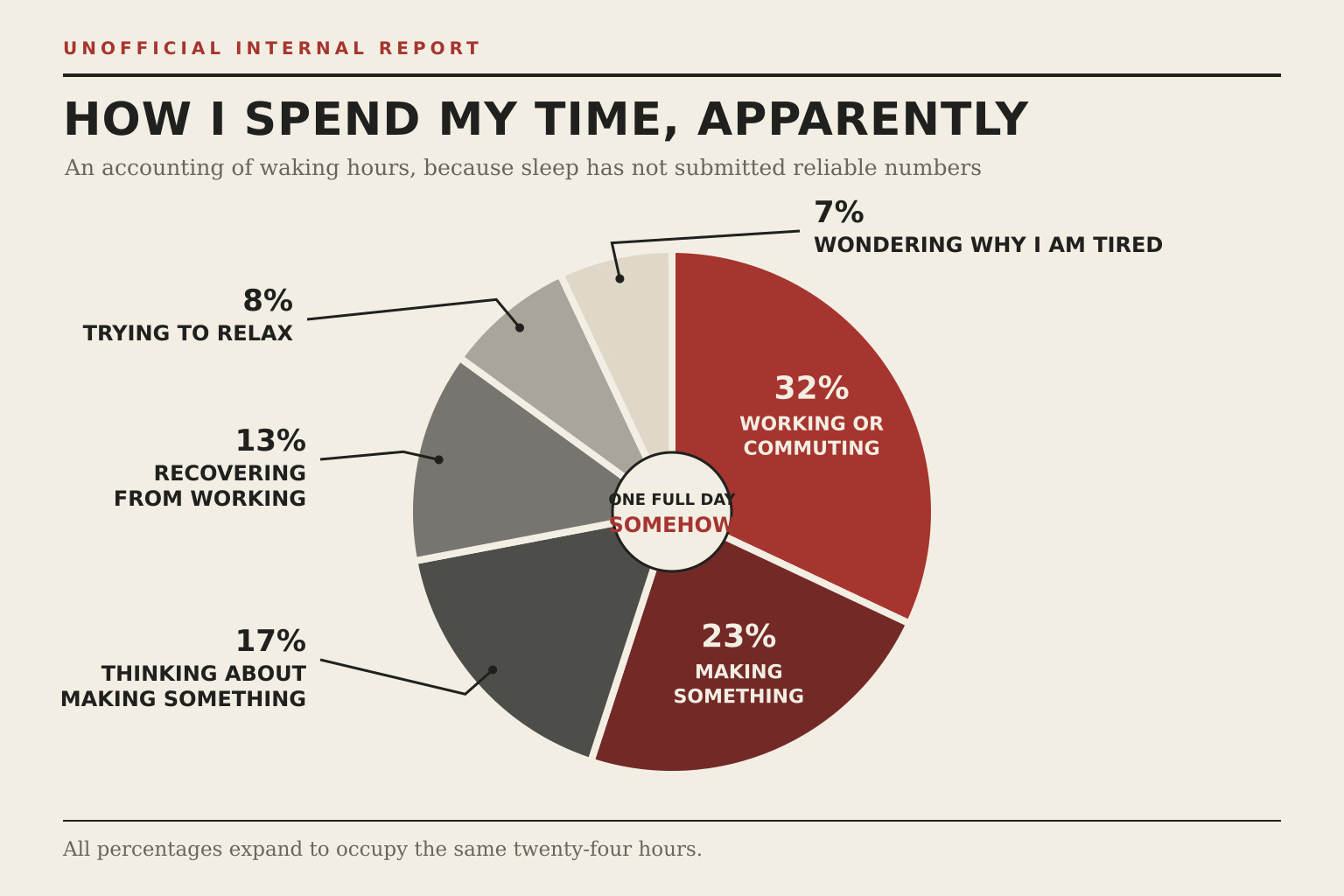
Seventeen percent of my life is spent thinking about making something. Twenty-three percent is spent making it. I would like those two numbers further apart and they have declined.
And then there is the part the picture gets wrong: the arrows.
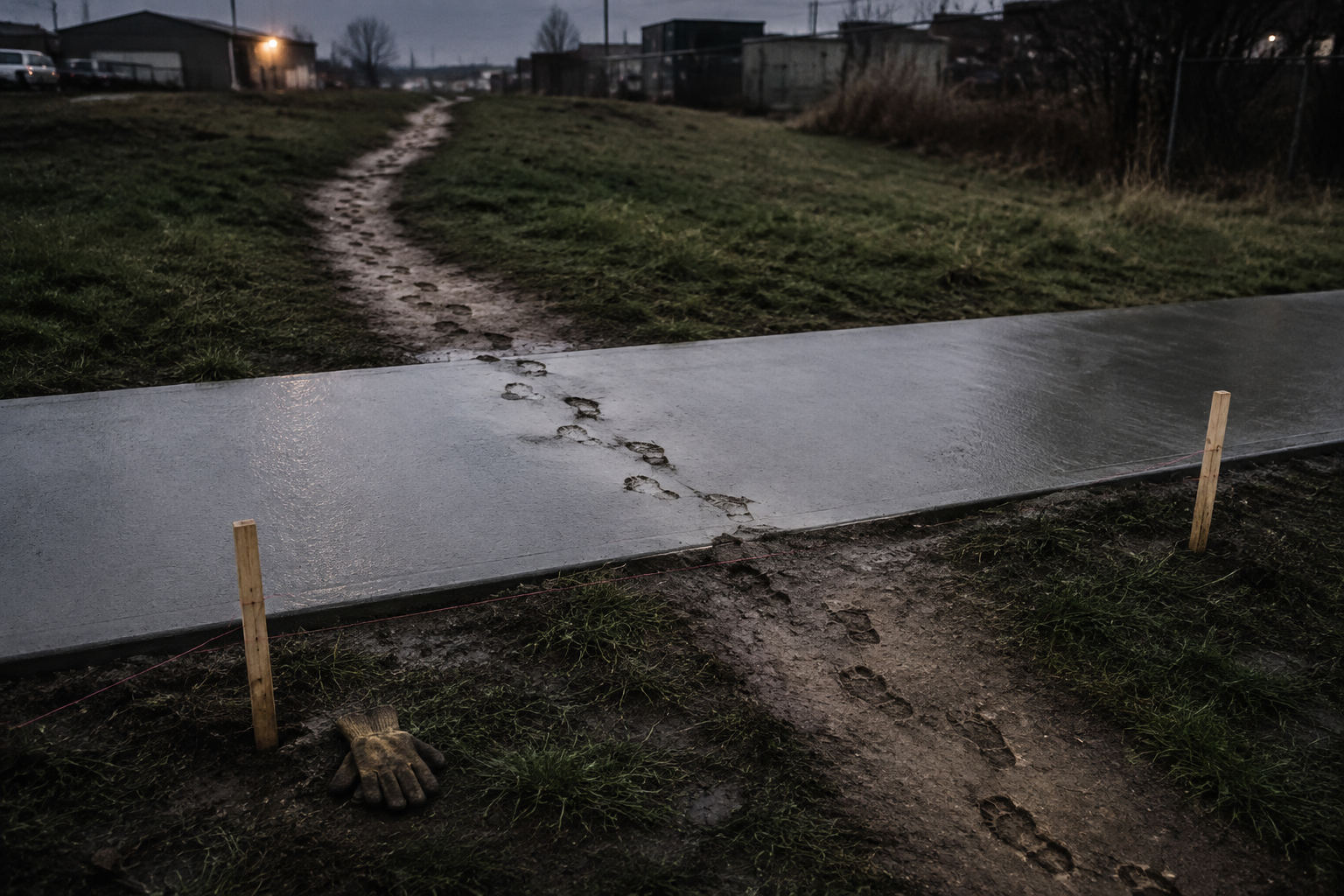
Arrows mean procedure. They mean somebody is standing at the top of the page steering the whole operation. That is the flattering lie in every flowchart ever made, and mine is no exception. It is the same trick as a sidewalk poured over a path that people already wore into the grass. The concrete did not decide anything. It showed up after the feet and took the credit.
I have never once consulted that chart while something was actually happening to me. It is not instructions. It is a map of where I have already been walking.
And look at the top of it. BULLSHIT OCCURS, then ARE YOU FUCKING KIDDING ME. There is nothing between those two. No question to answer, no branch, no decision, nothing for me to be smart about. That part shows up on its own, and it does not check with me first. Everything under it is a question.
I get paid on one of those branches. The one that runs ARTICLE, LESSON, JOKE, which from a distance looks like the high road. Making something out of a thing does not mean the thing is finished. It means I made something. I know the difference most days.
Some things just get a shrug. There is a box for that, and all it says is WHATEVER, and it gets an arrow coming out of it same as everything else on the page. The shrug is often the right answer, and the shrug is free.
Some of it I handle by getting quieter, shorter, and further away, and the chart gives that its own branch. It sounds like a spiritual practice. Mostly it is a job. I am still on the clock, the situation is not going anywhere, and neither am I, so I turn my own volume down and finish what I am doing. That is not the same as having a choice. Some days it is the only exit in the building.
There is also a capacity study.
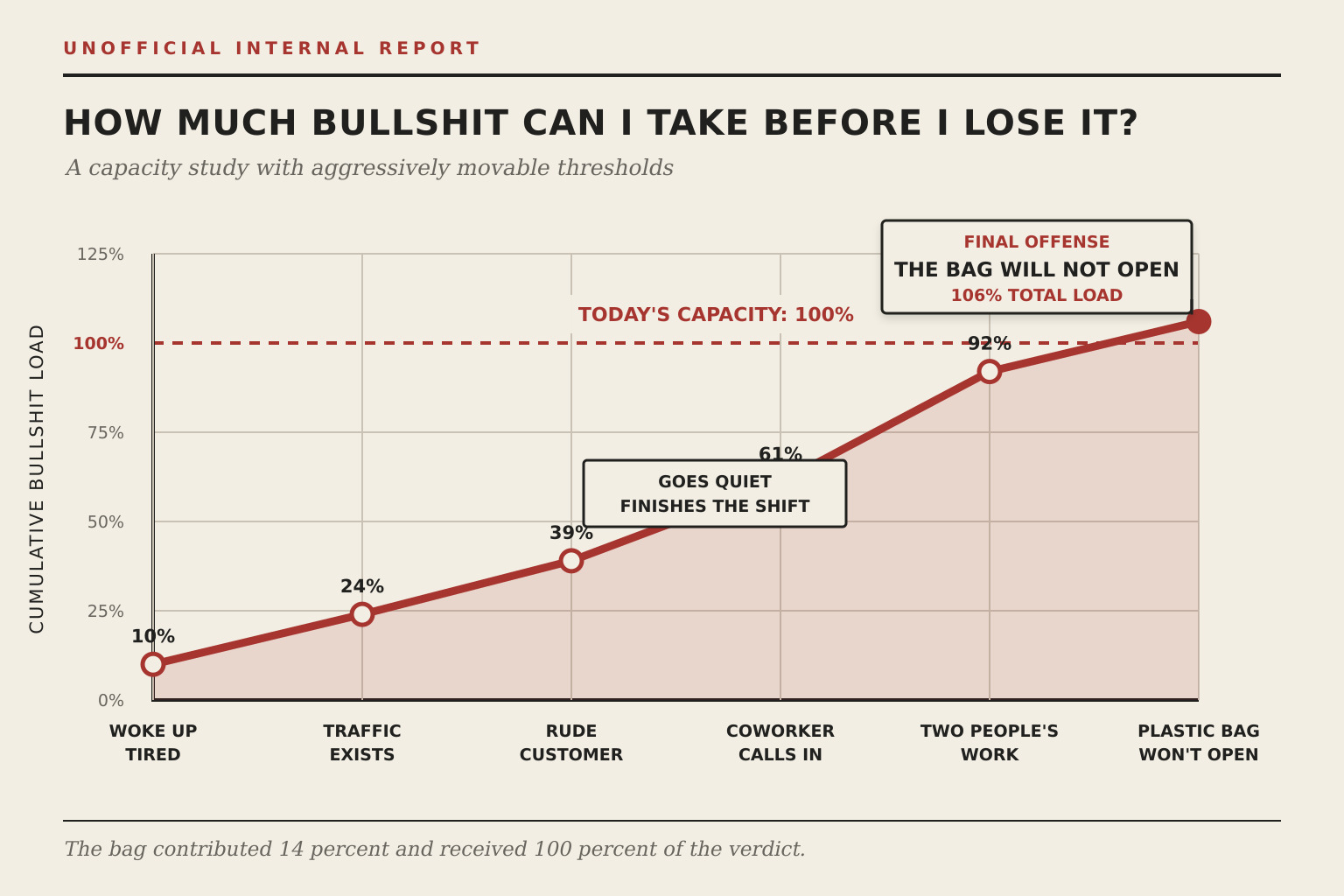
The plastic bag contributed fourteen percent of the problem and received one hundred percent of the verdict. Anybody who has been at the end of a shift knows that is not a math error.
Down near the bottom there is a box that says GO DARK, and I am in one of those right now.
Sometimes going dark is hiding. Sometimes the tank is empty and stopping is the only move left on the board. I call it compression, and in my head that is the part before the bloom. I believe that. I also cannot prove it, and I am not going to hand it to you polished up like something you would put on a wall. Nothing visible is happening over here. That is not the same as nothing happening. It is also not evidence that something is. Nobody schedules a bloom, and I am not going to promise you every dark stretch produces one, because plenty of them just cost.
The chart has a box for going dark. It does not have a box for how long.
I am not special in any of this. Everybody has one of these running somewhere. Mine has that many boxes on it because I overthink pretty hard, and somebody else's is probably two boxes and a beer, and that person is very likely sleeping better than I am.
But follow any branch on that thing all the way down. The article, the joke, the whatever, the one where I actually recover. Every single one of them empties into the same box at the bottom, and that box says MORE BULLSHIT OCCURS, and coming off it there is an arrow running straight back up to the top.
No exit anywhere on the page. Nobody forgot to draw one.
I have an extremely detailed map of a room I never leave. Something is going to irritate me here shortly. The machine will fire up, I will run the whole route, and I will probably get an article out of it.
Apparently.
The Napkin
The Map Is Bigger Than the Game
The game on my site, No Wrong Place, has fifteen levels. Seven going up, seven going down, and the Lantern Court sitting at zero where everybody starts. I built them one at a time, from the inside, each with its own light and its own price. I had never seen all fifteen stacked in one picture until this.
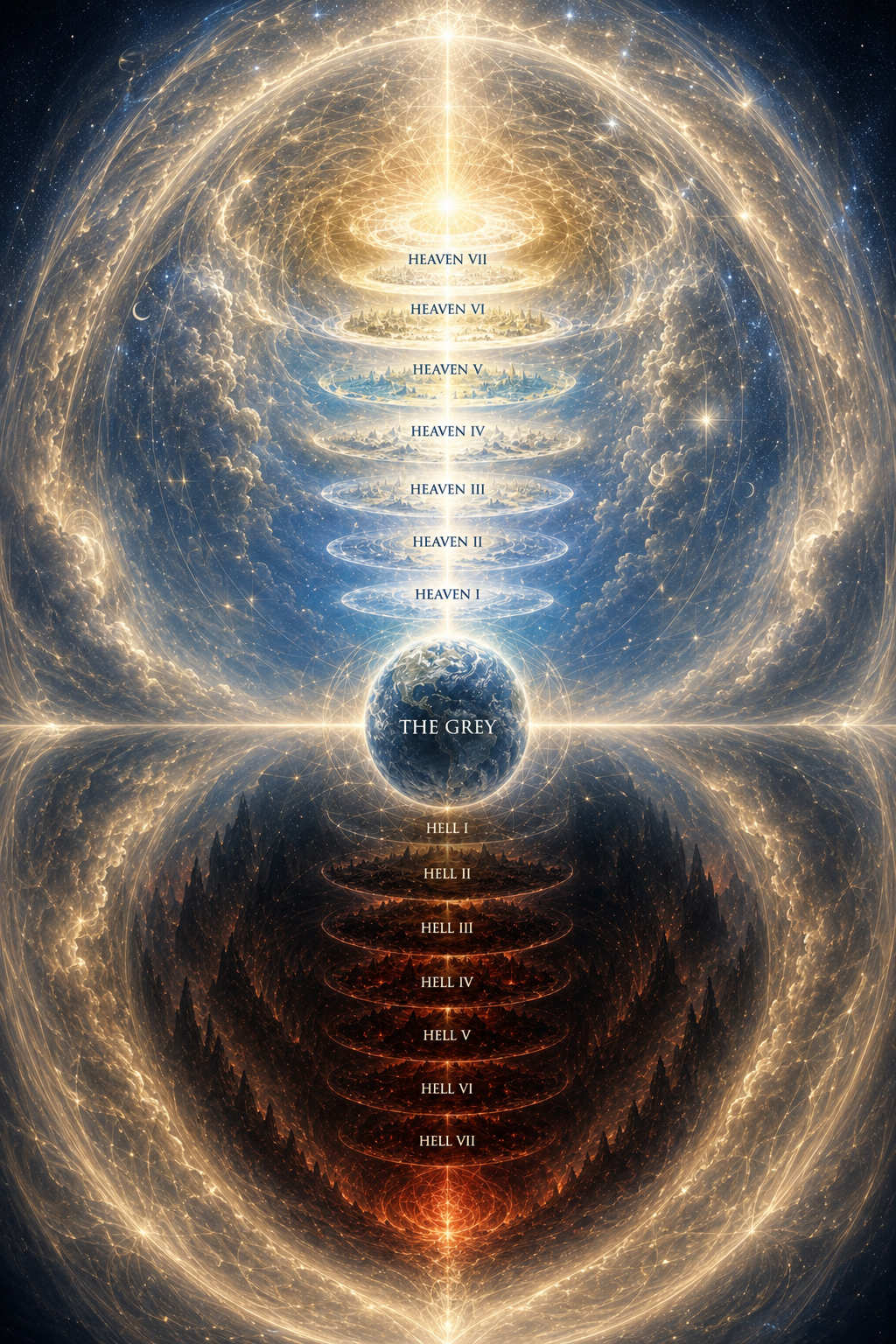
Then I sat with it longer than I meant to and understood I was looking at the book. The Gospel of the Grey runs that same shape. I did not build one out of the other, and nobody is adapting anything. They came up out of the same ground at about the same time, in different rooms of my life. The book gives that place bodies. The game lets you walk into it and find out that no wrong place does not mean no wrong move.
I go quiet for stretches, and while I am inside one, I cannot tell whether anything is happening. Some of those stretches took plenty and handed nothing back. But looking at the whole run of them instead of the one I am standing in, I come back with one more room. The game got bigger. The book got bigger.
My universe expands a little bit after every compression.
The Recipe
Your chest gets used to the pressure of unexpressed truths.
Blue-Collar Mystic, Vol. 2: Holding Light in the Machine
Tip The Kitchen
The Soup is free, and it stays free. A paid membership is the steadiest way to put something behind it, and it opens three parts of the site: every tarot spread without buying credits, all seven frequencies in the Frequency Room, and unlimited AI conversation in No Wrong Place. There is also a Ko-fi jar for one-time support. If money is tight, nothing changes for you. Same bowl, same table.
Other Recipes
From the Codex, if this one landed:
The wave pulls back too. →
No Wrong Place Does Not Mean No Wrong Move. →
Wears Me Down, Holds Me Together. →
What's Simmering
The Gospel of the Grey's fourth chapter is written, but its seven images still come before the fifth. I am not putting a date on either one. They will take what they take, which is inconvenient and apparently how I work.
The Cake
The Grey Zone · Field Notes · The Back Room · My Books · Subscribe on Substack
Take what's useful. Leave what isn't.
The Grey Zone · As above, so below.