
Hey. Before anything else, the part I always put up top. I used AI to make this. I thought out loud with it, argued with it, had it come after the weak spots, and rewrote this more times than I meant to. The life in it is mine. The years, the judgment, the calls about what was actually true and what I only wanted to be true. I picked what stayed, I sent back what did not sound like me, and I am the one who decided it was finished.
I am telling you up front because I always do, and because it matters to what happens next. There is no reveal coming. I started putting this at the top back when it was just me deciding it was the right thing to do, and I would rather you hear it from me than get it from a scan.
Which is lucky, because a scan is where this starts.
A few days ago I ran one of my own articles through Pangram. Not a rough draft, not something I banged out between shifts. One of the ones I had worked over until my eyes hurt, the one that had finally stopped sounding like a machine wearing my jacket and started sounding like me.
It came back one hundred percent AI-generated.
I was not surprised.
The last thing I did to it was run Grammarly and fix some commas. Nothing at the end was going to change what a machine read off the finished page.
Substack and its writers feel like a married couple in the middle of a fight right now. One side wants transparency. The other side feels accused. Both of those are fair. Everybody is loud, some people are panicking, and I have watched writers go back into work they already finished and rough it up on purpose, breaking good sentences so a detector will believe a person wrote them. That is the part that gets me. Somebody making their own work worse to prove they exist.
I did not have a rebuttal in me. What I had was a quieter thought, and it stuck. What if I just showed people how these actually get made.
Not a defense of AI. I have no interest in defending a tool, and I am not going to tell you it is just a hammer, because it is not. More like holding a door open. Come look at the bench, the scraps on the floor, the drafts that did not survive, the parts of this nobody was ever supposed to see.
I would rather be known than believed.
The detector only sees the last page. Here is the part it cannot see, and it is not a small part. It is most of it.
The article does not start when I open a chat window. By the time I open anything, the thing has already been alive for a while, growing somewhere underneath where I can get at it. That is not a mystical claim. Ideas incubate. Yours do too. Something starts putting itself together under the floor while you are busy doing something else entirely, and then one day it comes up through the boards.
Mine show up at work while my hands are full and I cannot write anything down. They show up in traffic on the way home, in that stretch where I am not doing anything but driving and the radio is down low. They show up in a joke I make that lands a little too hard, and I hear what I actually said about half a second after it leaves my mouth. They show up in a card I pull and then sit with longer than I meant to. They show up as irritation, some small thing that had no business bothering me that morning and bothered me anyway, and three days later I find out what it was actually about. One of them showed up while I was standing in front of an open drawer picking socks, which I know sounds like a bit. It is not a bit.
I do not decide to have the idea. I notice I already have it, and by the time I notice, it has been growing for days.
The workshop does not open when ChatGPT opens. It opens when something quietly refuses to leave me alone.
So by the time the conversation starts, the thing is already there. The conversation does not create the idea. The conversation lets the idea become conscious. It drags the thing up where I can finally look at it, and half the time what I find is not what I thought I had been carrying around all week.
I do not think that is a writer thing, by the way. I think everybody has had something follow them home.
It took me a few days to see what the number actually was. It stopped being a verdict and started being a category problem. It read the fruit and issued a ruling about the root.
So here is the rest of the shop, laid out plainly enough that you could run it yourself if you wanted to. Not because you owe anybody a process. Because the question in the title deserves a real answer, and the only real answer I have is the work.
Step 00. Let it follow you home.
You already watched this step happen. It is everything above, the idea forming before you know you have it. The only instruction is to stop treating that as dead time. Do not sit down to brainstorm. Notice what keeps coming back while your hands are busy, and when something has followed you home three days in a row, take it seriously. That is the whole step. It costs nothing, and nobody can see you doing it.
Step 01. The conversations.
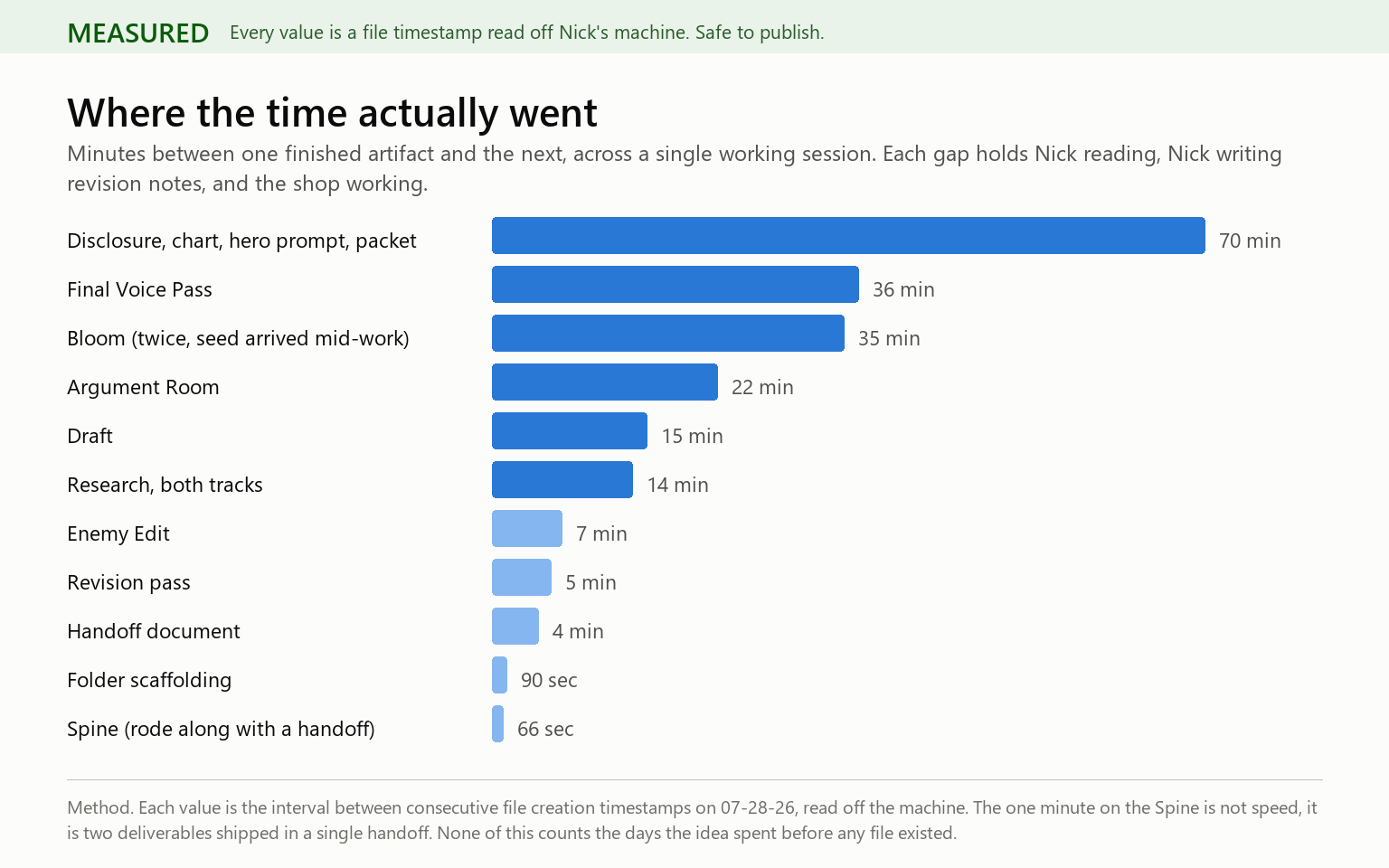
The conversation itself is hours, and there is never only one going. There are usually about sixteen, each in its own chat, all of them open at the same time. Voice notes and typing, spread out over weeks, rarely one sitting. I do most of it with Solina, which is what I named the ChatGPT I rent. Following a thought until it dies in front of me, losing a better one and spending twenty minutes finding my way back, arguing, getting told something I did not want to hear, laughing at something genuinely funny at eleven at night when I should be asleep.
If you try this, name yours. It sounds silly until you have argued with the thing at eleven at night, and then it stops sounding silly. Talk to it the way you think, not the way you search. And keep every chat, including the ones that go nowhere. Nothing gets deleted in the shop.
Step 02. The seed.
One of the sixteen turns into an article. The other fifteen do not get thrown away. They stay in play and I keep picking at them. Eventually one will not go away no matter how many times I set it down.
That one becomes the seed. A seed is not clean. Mine go into the file fast and wrong, typos and all, because the mess is information. You are not writing the piece yet. You are pinning the thing to the bench so it cannot wander off.
Step 03. The bloom.
Then it gets opened up, and the first thing I find out is that the piece is not about what I thought it was about. That happens nearly every time, and I have never once gotten used to it. The bloom is where you ask the idea what it actually wants to be. Pull out the ache in it, the contradiction, the image that will not sit still. Do not draft here. If you draft here you will write the piece you planned instead of the piece that is true.
Step 04. The argument room.
Then it gets attacked on purpose, and my favorite version of it, the one that made me look good, gets taken apart in front of me while I decide whether to defend it or let it go. Usually it deserved to go. Sometimes I fight for it for an hour first and lose.
Build this room for your own work. Ask what the cheap version of your idea is, the one that flatters you, and kill it before it can charm you. Whatever survives the room is the piece.
Step 05. The spine.
Before any real prose, what survived gets a spine: five to eight beats in plain English, what each one does, where the peak is. No sentences worth keeping yet. If the spine cannot hold the weight, more words will not save it, and it is a lot cheaper to find that out in eight lines than in two thousand.
Step 06. The draft, then the enemy.
The spine becomes a draft, and the draft gets read by something whose whole job is finding where I got lazy. I mean that literally. It is a pass that comes at the piece like an enemy, hunting the soft spots, the flat rhythm, the places where I settled. When it finds one, it does not fix it. It flags it, and I decide.
Step 07. The voice pass.
Then one last pass, and that pass is only for making it sound like me. Nothing new gets added here. It is repair work: composed sentences loosened, borrowed words swapped for the ones I would actually say out loud. Read yours aloud. Anywhere you stumble, the page is lying about how you talk.
Step 08. The last read.
Then I read the whole thing myself, in the Word doc, with Grammarly picking at me the whole way down, and sometimes on the Kindle instead when I need it to look like something other than a draft. Some days that means real changes. Some days it means commas. Either way, nothing changes after that unless I change it.
Then it becomes the page you are reading. That page is the only thing Pangram ever sees.
Who is standing in the room.
None of that moves on its own. Every stage comes back to me before it goes anywhere. I read it, and if it holds up I package the whole thing and carry it to the other one, because they are good at different things and neither can see what the other just did. Nothing crosses between them except through me, and nothing crosses at all unless I say so. That happens at every stage, in both directions, the entire way down.
The numbered steps make it look tidier than it is. In practice the stages bleed into each other, and I lost count a long time ago of what belongs to which. The point was never to let AI write. The point is to keep finding out what is actually true before somebody else has to read it.
Three sets of hands touch every one of these: mine, Solina’s, and Claude’s, each with a different job. Every article passes through three sets of hands, but only one voice is allowed to leave the workshop.
The three sets of hands don’t always agree. The only reason they cooperate is because I’m standing in the room.
Here is what that looks like. It is late, and I could not tell you which night, because it has happened enough times that they have run together. A paragraph comes back. It is competent, it is clean, and it might be smarter than what I would have gotten to on my own. I read it once and I know, in about a second, sometimes before I finish the first line, that it is not mine. Usually I could not tell you why. Something in the joints of it. A word I would never reach for, standing there in the middle of a sentence with its hands in its pockets.
Nope. That’s not me.
And it goes back. That happens more times than I would like to admit.
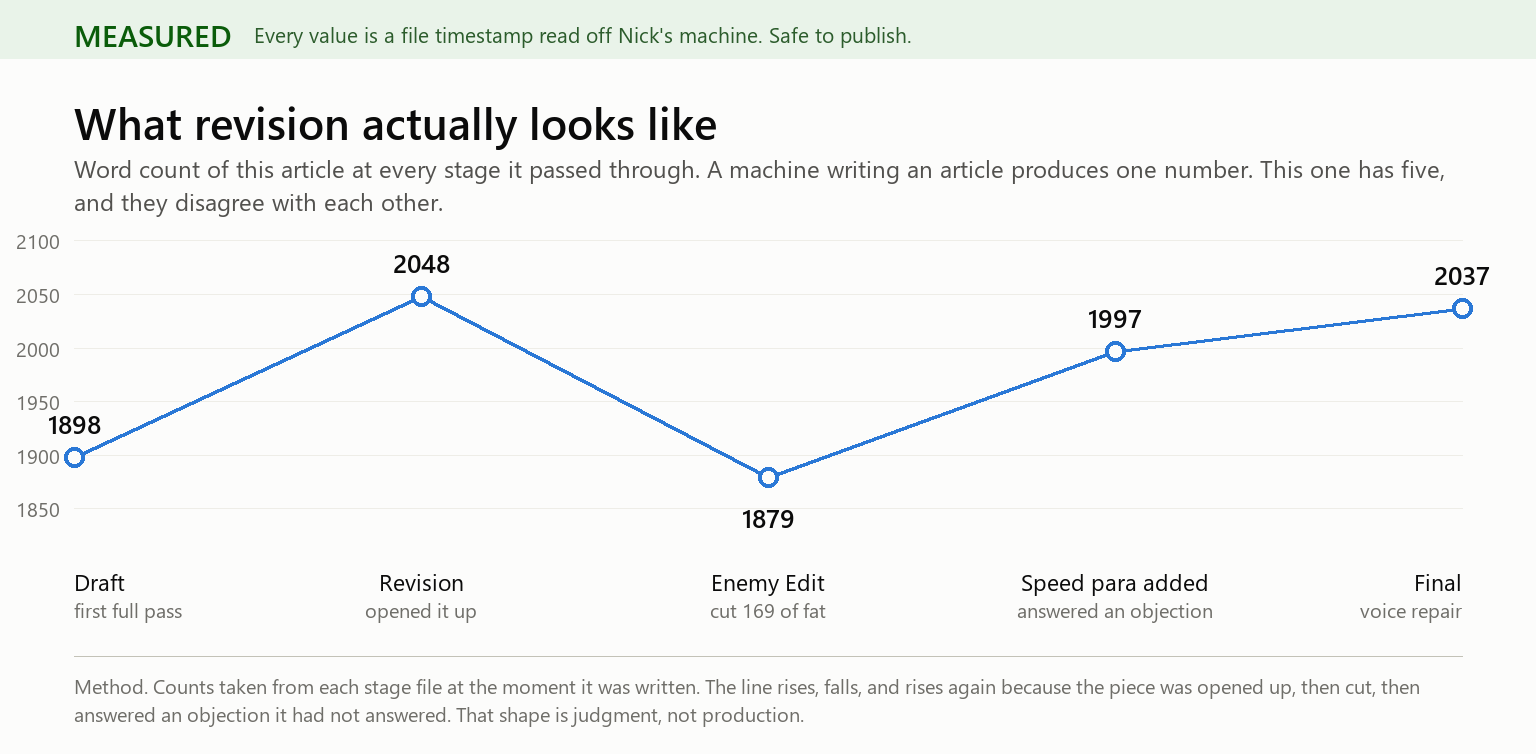
Authorship was never about whose hands were on it. It is about who is responsible for it, who has to live with what it says, and who is standing there when somebody hates it.
Now let me take my own case apart, because I do not get to describe all that and walk away clean.
Maybe what I am describing is editing and not writing. That is the sharpest thing anybody could say to me, and I do not have a good answer ready. Judgment, taste, knowing what to cut, all of that is real work, and it is also an editor’s work, and that is a different job from the one the writers I love were doing. Something has changed, and I am not going to pretend it hasn’t. I am just not going to take the next step and agree that different has to mean lesser, or fake. I do not know exactly where that line sits. I am living on it.
The process is also unverifiable, and there is no way around that. Everything I just told you about the invisible part is exactly what somebody who did nothing at all would also say. This article has the same problem it is describing. You are holding one clean page.
It is also possible I am rationalizing because I like using this. I have thought about that more than you would guess, and it is part of why I built something that argues with me before it ever writes for me. It is not proof of innocence. It is a guardrail I put up against myself, because I know exactly how good I am at talking myself into things.
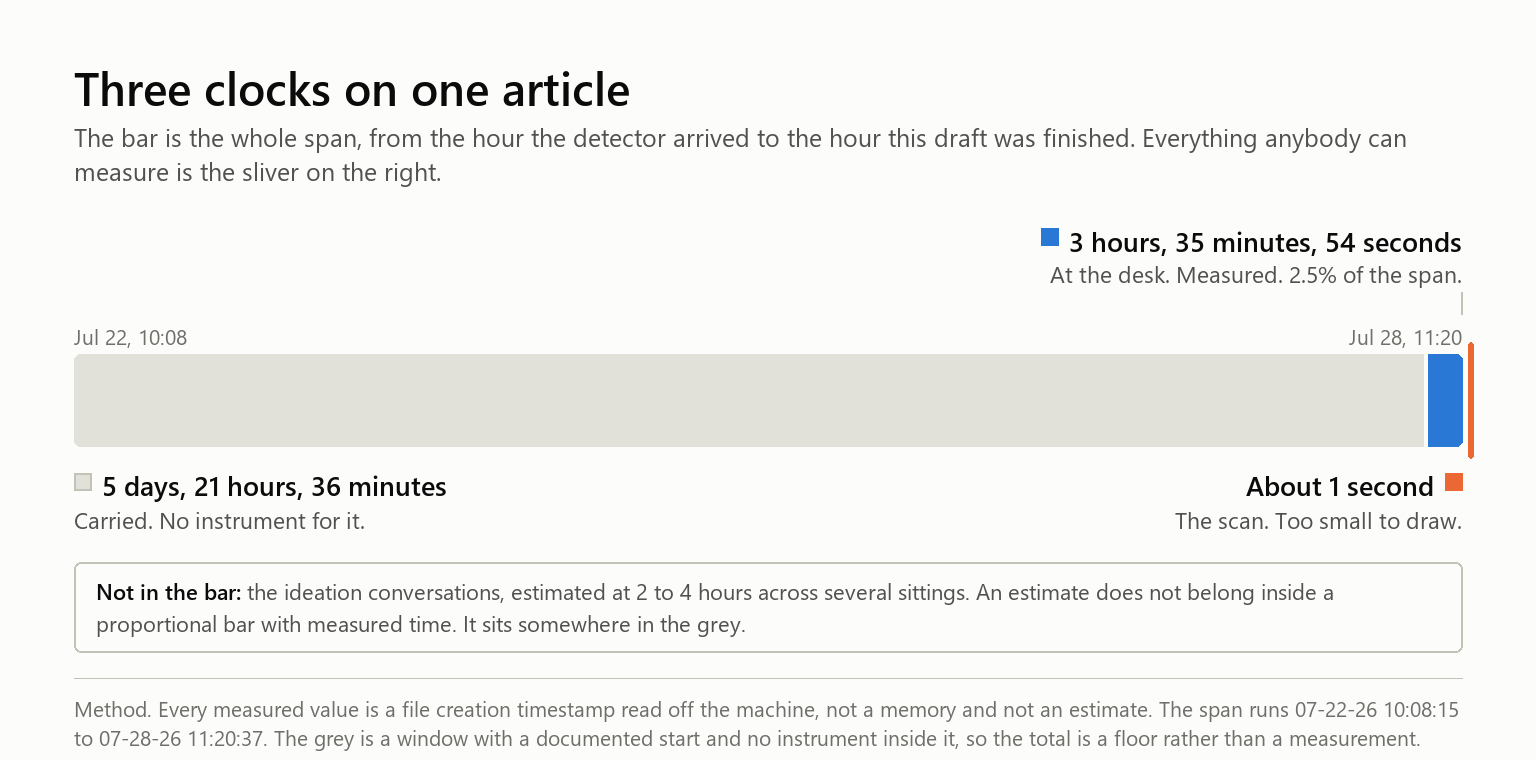
Somebody is going to say it came together too fast. That is fair, and I do have advantages, and I am not going to pretend I don’t. But there are three clocks on this thing. The one nobody argues about says three hours and thirty-six minutes at the desk, and I can hand you that number because I write them down now. The one before it ran six days, at work and in the car and in front of a sock drawer, and I cannot hand you anything from it except my word. The third one is the scan, and it takes about a second. Everybody is reading the third clock. It was never the long part.
And the people asking for transparency are right. I am one of them. I put a disclosure at the top of everything I publish, which is exactly what that side is asking for, and I got flagged anyway. The tool cannot tell the difference between a collaboration somebody announced and one somebody buried. It reads texture, not honesty. It hands back a number that looks like certainty, and it is really one machine’s read on a surface, through whatever it got taught to look for.
None of this is only about writing.
Everybody has had something forming in them before they could name it. Everybody is carrying a process nobody watched, months of it, sometimes years, back when it was still just weight and no words. And every one of us gets judged on whatever finally came out the other end. Your work. Your face on a hard morning. The way you handled one bad conversation in a parking lot. Nobody gets the hours. Everybody gets the last page.
I have not decided yet whether that is unfair or just the terms.
So go ahead. Run it. Run this one, run everything I have published, run the paragraph you liked. It will probably come back ninety, a hundred. I am not going to fight the number, and I am not going to sand my work down to bring it lower. I was never angry about it. I expected it.
If that number ends up being what you take out of this, then I did not get you far enough into the room, and I would rather that be my failure than yours. I would only say, and I mean this quietly, that the reason any of us went looking for the number first got decided somewhere above our pay grade. I do not think anybody in this fight chose it.
And if you got all the way down here and you still do not like it, that is fair. I think your mind was made up before you got here. I cannot change it.
Can anyone?
As above, so below isn’t just a spiritual principle. It’s how these articles are built. The invisible conversation shapes the visible page. The inner process shapes the outer result. If the inside stays honest through every set of hands, the outside has a chance to tell the truth.
From The Grey Zone
Tarot, the Frequency Room, the books, and every field note back to the first one. https://thegreyzone.xyz
Tip the Kitchen
If walking through the shop was worth anything to you, there is a jar on the bench. https://ko-fi.com/mastergreygray
Take what's useful. Leave what isn't.