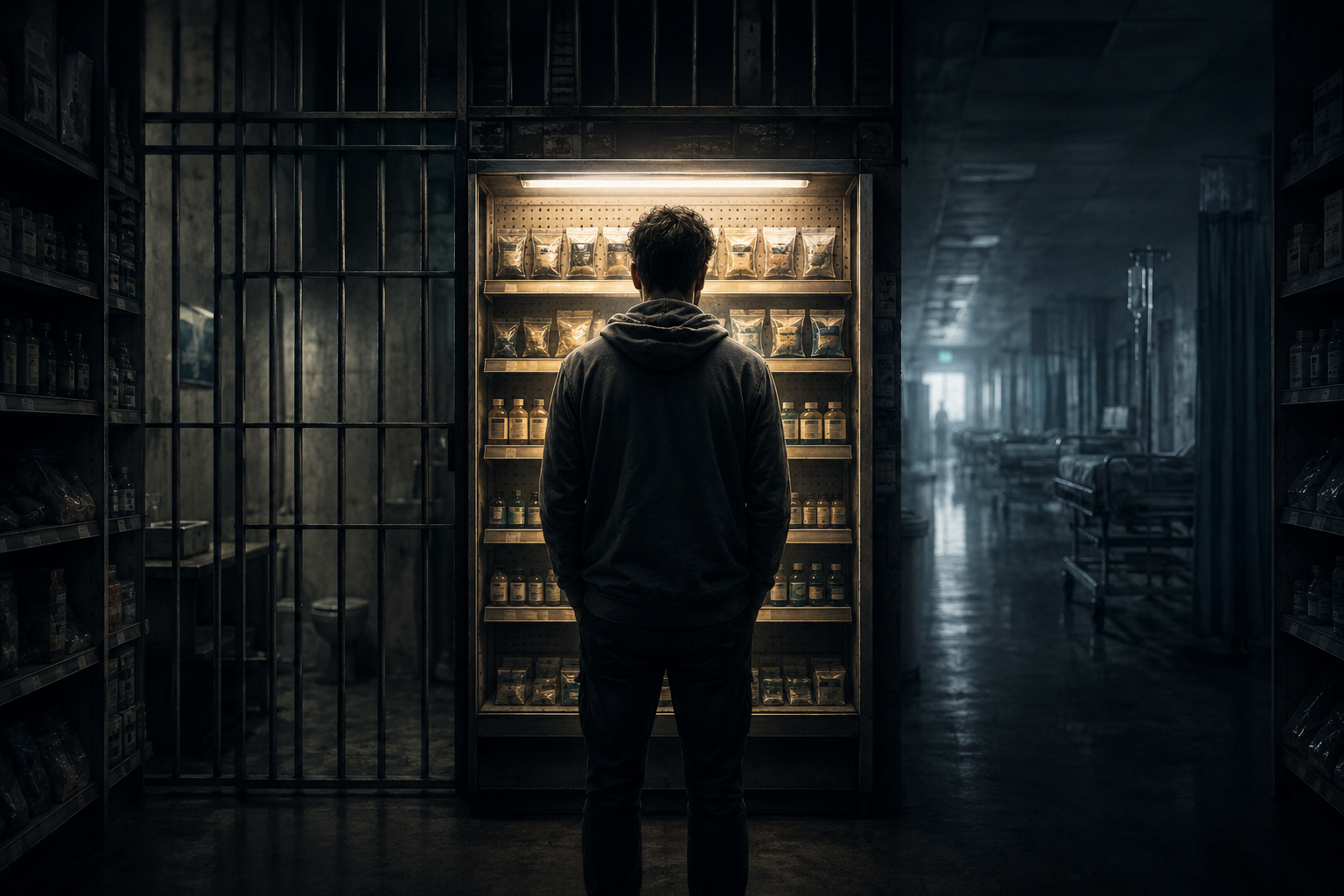
Word came down that they might make 7-OH harder to get. Pull it off the counters, schedule it, put it behind the same wall we build around everything once the damage is already done. And the first thing that moved in me was not the noble thing. It was not outrage. It was not a speech about freedom. It was relief. A small, quiet, guilty relief, the kind you feel when someone finally takes the bottle out of the house.
I have been sober a while now. I am not writing this from inside it. I am writing from the other side, from memory, from a body that still remembers. When I tell you what that stuff did, I mean what it did, past tense, what it used to do to me back when I was using it.
And what it did was simple and total. Every time I took 7-OH, it took a part of my soul. Not a mood, not a rough morning, a part. It would hand me an hour where the volume of the world dropped to something I could stand, and then it would send a bill, and the bill was always bigger than the hour. I came out the other side of those stretches broke, exhausted, and raw. Spiritually hungover in a way sleep does not touch.
The relief was real, but it was not faith in the system. I do not think a locked cabinet loves you. I know what cages do to people, which is mostly make them more ashamed, more alone, and more likely to come back to the same door. But I know from experience what happens when the wrong door is open at the wrong hour, when you are weak and tired and it is sitting right there on the counter next to the energy drinks like it is nothing.
Some doors are not neutral. Some doors are baited. This one was built to be easy to walk through and hard to walk back from, and calling that a free choice is its own kind of lie.
Pulling it off the shelf does not fix the man who reached for it. A locked door can be mercy in a weak hour. But a locked door is not a healed wound.
So take it off the shelf. Fine. But watch what we actually do, because we never stop at taking the trap away. We let the thing sit out there in the open, legal and easy, right up until somebody reaches for it and goes down. Then, and only then, do we get interested. Not in the shelf. In him. The shelf was never the problem. The second a man's hand closes around it, the man becomes the problem.
That is the trick nobody names. The bait gets a business license. The person who took the bait gets a record. We let the door stay open, then we punish people for walking through it, and we call that justice like we invented the word.
And here is what I know, not from a study but from watching it. A cage does not heal anybody. You do not walk into that place hurting and walk out mended. You walk out with a name you did not have before, a box to check on every job application, a quiet new belief that you are the kind of thing that belongs behind a door. So when a man carrying all of that reaches again for the same false exit that put him there, of course he does. It is the only thing that ever promised to make the shame quiet.
We are quick builders in this country, but only for punishment. We can stand up a court date, a fine, a record, a whole machine for processing the fallen, faster than we can get one wounded person a bed and a hand and a year of somebody believing they are worth the trouble. We are good at building cages. The hospital is the part that always comes later, always underfunded, always buried under a form.
I am not asking to let chaos dance naked in the street. I am not saying hand everybody everything and walk away whistling. I am saying we have the order backwards. You get to the wound before you get to the handcuffs. Heal first. Punish later, if you even still need to, and most of the time you will find you do not.
We built the cage before the hospital, then acted surprised when the sick kept ending up behind bars.
So where is the hospital? Not the building, the healing that reaches down to where the wound actually lives. Here is the part that should keep a person up at night. It exists, or the beginnings of it exist, and a lot of it is sitting in a drawer somewhere, buried under a form.
We are not short on the pieces. We have doctors who got into this to mend people, not just manage them. We have scientists who would give a decade of their lives to understand how trauma burns itself into a nervous system and how a body might be walked back out of it. What we do not have is a sane way through the red tape. The people are ready. The system is scared.
Take ibogaine. I am not here to crown it, condemn it, or tell anybody to go find some. I am saying there are serious people who want to study it carefully, in the light, with honest data, because early on it looked like it might do something for the kind of addiction that eats a life. And that study crawls. It crawls through scheduling, liability, and funding that dries up, and fear that never does. Meanwhile, the thing that took pieces of my soul was sitting at eye level by the register, no permission slip required.
The trap was easy. The trap had retail hours. The trap had a barcode. The bridge, the thing that might carry a person from the wound to the far side of it, that one we made complicated. We made it expensive. We made it slow. We buried the maybe-medicine, and we shelved the definitely-poison, and we told ourselves this was about safety.
This is not about trading one magic substance for another. I am not looking for a new pill to worship. A false exit promises relief and quietly bills your soul for it. A real bridge, if we were brave enough to build one and walk it, would not take you out of yourself. It would carry you back to yourself. Those are opposite directions wearing the same face.
The trap gets a shelf. The possible medicine gets a permission slip. That is not morality. That is a spell cast by a sick system.
Let me bring all of this down out of the courtroom and the red tape and back into the ribs, because that is where I actually live. I am sober. I am medicated. I work, I move my body, I show up. And still, about half the time, my body sits there uneasy, humming at a frequency I did not ask for, like it is bracing for a hit that already came and went years ago.
The medicine helped, and I am not about to bad-mouth it. It caught me when I was falling and built a floor under a man who did not have one. I am grateful for it the plain way you are grateful for anything that keeps you here. But being functional is not the same thing as being at peace. You can be upright, employed, and technically fine, and still feel like a stranger renting a room in your own chest.
And somewhere in me, not as a plan with a date on it, just a hope I carry for the long haul, I would like to need it a little less as time goes on. Some of it first, maybe, someday, slowly. Not because medicine is the enemy. Not because I think I am too strong to need help. But because I do not want to reach the end of my life with all my steadiness hanging on a bottle, a refill, an insurance decision, a system that could hiccup and take my floor with it. I want more of the ground under me to be mine.
That scares me a little. But it is not a rebellion. It is a homecoming. I want to know what my nervous system sounds like when it finally believes the danger is over. The sickness took a lot from me. It took years, it took money, it took some faith. But it never once took the part of me that was watching it all happen. The witness stayed, and the witness is the part that gets to decide what comes next.
The body still has to learn that the war is over. Mine is a slow learner. I am teaching it anyway.
I am not trying to be pure. I am trying to be free.
That unease in the body has a cousin, and its name is loneliness. Not despair. The two get mistaken for each other, but they are not the same animal. Despair says the water goes on forever and nothing crosses it. I am not there. What I get is quieter. I know the bridge is there. Some days I just cannot feel it holding.
It shows up small. Not long ago someone close to me looked at the spiritual work I do, the Tarot, the sitting with people in their hard hours, and could not see any of it as real. To them it looked like a con, or like a man losing his grip. I understand where that fear comes from. But it found the oldest bruise I have, the one that says the thing I am here to do is the same thing that makes me strange to the people I come from.
Then the next day at work, already low, I said the simplest kind thing there is. Everyone have a great and safe 4th of July. Nothing came back. They probably just did not hear me over the noise of the place. It almost certainly meant nothing. But when your confidence is already on the floor, silence stops being silence and turns into a courtroom, and every quiet second sounds like a verdict.
Despair says there is no bridge. Loneliness says I cannot feel it under my feet right now.
What I feel as one man on the nights I cannot find the bridge, a whole culture can be taught to feel too. You can put the forgetting into millions of people at once. We have been doing it since we painted animals on cave walls by firelight, and we never stopped. We just got better tools.
Call it media, call it story, call it spellwork. It is the same craft. A spell is not a wand and a puff of smoke. A spell is anything that tells a crowd where to put its feeling. The cave painting told the tribe what to fear and what to hunt. The flag tells you who to weep for. The prison uniform tells you who to stop seeing as human. The ad, the news cycle, the war movie, the scripture, even a Field Note like this one, all of it points a finger and says where the feeling goes. The question was never whether the crowd gets shaped. It always does. The only question is toward what.
And look at what our spells keep casting. One says the addict is separate, so cage him. One says the enemy is separate, so bomb him. One says your pain is something you can buy your way out of. One says the false exit is freedom, ticket for sale. One says the wounded man is the problem and never mentions the wound. It takes no secret room full of men in robes. It only takes the same story told enough times that we stop hearing it as a story.
But a spell can be answered. There is a counter-spell, almost too simple to trust. We are not separate. We are hurting people standing inside machines that make good money off our forgetting, and the forgetting is the product.
Media is spellwork because it tells the crowd where to place its emotion. Fear here. Desire there. Shame here. Enemy there. Belonging here. And if we do not know which spell we are under, we will call the cage normal and the bridge impossible.
And then, the other night, I caught a crack of light in that same cave wall. I was watching the World Cup.
Look at what it actually is. Whole nations pour themselves into it. Flags everywhere, chants that shake a stadium, uniforms and territory and strategy, heroes and villains, grown men weeping in the street over what a stranger did with his feet. Humiliation, redemption, grief, and a joy so big it looks like grief from a distance. That is the exact chemistry of war, every ingredient of it, right there on the field.
Except nobody dies. That is the whole miracle, and we walk right past it like it is nothing. We took the oldest, most dangerous thing in us, the tribal animal that has filled graves since before we could write, and we talked it into a pair of cleats. Grass instead of graves. A whistle instead of a missile. A scoreboard instead of a body count. Ritualized war with the soul still in it. Somebody loses and goes home heartbroken instead of dead. That is a whole species doing surgery on its own worst instinct and letting everybody live.
I am not naive about it. There is filthy money in it, sponsors and corruption and men in suits who never smelled the grass. Nothing that big is pure. But even under all the money, the thing underneath is real. The animal got redirected instead of unleashed, and that is something I cannot un-know. We may always need the contest, the pressure, the loyalty, the release. We do not have to keep turning all of it into rubble. We do it every four years and call it a game.
We could play instead of bomb. We could chant instead of bury. We could let the flags wave over grass instead of graves. We know how. That is what makes it hurt.
On the hard nights, looking at all of it, the caged and the sold and the bombed and the forgotten, I have wondered if this place is simply hell.
I do not think it is. Earth is not hell because Earth is evil. Look at the place. There are oceans, and dogs who lose their minds when you walk in the door, and rain on a roof, and hot food when you are actually hungry, and books, and pickles, and laughter, and a corner kick that lifts eighty thousand people off their feet at once, and kids, and music, and people who drag themselves up after a long shift and bad sleep to go love somebody anyway. That is not the devil's work. That is the other thing, still breathing.
Earth turns into hell in one specific way, and only one. It happens when separation becomes a business model. When the addiction gets sold, and then the addict gets punished. When the war turns a profit. When the cage turns a profit. When healing is the one thing that needs a permission slip, because there is money in keeping the wound open and next to none in closing it. That is the whole machine, and it runs on one lie: that you are alone.
And that is the one lie the machine cannot afford for you to see through. Underneath all of it, we are not separate. We never were. We are just people in bodies that hurt, living inside systems that keep forgetting the bridge.
We are here. The time is now. Deal with it. Not because I have solved the world. Not because I have healed every wound. Not because the bridge is always easy to feel under my feet. But because I am done pretending the cage is medicine, the shelf is freedom, the war is glory, the silence is truth, or the false exit is a home.
We are here.
And if we are here, then the bridge has to be here too.
From The Grey Zone
This is where I keep looking for the bridge out loud, note after note. There is more here now than the field notes. New tarot work, the frequency rooms I have been building, the books, all of it coming from the same place this note came from. Come sit in it: https://thegreyzone.xyz
Tip the Kitchen
This one cost me something to write, the way the true ones do. If it moved something in you, you can leave a little in the kitchen. Honest exchange, both directions. One is enough: https://ko-fi.com/mastergreygray
Take what's useful. Leave what isn't.