This one is for Rache Brand, and I am saying so at the top instead of burying it at the bottom, because it changes how you should read the rest.
She did a reading for me. A long one, hours of my life laid out by somebody who had only just met me, and I am still turning most of it over. But one part stopped me, and it stopped me because of how small it was. The first practical thing she pointed at was not something to make. It was a person. Reach toward one person, nothing attached to it, no ask on the end of it.
I sat with that longer than I sat with the rest, because making things is the part I already know how to do. You could put me in an empty room with a pencil, and I would come out with a book, a website, and probably a game nobody asked for. What I have not done much of is make something with one person in mind and then go tell that person I did.
So, I am changing something about these. Field Notes have been me following something down and reporting back from the bottom of it, and that stays. But I want them pointed at somebody now. I want you to know there is an actual person on this end, and that if something I have been through aligns with what you are carrying, you can talk to me about it.
I don't write fiction. Field Notes are usually things that actually happened to me, and this one did not. I am trying something.
I had been walking a long time, and I was good at it, which is a thing you are allowed to say about yourself when it is true and when it cost you enough to earn it. I knew how to keep my feet dry and what to carry and what to put down, and that the wide road with the good surface will run you four days into country that does not want you, and the little path leaving at a bad angle through the weeds is sometimes the one that gets you there.
The roads split more than seems fair. You pick one, and before you have walked it far enough to know whether you picked right, it splits again, so you are making a second decision on top of a first one you have not finished having an opinion about. And you cannot stand there and wait it out. I have tried. I believe in movement, and standing around waiting is no longer part of my method.
I had a map. I made it myself over years, and by then it was the size of a tablecloth and about as easy to handle in wind. Ordinary paper, taped along the seams, ballpoint mostly, pencil where I was not sure. The folds had gone soft and furry the way paper does when you open it a few thousand times. There was a section up north I had redrawn three times because I kept getting it wrong, and if you held it to the light you could see all three underneath each other. The left boot had been rubbing since spring.
I had it in my head as insurance. Every mile on that paper was a mile I would not have to guess about twice, and underneath that I was working on the idea that if I got it detailed enough I would stop making bad calls.
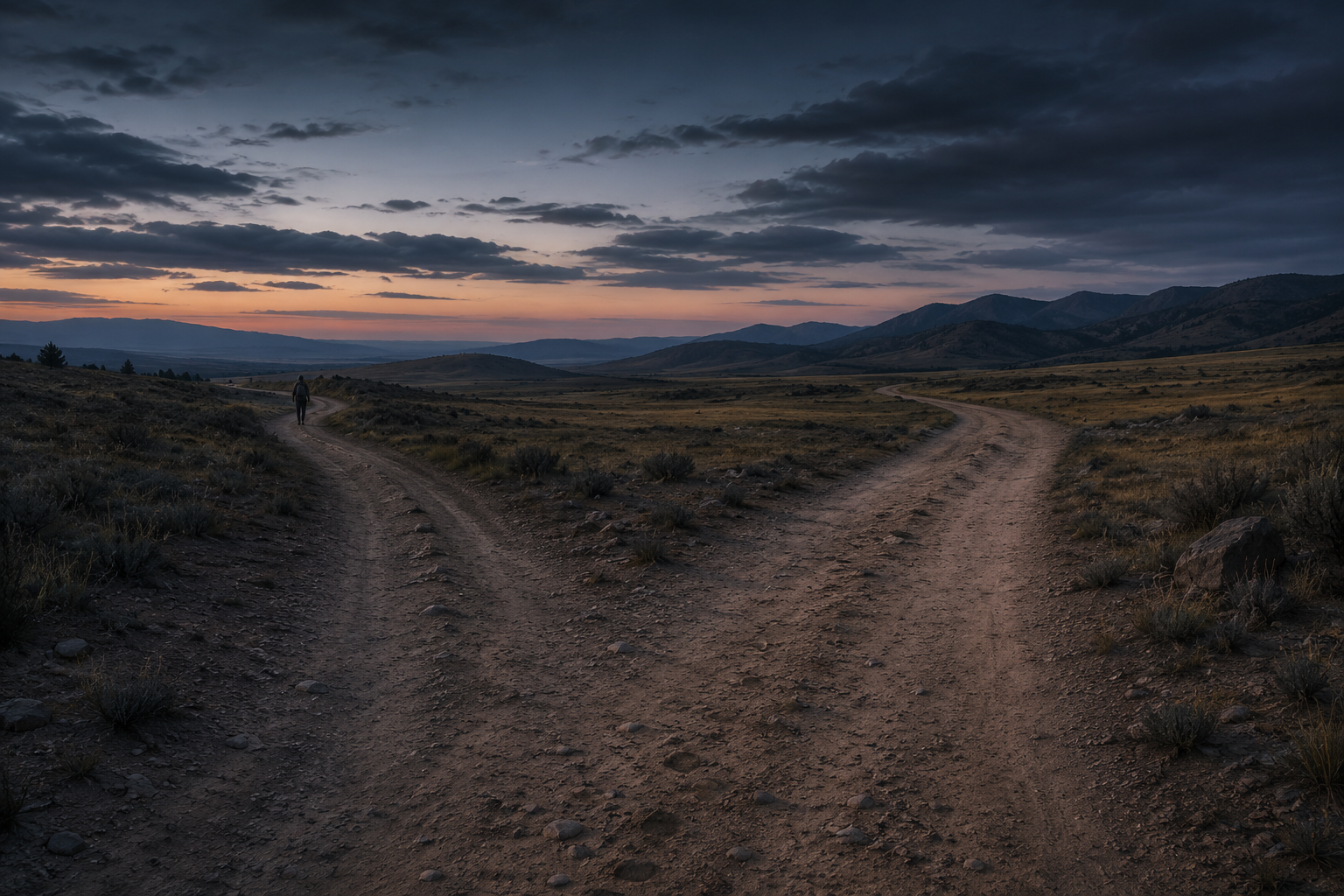
I met Dana at a fire, at a place where four roads came together and none of them agreed about where they were going.
She had it going when I came up and did not seem thrilled about company, which I respected. We split what we had. Mine was the last of the cheap noodles, and hers was better than that. After a while, I got the map out to work out my morning; she leaned over to look, and I started telling her how to get south.
She had not asked. She let me go for a bit, the way you do, and then she said she knew where she was going. She was not lost. She had been on that road a month. What she wanted to know was what the crossing at the river is actually like, because four people had told her four things and none of them had been there in two years.
So, I answered a question nobody asked me. It happens.
After that, we did it properly: we marked it out between us with rocks on the corners. She read one of my marks as a spring. It is spring in March, and she was annoyed by that; fair enough, she had been planning water around something that would be dry by June. But I could give her the approach, because I had walked it twice. I told her where the road goes stupid and where it turns back into a road, and how long it actually takes, which is not how long people say. And then my finger went off the drawn part and onto the white, because past the crossing I have never been. That was everything I had. She was going eleven days further than the edge of what I knew, and about those eleven days I could not tell her one thing.
She sat back after a while and said she had been reading my map for an hour and had only had to ask me about one mark. She said it slowly, like she was working something out. Then she asked, “Does the map show you where you are going?”
“No. It shows where I have been.”
On a deep exhale, she said, “Then who's it for?”
I did not have anything for that. I started telling her about the empty parts instead, because there are empty parts, big ones, and I have a reason ready for them that I have used before. Too busy staying alive to be drawing. That is true, and it is not the whole truth, and I got about half of it out before I heard how it sounded.
She let it go. She did not ask what happened there. She never really unpacked either. Took out what she needed and put it straight back, the whole night, straps done. I do not think she knows she does that.
Somewhere in there I noticed I had not looked at the roads since I sat down.
She left before I was up. Not dramatically. She had further to go than I did, so she went.
I took the east road. I would like to tell you there was a reason, and there was, sort of, in the way you can always build a reason afterward. Nothing lit up. Nothing agreed with me. I stood there in the morning with cold feet and picked one, and the picking took about as long as it takes you to read this sentence.
Nine days later the bridge at the narrows was gone. Not damaged. Gone, and gone a while by the look of it, and there was no crossing for two more days south. That cost me the better part of a week and most of what I had left to eat. I got the map out that night and drew it in.
That was two years before I came up on the fork where somebody was already sitting.
You could see how long they had been there. The grass was worn off in a loop about ten feet across from walking it, the pack was open with everything out of it and half of it eaten, and there was a lean-to somebody had built for one night and then kept.
They asked me, “Which road does one take?”
Straight out, no preamble, like they had been saving it for whoever came along first.
And I knew the left one. Not that exact stretch, but the country it runs into, which is the same country that took me apart when I was younger and dumber and carrying less. I know what the water does there in late summer. I know what happens to the road after the second ridge. I have a real reason to be afraid of that ground, and I was not going to pretend otherwise.
So, I told them.
“That road nearly killed me. I went in at twenty-six and came out as something else, and it took a year to get back. It WILL do the same to you.”
And then I kept going, because I was rolling.
They looked at me for a second. They said, “You don’t know that.”
They were right.
I took my pack off and sat down in their dirt, which I had not done for anybody in a long time, and I did not open my map. I asked to see theirs. It was not much. A page torn out of something, folded to death, drawn in somebody else's hand with about four things on it.
I said, “Show me where you think you are.”
They said, “I asked you which road we should take.”
I sat there.
Then they said they had not come all this way for another question, and they were not wrong about that either. But they got the paper out. And somewhere in the middle of it they said the right-hand road adds nineteen days.
“Nineteen.”
They said, “I have food for eleven, and there is nowhere to buy any until the far side.”
I had never once had a reason to count that road in days. That does not make the left road safe. It is not safe, and everything I said about it was still true when they finished talking, so I told them exactly what I knew.
“I know what the water does there in late summer. I know what happens to the road after the second ridge. If I had to take it, I know where I’d put my feet.”
Then I said, “I wouldn’t.”
They said, “I know.”
They were packed in about six minutes. They went left. They did not thank me. I watched until the road bent.
I do not know what happened to them.
I kept walking. I got lost twice more that year in ways that were entirely my own doing. Then last spring I came up over a saddle into country I had never been in, and I got the map out, mostly from habit, and my finger ran off the drawn part and onto the white the same as it had at Dana's fire, except this time it was my own route running out of paper.
I was standing at a split, looking at nothing, when somebody came up the other side of it out of the exact ground I could not draw.
I asked what they had seen.
They told me. Some of it was wrong. Some of it saved me two days.
That is the end of the made-up part.
Rache looked at a lot of my life, told me what she saw in it, and then gave me something to do with it. Reach toward one person. Make the work useful to a specific person. Don’t just put it out there and hope it finds whoever needs it.
I noticed that more than I expected to, probably because I knew she was right.
And this is me doing it.
So here is the door, and I mean it.
If something I have been through lines up with something you are in the middle of, write to me. Reply to this email; it comes straight to me. Or send me a message here. Say as much or as little as you want.
I can listen, and I can tell you what happened to me, what it cost, and what I would do differently. I can help you think out loud. What I cannot tell you is how yours comes out, because I do not know, and anybody who tells you they do is guessing at you. And if what you are carrying belongs with somebody trained for it, I will say so, and I will still be here. Some things need hands that know what they are doing, and I am not going to pretend mine are.
I will answer when I can. Some weeks that is quick, and some weeks I am on shift.
If you're lost somewhere I've been, ask me about the road.
From The Grey Zone
Everything lives here. The Field Notes, The Soup, the books, the rooms. https://thegreyzone.xyz
Tip the Kitchen
No ask attached to any of this. The jar is there if you want it. https://ko-fi.com/mastergreygray
Take what's useful. Leave what isn't.