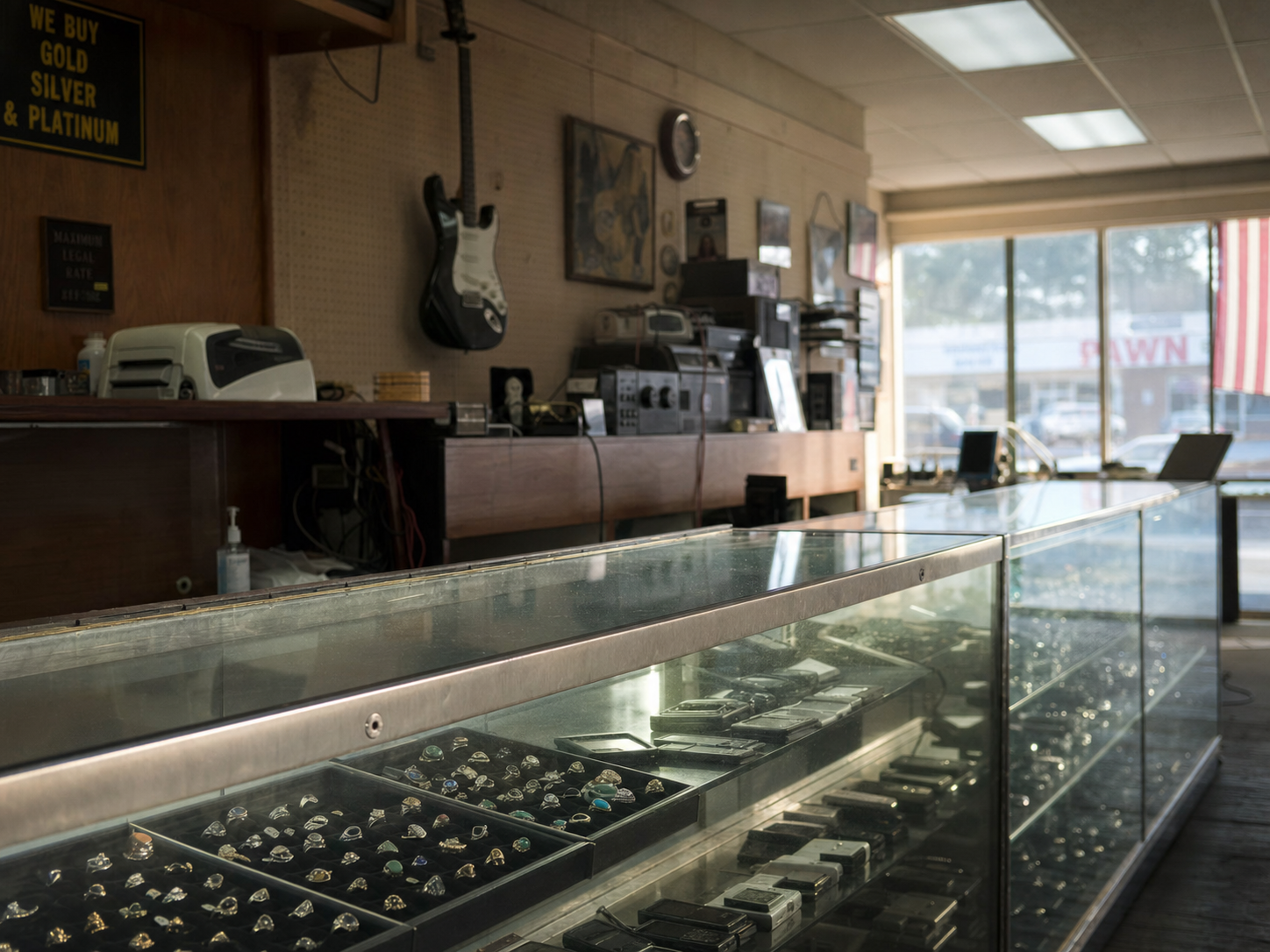
There is a counter I have stood at more than once. Not the one at work. The other one. The one behind the strip-mall glass, with the guitars on the wall and the power tools in the case and the guy on the other side who has already seen every version of the face I am about to make.
I am going back tomorrow. I already know the number. I have known it for a while, because I have done this before, and the number does not move much. The thing I am bringing in is my Kindle Scribe Colorsoft. The color one. The flat slab where I do half my reading and a fair piece of my writing. I paid for it myself, off my own shifts, which is the part the counter never asks about. It has ridden in on that counter before, and it has ridden home before, which is the only reason I can stand to carry it in at all.
I will put it in its sleeve. I will drive over with it on the passenger seat like a person I am dropping at the airport, knowing the flight comes back. I will wait behind whoever is ahead of me, somebody hocking a ring or a drill or a game console, and I will watch them do the same quiet math I am about to do. Then it will be my turn.
Here is what nobody tells you about a pawn shop. The danger is not that they give you too little. The danger is that they offer you too much.
The offer
When you are short on money, more money sounds like more help. Everywhere else in your life that is true. At the pawn counter it flips over.
The money is a loan. The thing you love is the collateral. Whatever number you take, you have to bring back, plus their cut, inside a window that is always shorter than you want it to be. Make the window and the thing is yours again, like nothing happened. Miss it and the thing stops being yours. It does not get mailed back to you out of sympathy. It goes up on the wall. Somebody else carries it home and never knows whose it was.
So the move that feels like winning is the move that loses you the thing. Take the biggest number they will write on the ticket and you have signed up for the biggest buy-back, the steepest climb, the highest chance of coming up short on the day it is due. The generous-looking offer is a trap with a bow on it. The guy is not being kind. A good chunk of his inventory is exactly the stuff people loved and could not quite afford to redeem, and he would not mind adding yours to it.
The discipline is small and it is brutal. You take less than they offer. On purpose. You look at a number that would solve more of your week, and you say no, less than that, give me less, because you have run the real math. The real math is not how much do I need today. It is how much can I be certain to claw back before the window shuts. You borrow against what you love only as far as your own return is guaranteed. Not a dollar past it.
From the outside that looks like a man too proud or too scared to take help. From the inside it is the only version of this that ends with the thing back on my desk.
What the ticket is
People think a pawn ticket is a receipt. It is not. A receipt is proof that something is finished. You paid, you own it, the story is closed, throw the paper in the bag.
A pawn ticket is the opposite kind of document. It is proof that something is not finished. It is a promise with a date on it. It says this is parked, not sold. It says the chair is still warm. It says come back.
I keep mine where I will not lose it, because losing the ticket is its own special way to lose the thing. And I have a quiet history of those promises kept. Different counters, different towns, different lean stretches, and every single time I came back inside the window and walked the thing out. That is not luck, and it is not a sob story with a happy ending stapled on. It is the direct result of never once reaching for the big number. The small number is what keeps the promise keepable.
A ticket is a door someone agreed to leave unlocked, as long as you come back through it on time. The whole art of the counter, if you do it enough to call it an art, is keeping that door cheap enough to walk back through.
What the old ones knew
I did not invent any of this. I just learned it at a counter instead of in a book. But the books got there first, and they are blunter than people expect.
There was a man named Epictetus who taught philosophy in Rome a couple thousand years ago. He started out as a slave. Somebody owned him. And the first thing he tells you, before anything else, is that the world splits into two piles. There is the pile of things that are up to you, and the pile of things that are not. Your body is not fully up to you. Your property is not up to you. Other people are not up to you. All of that can be taken, taxed, broken, or repossessed, and a lot of it eventually will be. What is up to you is narrower and tougher. How you meet it. What you decide it means. The part of you doing the deciding.
He said his leg could be chained but his will could not. He was not being poetic. He had a leg that had been in a chain. He was telling you where the property line actually runs, the real one, the one no owner and no creditor and no pawnbroker has ever been able to step across.
The contemplative traditions walk the same fence from the inside. The whole long argument about non-attachment is not an order to stop loving your things. It is a reminder about which things can be held and which only seem to be held by you. You can lose the object. You were always going to, one way or another, on a long enough line. What you cannot lose, what was never up for collateral, is the one doing the losing.
None of those guys were in a strip mall on a weekday with a Kindle in a sleeve. But they were at their own version of the counter. Everyone is, eventually.
What is not on the ticket
Here is the part I did not understand the first few times I made this walk, and understand now.
They can only hold what you can carry in.
A pawn shop runs on collateral. Something has to fit on the glass. Something has to have a resale value the guy can look up on his system. Over the years I have set a lot of things on that glass and bought most of them back, and along the way I learned the exact shape of that category, because I also learned the shape of everything that will never fit in it.
The writing does not fit on the glass. Tomorrow they take the Scribe, the slab where the words sit before I move them somewhere that lasts, and they cannot take one word that was ever on it. The reading does not fit on the glass. They can hold the device I read on. They cannot hold the fact that I read, or a single thing I understood by doing it. The people who would pick up if I called them tonight do not fit on the glass. The work I do at the kitchen table after the shift does not fit on the glass. The voice that writes these does not fit on the glass. The home I spent years feeling homesick for, before I worked out it was never a place and never went anywhere, does not fit on the glass.
None of that has a resale value the guy could find. None of it can be parked, or repossessed, or hung on the wall for a stranger. Poverty has had its hands on nearly everything I own that fits in a sleeve. It has never once gotten a finger on any of that, because there is no counter low enough to set it on.
What this is not
Let me be clear about what I am not saying, because this is the kind of story that gets misread on purpose.
I am not telling you the pawn shop is a blessing. It is not. It is a place I go when the month is longer than the money, and I would trade the whole hard-won wisdom of it for a boring stretch where I never had to think about it at all.
I am not telling you to admire me for it. There is nothing to admire. Taking less than they offer is not bravery. It is arithmetic, done by someone who has lost the bet before and does not care to lose it again.
And I am not asking you to feel sorry for me. That is the one I want to stop at the door. This is not a man holding out a tin cup. This is a man telling you something he figured out at a counter, which he suspects is true at every counter, including the ones that do not look like counters. I am fine. I will be fine. The Scribe will be back on my desk inside the window, and I will keep writing on it, probably about something a lot like this.
The grey zone, the place I am always trying to write from, is the honest middle. Not the denial that says none of this is hard. Not the catastrophe that says it is the end of the world. Just the true thing between them, which is that it is hard, and it is survivable, and surviving it showed me where my actual property line runs.
The walk back out
So tomorrow I will hand over the thing I can hold, and keep the thing I can't.
They will take the Scribe. The slab where the words sit before I move them somewhere that lasts. They will not take the words. They will not take the hand that put them there, or the years that taught it how, or the reason I will be back at that counter the moment I have the number plus their cut. I have walked into the place that takes your things more times than I would like to admit, and I have walked out every single time still carrying the part of me that was never for sale. Not once has it been on the ticket. Not once has it been at risk. The counter does not even know it is in the room.
That is the big one. Not that I will get the Scribe back, though I will, paid for the same way I paid for it the first time, off my own shifts. The big one is that the thing which makes the Scribe worth reclaiming, the writing, the reading, the work, the voice doing all three, was never collateral and never could be. I am, in the only sense the pawn shop understands, unpawnable. They can hold my stuff. They have never once been able to hold me.
You take less than they offer, on purpose, because you only borrow against what you can buy back. And the part of you worth buying it back for was never on the ticket in the first place.
Tomorrow I will walk in, set it on the glass, take the small number, and pocket the ticket. The door left unlocked. The promise I always keep. Then I will walk back out into the parking lot, and every word I have ever written or am ever going to write walks out with me, because there is no counter in the world built to take it.
You can pawn the pen. You cannot pawn the writer.
That part was never in any danger at all.
Take what's useful. Leave what isn't.