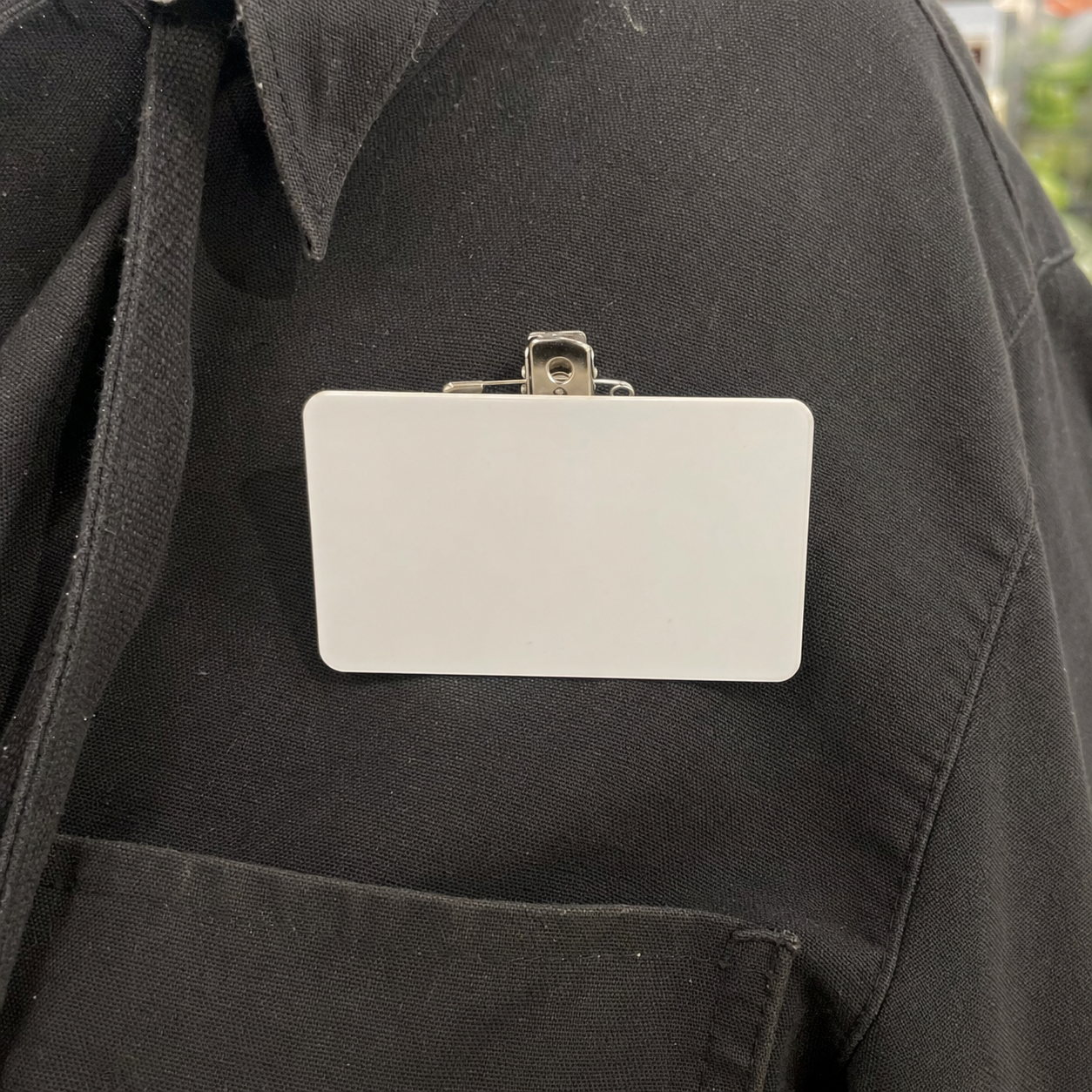
There is a small rectangle of fake brass that sits on my chest from clock-in to clock-out. It says NICHOLAS. This is correct, in a technical way. It is the name on the driver’s license and the W-2 and the paperwork the manager keeps in the filing cabinet behind the breakroom door. It is the name my mother gave me. It is not, in any other meaningful sense, my name.
My name is Greygray. Has been for years. It is what I sign on the things I make, what the people who actually know me say when they say me. It is the name on the books I have published and the name at the bottom of every essay I have ever written that was honest. It is the name on the website where this very sentence lives. NICHOLAS is what you call me if you are reading me off a payroll. GREYGRAY is what you call me if you are reading me at all.
I asked, politely, if I could have a name tag that said GREYGRAY on it.
I was told no.
The reason they gave
The reason was something about consistency. About professionalism. About the customer experience, which was the phrase used by someone who has never in their life had to face the customer experience from this side of the counter. The name tag, I was told, has to match the name on file. The name on file is what the company knows you as. The company knows me as NICHOLAS. Therefore the tag says NICHOLAS. Therefore the small rectangle of fake brass is, in some quiet bureaucratic sense, the company’s piece of property pinned to my body, naming me whatever it needs to name me to keep its filing system tidy.
I understood the policy. I did not argue with the policy. There is no winning by arguing with a policy whose entire purpose is to be unarguable. The policy is the wall. You do not get to talk to the wall. You just get to decide what you are going to do about the wall.
What the tag is for
A name tag is supposed to do two jobs, and only one of them is honest.
The honest job is so the customer can ask for you by name. So the old woman with the wrong onion can come back and say, the guy named such-and-such helped me yesterday and was nice, can you find him. So the kid who lost his mom in aisle six can say there was a guy with a name tag. The name tag, in this sense, is a small social courtesy. A way of saying I am willing to be known by you for the next eight hours. Here is what to call me.
The other job, the dishonest one, is to remind you that you are a unit in a system. The tag is the same color, same shape, same font, same plastic pin assembly as every other tag in every other store in every other strip mall in the country. The tag is corporate’s way of saying we recognize you the way we recognize inventory. You are the labeled item. The tag is not for you. It is for them, naming you in the way that is convenient for their paperwork.
And when I asked to put GREYGRAY on it, and the answer was no, what I was actually being told was: we will name you, and you will wear our name for us. Your real name is not relevant to the operation.
What I am going to do about it
I am going to wear a second tag.
Not over the first one. Not instead of the first one. Underneath it. A small one. A homemade one. A piece of folded cardstock with GREYGRAY written on it in my own handwriting, slipped behind the brass NICHOLAS so it sits between the official name and my actual chest. They will see NICHOLAS. The world that pays me will see NICHOLAS. The system that needs to file me will see NICHOLAS. And underneath the rectangle of fake brass, against the cotton of the hoodie, the real name will be there, in pencil, where only I know it is.
This is small. I know it is small. It is, in the literal sense of the word, a pocket-sized rebellion. It changes nothing the company can see. It will not increase my pay or shorten my shift or convince a single manager that I am anything other than what the file says I am. The customers will still call me Nicholas. The schedule will still call me Nicholas. The W-2 in February will still call me Nicholas.
And that is exactly why it works.
What the smuggle is for
The smuggle is for me.
The smuggle is the small daily reminder, at the exact place on my body where they have pinned their version of me, that there is another version underneath. That I have not, in fact, been replaced by the labeled item. That the part of me that writes the books and posts the field notes and signs the bottom of the things that matter is still here, just out of view, exactly where it always was. Quietly. Where they cannot get to it.
This is what the working class does, generally, when the working class is paying attention. We do the small smuggles. The lunch box that has the book in it. The phone in the apron pocket with the half-written paragraph on the notes app. The bumper sticker on the car in the lot. The tattoo behind the ear, where the polo shirt almost covers it. The earring you take out at the start of shift and put back in before you have even crossed the parking lot. The small, daily, unwitnessed acts that say: there is more of me than this, and you do not get all of it.
You are not paid enough to get all of me. Nobody is paid enough for that. The paycheck buys the labor. It does not buy the name. It does not buy the underneath.
What the old books say
I keep thinking about the desert fathers. The men and women who walked out into the wilderness in the third and fourth centuries and gave themselves new names because the old names had a city attached to them, a station, a tax bracket, a story other people kept telling about who they were. They went out into the dust and renamed themselves and lived under the new names. Antony. Pachomius. Macarius. Mary of Egypt. The new name was the marker that said: the person you knew is no longer available at this address.
I am not a desert father. I work at a grocery store. I do not have the option of walking out into the wilderness, because the wilderness is also paying rent. But the principle is portable. The principle is that the name a system gives you is the name of who that system needs you to be. The name you give yourself is the name of who you actually are. And in the gap between those two names is the entire question of whether you are still in there.
For eight hours a day I am NICHOLAS. NICHOLAS is real. NICHOLAS has a register and a code and a pay stub. I am not pretending NICHOLAS does not exist.
For the other sixteen, and underneath the brass, I am Greygray.
The paycheck buys the labor. It does not buy the name. It does not buy the underneath.
If they ever catch me with the second tag, I will take it out and shrug and put it in my pocket and keep working. They are not going to fire me over a piece of cardstock. They might write me up. The write-up will sit in the file next to the name they put on the brass.
And under the polo shirt, against the chest, the real name will still be there. In pencil. Where it has been the whole time.