Did you know I’m a wizard? No? Me neither. At least not until I learned a little more about how language works, and I don’t mean wand language, or fantasy language, or the kind where I whisper Latin at a candle and suddenly my bank account stops looking like a police report. I mean regular language. Human language. The kind we use to complain at work, bless our children, insult traffic, pray into the ceiling, write books we are afraid to finish, and ask another human being if the salmon is local.
Words are little mouth-spells, tiny arrangements of sound and meaning that crawl out of the invisible world, put on clothes, and start moving things around in the visible one. A word names the fog. A sentence gives the fog a shape. A paragraph gives the shape a spine. Enough paragraphs, arranged with enough attention, become a body, and that body can become a book, and that book can become a signal, and that signal can reach another human being at the exact moment they need it.
That is the spell.
The strange part is, you are doing it too. You are a wizard too, even if you do not call it that because you have bills, back pain, text messages to answer, weird family history, and at least one drawer in your house that looks like a raccoon packed it during a divorce. You are doing magic all the time because every time you name something, you change your relationship to it. Every time you say, “I can’t,” you build a fence. Every time you say, “I’m trying,” you leave a door cracked. Every time you say, “This matters,” you place a candle in front of the thing the world told you to ignore.
Language points the nervous system. Language chooses the altar. Language tells the body where to aim. A sentence can shame a child for thirty years, and a sentence can forgive a man before he knows how to forgive himself. A sentence can end a relationship, start a war, save a life, open a wound, close a wound, sell a lie, tell the truth, bless the dead, or drag a half-finished book across the floor until one day the fucker stands up.
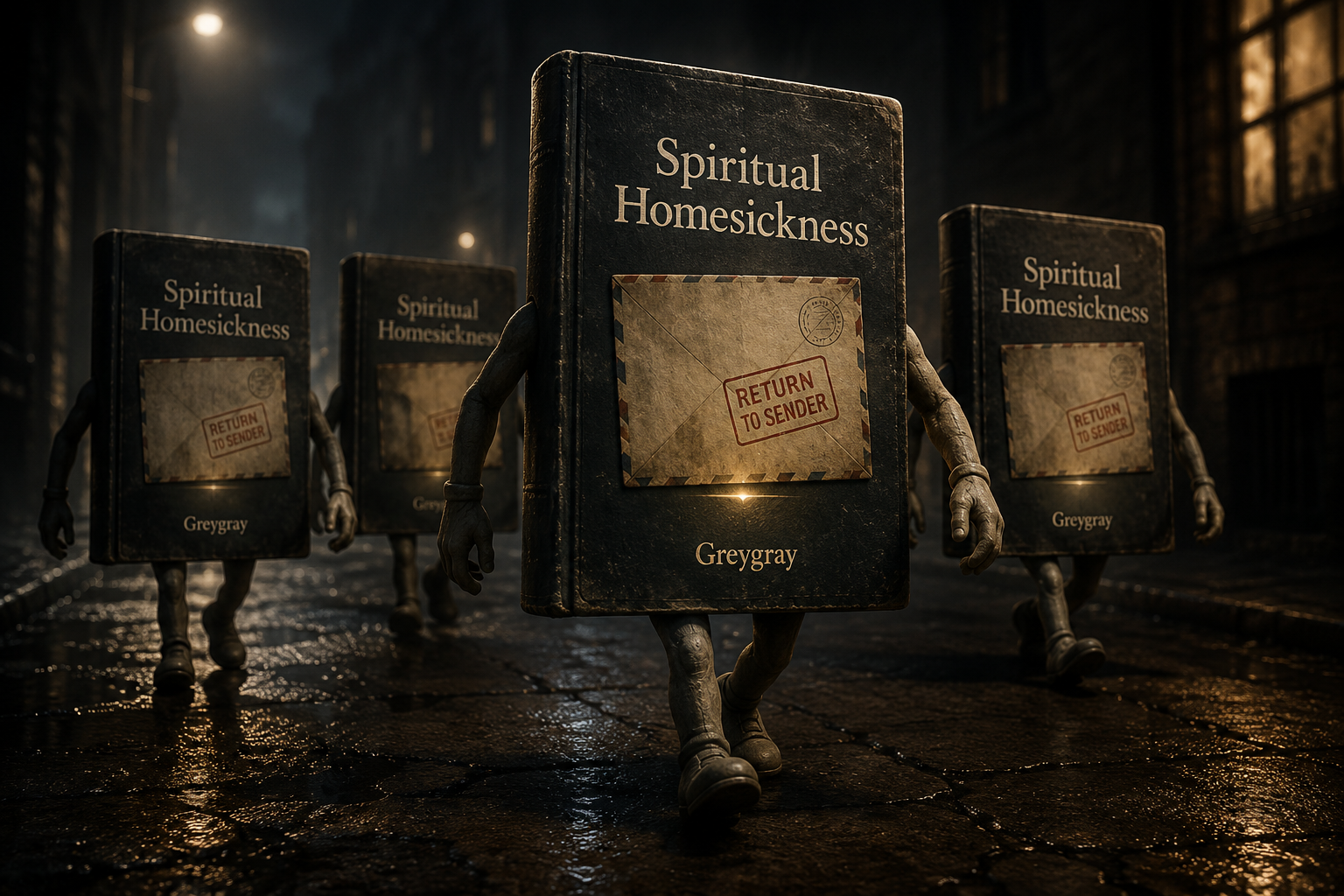
That is where I am right now. I am watching something stand up. The book is standing up because I kept speaking it into shape, and that, to me, is what completion actually is. Completion is language becoming matter. Completion is the invisible getting heavy enough to cast a shadow. Completion is the moment an idea stops haunting you from the corner of the room and starts having weight, edges, pages, a cover, a spine, a body. It is not the disappearance of struggle. It is struggle becoming structure.
That is what this book feels like. It has dirt in its mouth. It has work shifts in it. It has bad sleep in it. It has recovery in it. It has faith in it. It has formatting hell, citation goblins, spiritual ache, ordinary exhaustion, and the private little collapses nobody sees because the world keeps expecting you to clock in anyway. It has the seafood counter in it. It has the fluorescent lights. It has my sore feet. It has customers asking questions that sound like riddles from a rich swamp oracle, like, “Is this local?” or “What do you have that’s wild caught, not previously frozen, tastes rich, doesn’t overcook, and is shaped like a pentagram?” I am exaggerating, but only barely.
The sacred thing formed in the middle of the life I actually have. That matters to me. The book did not wait for silence, serenity, financial ease, perfect health, perfect confidence, or some clean artistic chamber where every thought arrives wearing linen and smelling faintly of expensive coffee. The book formed before work, after work, during crashes, between errands, inside anxiety, around exhaustion, under the dumb little pressure system of deadlines and bills and “I swear I just had that thought a second ago, where the hell did it go?” The spell happened while ordinary life kept making noise.
That is usually how sacred things happen. They do not always arrive as lightning. Sometimes they arrive as a sentence before work, a revision after work, a note in the middle of the day, a thought caught before it disappears, a paragraph moved, a source checked, a chapter fixed, a title found, a metaphor sharpened, a mess returned to again and again until the mess starts revealing the shape hidden inside it. Return is stronger than mood. Return is stronger than doubt. Return is stronger than the little prosecutor in the skull who keeps trying to turn every unfinished thing into evidence that you are defective.
The book stands up because I kept returning to it when it was still crawling.
There is a kind of faith that feels like stubbornness while you are doing it. It feels like opening the document again. It feels like fixing one paragraph. It feels like checking one source. It feels like cutting a section you wanted to keep because the sentence was pretty, but the chapter needed mercy. It feels like looking at the same page for the ninth time and realizing the work is still asking for honesty. It feels like continuing after the part of you that wanted applause has gone home, taken off its boots, and started eating cereal over the sink.
That is faith with dirty hands. That is spellwork with a time clock. That is the invisible becoming visible one stubborn return at a time, and lately, because apparently my life was not already strange enough, artificial intelligence has made this even clearer to me. A large language model shows you that words have architecture. You give it loose language and it gives you loose fog. You give it context, source files, boundaries, examples, tone, purpose, and voice rules, and the shape changes. The machine reveals the structure already hiding inside language.
Prompts are spells with instructions. Source files are grimoires with folders. Voice rules are salt lines around the circle. The model translates, the human charges, the tool reflects, and the writer decides. That is the order. When I use AI well, I am asking it to help me hear myself more clearly. I am asking it to hold the mirror steady while I choose the words that still have blood in them. The spell is still mine. The responsibility is still mine. The voice is still mine. The mud is still mine.
And the book, somehow, is standing.
For a long time, it was vapor. Then it was notes. Then it was a draft. Then it was a problem. Then it was a bigger problem. Then it was a manuscript. Then it was a thing I was tired of carrying. Now it is becoming an object, something with edges, something with pages, something that can leave me and go find whoever it is meant to find. That is the holy terror of completion. A finished thing can move without you. It can be judged, misunderstood, ignored, loved, passed over, found late, found at the wrong time, found at the perfect time, or read by someone sitting in a room you will never enter, carrying a wound you will never know by name.
I want it to walk. That sentence feels new in my body, because there were long stretches where I only wanted the book to stop weighing on me. Now I want it to move. I want the spell to leave the circle. I want the book to stop being a private burden and become a public offering. I want the ache to become useful. I want the years of reaching, stumbling, relapsing, recovering, praying, doubting, learning, and dragging myself back toward the light to become something another person can hold when they feel spiritually homeless in their own life.
That is what the book is to me. A spell for the spiritually homesick. A record of the reach. A map drawn by someone who got lost enough to respect the dark, but stubborn enough to keep walking toward God anyway. It is a body made out of language, a bridge made out of nerve endings, a way of saying, “I was here. This hurt. This mattered. Here is the shape I found inside it.”
That is why the words matter. That is why the voice matters. That is why I want the work clear, alive, breathing, and marked by the hand that made it. The handprint is part of the spell. The mud is part of the spell. The profanity is part of the spell. The strange humor is part of the spell. The long sentence that runs a little hot because the thought itself is still glowing is part of the spell. The goal is not to make the work sound untouched by a human being. The goal is to let the human being become legible without becoming less alive.
You have one too, don’t you? Some unfinished thing. A project, an apology, a boundary, a prayer, a body you keep treating like a malfunctioning employee, a life you keep almost living, a sentence you keep swallowing because it would change too much if you said it out loud. I do not know what your thing is, but I know most of us are carrying something that has not stood up yet, and I know naming it changes the room. Naming it tells the body where to look. Returning to it tells the soul it still matters. Speaking it honestly gives it shape. Returning again gives it bones. Returning again gives it breath. Returning again gets one knee underneath it.
Then one day, maybe while you are exhausted, maybe while you are working, maybe while some stranger asks if the fish is local enough to have a voting record, something shifts. The thing moves. The thing coughs. The thing stands. You realize the spell was never about controlling reality from above it. The spell was participating in reality with enough attention that the invisible could become visible through you.
I thought I was writing a book. Then I thought I was fighting a book. Then I thought I was being punished by a book. Then I thought I was finishing a book. Now I think I was casting a long, messy, blue-collar spell through every sentence I refused to abandon. I kept saying the words until they made a spine. I kept returning until return became structure. I kept dragging the invisible into the visible one sentence at a time.
And now the fucker stands.
From The Grey Zone
The Grey Zone is the space between certainty and mystery, body and spirit, work and wonder, exhaustion and the quieter wisdom underneath it. For more of the work, reflection, and little lanterns for the walk, visit:
The Grey Zone: https://thegreyzone.xyz
Tip the Kitchen
This free piece is made with one tired mystic, a robot, and caffeine. If it fed something in you, you can help keep the Soup warm here:
Tip the Kitchen on Ko-fi: https://ko-fi.com/mastergreygray
Take what's useful. Leave what isn't.