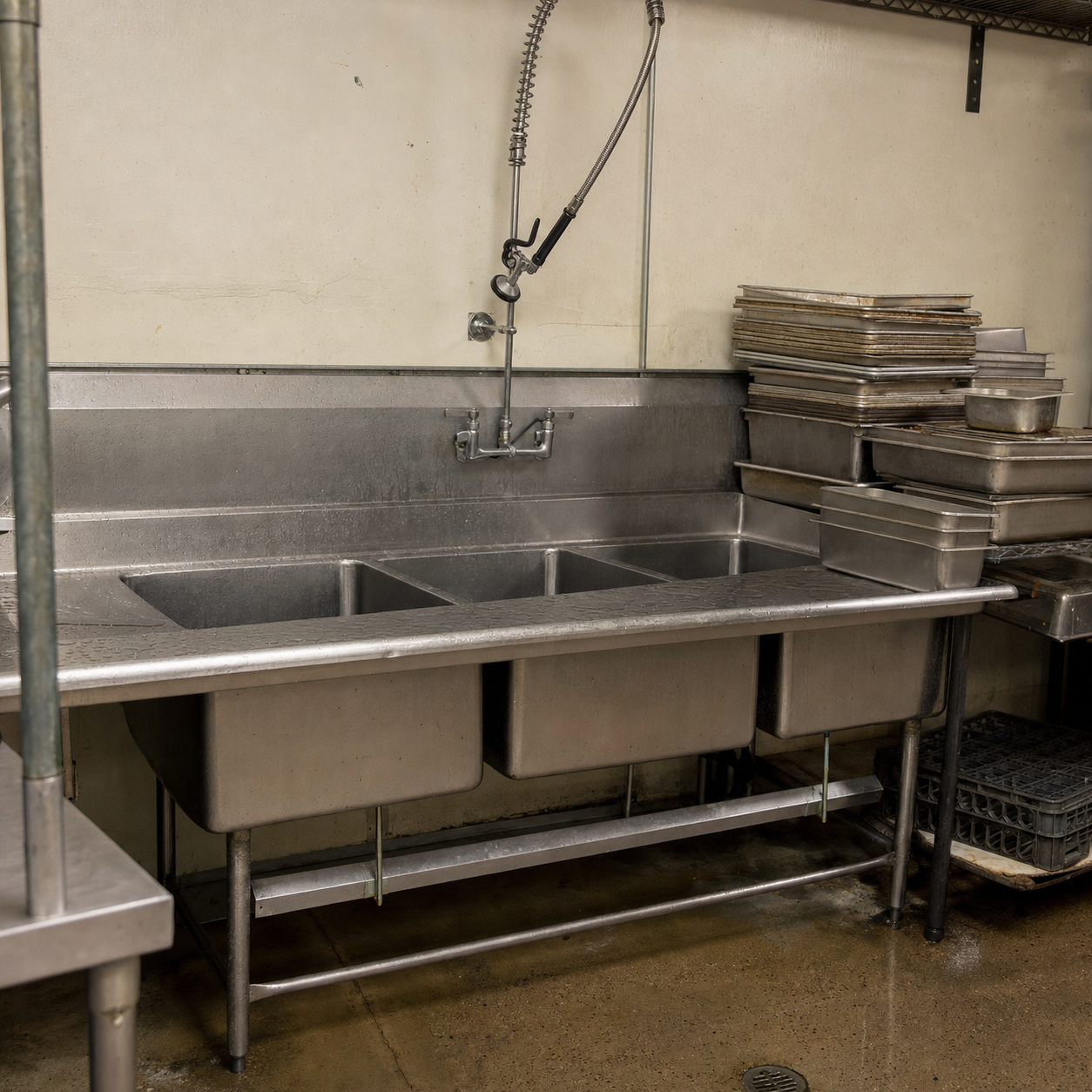
At Partially Eaten Foods the deli has a three-bay sink in the back corner that everyone just calls the pit.
You can stand at the pit for six hours and not finish the pit. That is not an exaggeration. It is the operating principle of the thing. You wash a sheet pan, you turn around, somebody has set down four more. You crank the sprayer at a hotel pan crusted with whatever the morning shift made, you scrape it, you soak it, you scrub it, you stack it on the drying rack, and while you are stacking, the line cook walks past and drops a mixing bowl into the wash bay with a sound like a small bell. You hear that sound maybe forty times a shift. After a while you stop turning around to look. You just know.
I worked the pit when I was nineteen. I have worked some version of the pit at every job since. Different sinks, different sprayers, same physics. The stack is always taller than you think it is. The bottom of the basin is always a little farther down than your gloves are long. There is always something stuck to the rim of something else that should not be stuck to anything.
And there is a thing that happens, sometime around hour four, that I have been trying to write down for a long time.
What they mean by pit
They call it a pit for a reason. Not just because the basin is sunk lower than the prep tables. They call it a pit because it does not have a bottom in the way other tasks have a bottom. You face a shelf, the shelf is faced. You stock a cooler, the cooler is stocked. You do the pit, and the pit is not done. The pit is never done. The pit is the work that consents to being interrupted by more of itself.
Most jobs at the store have a finish line. The truck gets unloaded. The deli case gets filled. The bread aisle gets faced. There is a moment, however small, where you stand back and the task is over. You wipe your hands on the apron. You walk away. The pit does not give you that moment. If you walk away from the pit, you are walking away from work that is still there, work that will be there at the start of the next shift, work that will outlast you at this job and at the next one.
This is why people hate the pit. It denies them the small ceremony of being done.
What hour four tells you
The first hour you fight it. You think, if I move faster, the stack will come down. The stack does not come down. The stack is a function of the kitchen, not a function of your speed. The line is producing dishes at roughly the rate you can wash them. Sometimes a little faster. Sometimes a little slower. The arithmetic is not in your favor and was never going to be.
The second hour you get angry. You get angry at the line cook who keeps stacking pans without scraping them. You get angry at the bus tubs that come in with silverware buried in lettuce. You get angry at whoever designed the sprayer hose to be exactly three inches shorter than the far edge of the third basin. You get angry at the manager who scheduled one person on the pit during a Saturday rush. The anger is correct. The anger does not wash the pans.
The third hour you go quiet. The radio over the prep table is playing the same six songs it always plays. Your apron is wet through. Your back has decided what it has decided. You stop counting pans. You stop looking at the stack. You just take the next one off the top.
The fourth hour is the one I keep trying to describe.
In the fourth hour the pit stops being a problem to solve and starts being a place you are in. The dish in your hands is the dish in your hands. The water is the temperature it is. The next one will come when it comes. You are not trying to get to the end of the stack because you have understood, somewhere lower than thought, that there is no end of the stack. There is only this dish. And then this one. And then this one.
I am not going to tell you this is enlightenment. It is not. It is the cessation of a particular kind of suffering, which is the suffering of believing the pit should be finishable. Once you let go of finishable, the pit becomes work. Just work. Hard, repetitive, slightly absurd, and bearable. More than bearable. Some days, quietly good.
What the books call it
The old contemplative traditions have a word for this and they keep almost saying it without saying it. The Benedictines have ora et labora, prayer and work, with the strong implication that the labor is not separate from the prayer. The Zen kitchen manuals are full of instructions for washing rice with attention. Brother Lawrence, again, in the abbey kitchen, says outright that he found God among the pots more reliably than he ever found God on his knees in the chapel.
None of those guys were at a three-bay sink at Partially Eaten Foods on a Saturday. But they were at the medieval equivalent. They were at the work that does not end. And they all arrived at the same heretical-sounding conclusion, which is that the unfinishable work is a better teacher than the finishable kind, because the unfinishable work strips out the part of you that wants the gold star at the end. The unfinishable work just keeps asking, are you still here. Are you still here. Are you still here.
The pit asks that question with every pan.
What it is not
I am not saying the pit is good. I am not saying you should be grateful for the pit. The pit is a wage labor situation in a low-margin grocery deli and the wage is not commensurate with what the pit takes out of you. The pit will hurt your back if you do it long enough. The pit will give you the kind of dishpan hands that crack and bleed in the winter. If your shift lead is the kind of person who schedules you on the pit alone during a rush, that shift lead is wrong, and you are allowed to say so.
What I am saying is narrower. I am saying that the pit, which I did not choose and which I do not recommend, taught me something I have not learned anywhere else. It taught me that some of the most important work in a life is not work that finishes. The list of dishes is the same shape as the list of things that need attention at home, the list of conversations you owe people you love, the list of small attentions a body requires to keep going. None of those lists empty. None of them were supposed to empty.
The retreat will sell you the idea of finishing. The pit knows better.
What I do with that
Mostly I just try to remember it. When I am at home and the laundry basket is full again and the dishes are in the sink again and I have written a thousand words today and I am still behind on what I owe, I try to remember that I have stood in front of a stack that does not come down before. I have stood there for six hours. I am still here. The fact that the stack is still there is not a referendum on whether I am doing the work. It is just the shape of the work.
The pit was honest about it. Most things are not. Most things pretend they will end if you just push a little harder, and most things are lying. The pit was never lying. The pit was the most honest job I ever had.
The pit is the work that consents to being interrupted by more of itself. Once you let go of finishable, the pit becomes work. Just work.
Somewhere in there is the thing the old books were trying to say. Not loudly. Not as a revelation. Just as a fact about how a life is shaped. Some work finishes. Some work doesn’t. The work that doesn’t is not lesser. Sometimes, on a quiet hour-four kind of evening, it is the work you remember.