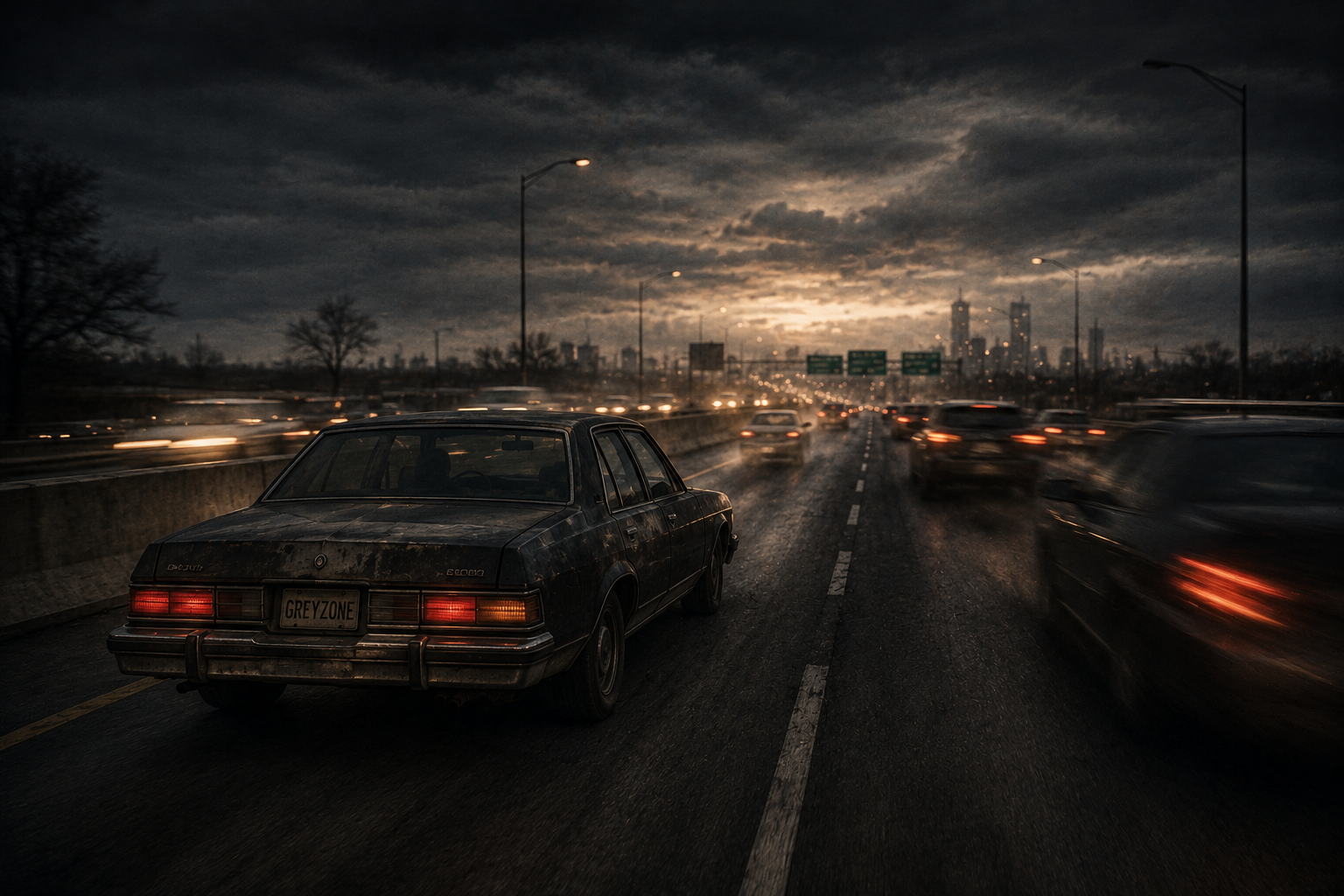
The brake is not the worst part. The invoice is.
By the time you read this, something has probably shifted. I am writing from the middle of the week that made this clear to me, the week that showed me the compression cycle again, start to finish. The cited draft of Spiritual Homesickness may be done by Sunday, or close enough that it is visible from here. I may be into the final draft. Two chapters left after this one, then the bibliography, then the version that leaves my hands and goes out into the world. That is the picture on the good days, when the hill is going downhill, and the momentum is real, and I am just barely smart enough to notice before I let myself believe.
This week has had both kinds of days.
I was trying to finish the cited draft before the library books came due and could not be renewed. That is not a metaphor for something else. That is the actual thing: the actual book, the actual citations, the actual window. I am on Chapter 10, deep enough in to feel the weight of everything that came before, close enough to the end to feel the pull of what comes after. And I had been pulling the citations, actually pulling them, not thinking about them or making a plan to pull them, but doing the work. The chapter was starting to show its shape. The argument was making sense. The momentum was real, and I know the difference between real momentum and the performance of momentum, and this was real.
It took a while to get there. The ramp-up was not exciting. There were days in the last few weeks when I sat at the desk, and the desk was just a desk, and the project was just a file I owed. And then something shifted. The sentences started arriving in the right order. The citations started connecting to each other. The chapter started talking back. I started seeing far enough ahead to know what the next thing needed to be, and that is rare enough that I stopped to notice it.
And then I let myself believe I would finish this.
Not just the citations. The bigger thing. That I could carry something to completion without the floor dropping out halfway through. That I could be the version of myself who keeps going long enough for going to mean something. That is the bet I placed, not out loud, just in the quiet way where you start making plans you actually intend to keep, where you let yourself believe the desk is on your side for once.
That was the bet I placed. I hate that I can see it so clearly now.
Then the switch went off.
Not gradually. Not with a warning.
The parking brake got pulled while I was doing 70 on the highway.
Here is what that actually feels like: the thought I was holding evaporates before I finish it. The sentence I was building goes somewhere I cannot follow. My hands were on the keyboard and I knew the keyboard was not the problem, but I sat there for a second looking at it anyway because at least it was a thing I could see. The printer would not print. The Perplexity credits were basically gone until payday. The chapter I was waiting on was processing in another chat and had been for longer than I expected. Everything in the house had joined a tiny union against me, and I did not get a vote.
Here is the part nobody tells you about the timing: when nothing is moving, the brake costs less. You are already stopped. You are already in the ditch, and you know it, and the ditch is at least a known location. But Chapter 10 was moving. The whole book was moving. I was close enough to the end to feel it, which meant I had something real to lose, and the brake had real ammunition for the first time in a while. It knows. I do not know how it knows, but it does.
I know that if I said any of this to the wrong person, they would tell me to drink some water or take a walk. So I did not say it. I sat with the fact that today was supposed to be a real day. The citations were not finished. I was still pointing at the road.
But I was not going 70 anymore.
That is the part that makes me furious. Not the slowing. I could almost survive the slowing. The part that makes me furious is that it does not ask permission. It does not show up during a dead week when nothing is due, and nothing is moving anyway. It shows up when the citations are half done, and the chapter is within reach. It shows up right when I finally let myself believe.
The cost is not the slowdown. That is the part that keeps getting lost. The cost is what builds up during the slowdown. The work that sits. The window that cools. The opportunity that stopped waiting while I was fighting the brake.
The citations were not done. I could not renew the books. The printer was still not printing. The website had a thing that needed fixing. The post that should have gone out did not. The Soup is coming, which means the announcement of the signed book winners is coming, which means there are people waiting downstream of my current functional capacity who do not know they are waiting and would not be reassured to find out why. The inbox had messages in it that I had read enough times to memorize, but had not answered because answering would take a kind of functional capacity that was currently somewhere I could not reach.
The deadline keeps walking toward me like it has a clipboard and no mercy.
That is the invoice. Not a metaphor. The actual list of what sat there while I was fighting the brake. And the hard part, the part that makes the compression genuinely costly rather than just uncomfortable, is that the list does not care why it got long. The books did not care that the brake was real. The chapter did not care. The window that cooled while I was trying to get back to operating temperature did not care. The invoice just keeps printing. I did not get to approve the charges.
And none of that is the worst part.
The worst part is what the mind does when it looks at the invoice.
Here is what the mind does when it is tired and looking at a bill it cannot pay.
It starts sorting the evidence.
It says: See? You are behind. See? You cannot hold momentum. See? You had it. You could feel it. And then you did this again. See? This is why things do not work.
I know this machine. I have worked alongside it for a long time and I know its habits. It is fast. It does not wait for all the evidence to come in before it starts filing reports. It takes the invoice and converts it into a verdict, and the verdict is not about this week. The verdict is not "the brake hit at a bad time." It is something older. Something that has been waiting for exactly this kind of afternoon to confirm what it already believed about the whole project, about the pattern, about whether the momentum was ever real or just a good run before the next stop.
Here is something I have noticed about the machine: the closer you are to something real, the louder it gets. When the dream is distant and vague, the machine is almost quiet. It sorts in the background, muttering. But get on Chapter 10 with two chapters left, with publication a week out and not a wish, with something almost done that you have been building for a long time, and the machine starts working overtime. Because now it has something real to threaten. The further you get, the more you have to lose, and the shame machine is a precise inventory of everything you have to lose, presenting it to you at the worst possible moment with remarkable accuracy.
The consequences are real. I am not trying to talk myself out of the facts. The citations were actually not done. The post actually did not go out. The facts are the facts.
But the mind turns consequences into evidence, and that is where the machine starts lying.
Evidence means something. Evidence points to a cause. Evidence builds a case. And the case the shame machine is building is not about one compression period with bad timing. It is about whether I am the kind of person who finishes things, whether the dream has real weight or just a mood behind it, whether the whole thing is true or just a story I tell myself between stops.
That is not what the consequences say. That is what the machine says.
Tired and scared are not the same as wrong. Behind is not the same as finished. The invoice is not a verdict. The brake is not a character reference.
The machine does not care about the distinction. It just keeps sorting.
Not for anyone else. Just to get it clear, because I have spent enough time calling this something it is not.
Compression is not laziness. When I am actually avoiding something, it feels different inside. There is usually a choice in it, or at least the shape of a choice. I look at the work, I decide I would rather not, I do something else instead, and then I can usually tell myself the truth if I am willing to stop performing innocence in my own courtroom. I am not claiming I have never done that. I have. What I am describing here is different. Compression can look like laziness from the outside because the output is similar: not much happening, nothing getting done, the desk gathering evidence against you. But the inside is nothing like that. The inside is someone sitting in a car that will not move while the traffic keeps going. Nobody looks at a stalled car and says the driver is lazy. They say the car has a problem.
Compression is also not an excuse to let everything burn. I want to name that directly because there is a version of this kind of writing that slides into permission-giving, a gentle voice saying: rest; you do not owe the world your productivity; be soft with yourself; cancel your plans. Some of that is true. Some of it is dangerous. The line between them is not always easy to see from inside a compression period, but here is how I tell them apart: letting the invoice get longer does not help. One small repair does. The goal is not to declare a personal emergency and wait it out. The goal is to find the one thing that keeps the next layer of damage from landing.
Compression is also not destiny. The pattern is real, but it's workable. I have been here before and gotten through before, and the chapter has moved before, and it will move again. This is not a story about someone who is always going to slow down at the worst moment. It is a story about a pattern with a shape, which means it can be named and worked with instead of just surviving.
And compression is not something to romanticize. I am not going to tell you it is beautiful. I am not going to say the pause is sacred or that the body was sending a message you needed to hear, or that the interruption was the real work all along. Sometimes the timing is just bad and the cost is real and none of it is beautiful and pretending it is does not make the invoice shorter. The beauty model of compression is a luxury belief. You can hold it when the invoice is manageable. When the window is cooling and the books cannot be renewed and the chapter is half-done, what you need is not a reframe. You need a strategy.
Here is the strategy: one small thing at a time. Not full function. Not a comeback. The brake does not respond to force and it never has. Force on compression is like putting more gas into a seized engine. You are not fixing the problem. You are burning fuel you will need later. The brake responds to one honest act pointed at the invoice. Then another. Then another, until the road opens again and you are not sure exactly when it happened but you are moving.
That is not a comfort. It is a fact about the terrain. The sooner I can hold it as a fact instead of a personal failure, the faster the invoice starts to get shorter.
The goal when the brake hits is not to become fully functional again. That is the wrong target. Pushing for full function when you are compressed is how you burn through what little capacity you have left and end up with a longer invoice than when you started. I know this. I aim for full function every single time anyway, and every time I end up staring at the keyboard spending fuel I needed for the actual repair.
The goal is to reduce the next layer of damage.
One message answered. One citation pulled. One paragraph that moves the chapter forward one inch. One glass of water. One honest reset that says: I am still here, the work is still here, the dream has not changed just because today has been this kind of day.
Just one thing I can actually do right now.
Here is what it looked like this week. I sat back down at the desk. Not after the brake released. Before that. While it was still on. I opened the citation I had been staring at for two days, the one that needed a page number from a book the library was about to reclaim, and I went and found the page number. That was the thing. That was the repair. Not the chapter, not the post, not the website fix or the inbox or the Soup announcement. One page number that had been holding one citation that had been holding one paragraph that had been holding the momentum of the whole chapter.
The chapter moved.
Not because I became fully functional. Not because the printer started printing, or the credits came back, or the tiny union dissolved in the face of my determination. Because one thing got done, and then one more thing was possible, and the invoice got a line shorter.
I am slowed, not gone.
The citations got done. Not all at once, not on schedule, not the way I wanted them done. One at a time, on the days the car would move. The machine kept sorting and I let it sort and I went back to the desk anyway. By the time you read this, I may be deep in the final draft. The Soup is coming. The book announcement is coming. Two more chapters, then the bibliography, then whatever comes after.
The parking brake got pulled. The cost was real. The shame got some of the facts right and lied about what they meant.
I do not have to like this to survive it.
From The Grey Zone
The Grey Zone is the space between certainty and mystery, body and spirit, work and wonder, exhaustion and the quieter wisdom underneath it. For more of the work, reflection, and little lanterns for the walk, visit:
The Grey Zone: https://thegreyzone.xyz
Tip the Kitchen
This free piece is made with one tired mystic, a robot, and caffeine. If it fed something in you, you can help keep the Soup warm here:
Tip the Kitchen on Ko-fi: https://ko-fi.com/mastergreygray
Take what's useful. Leave what isn't.