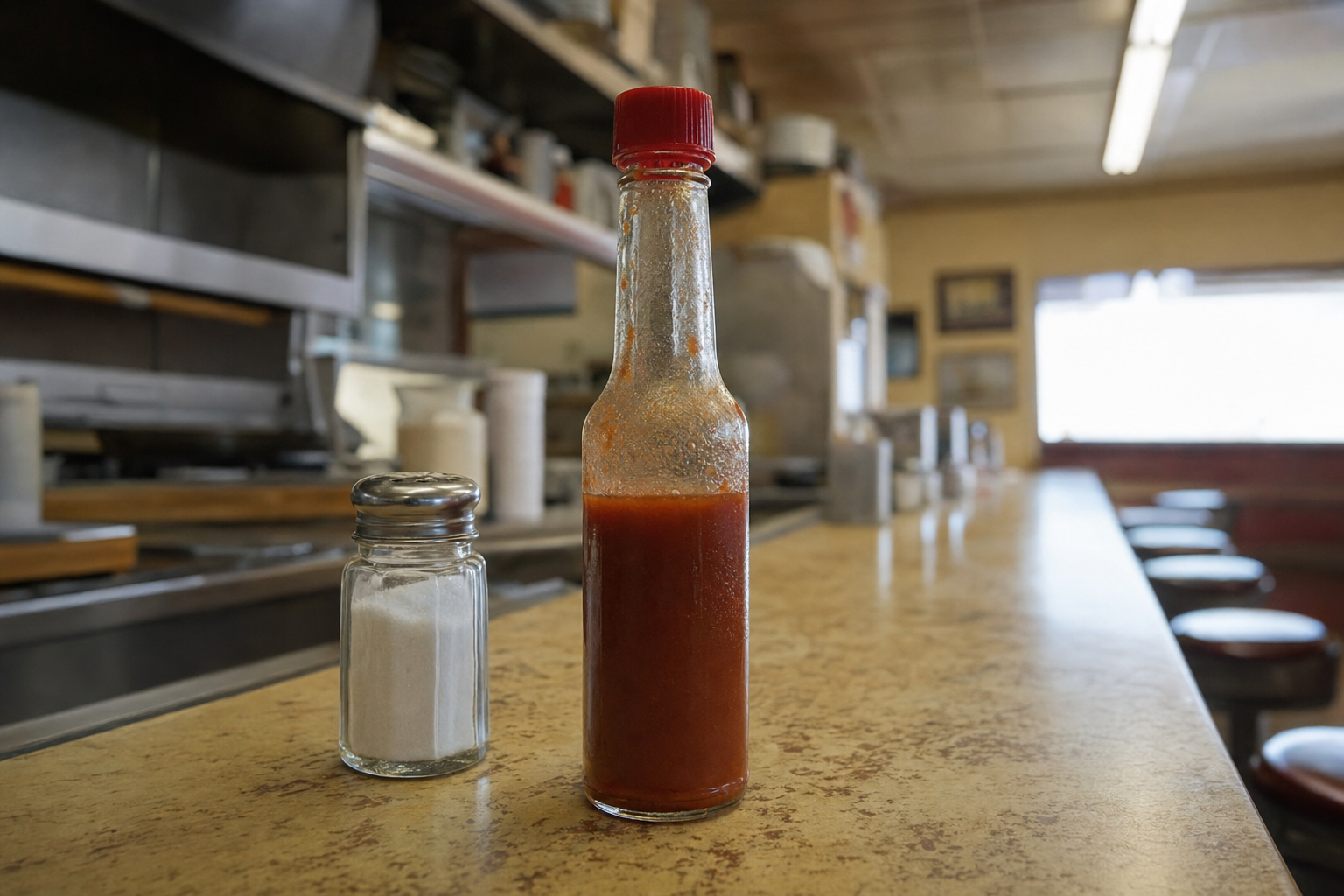
Autocorrect has been trying to ruin my life for years, but the other day it accidentally helped me write a field note. I was joking around and trying to say something close to, “If I say so myself,” which is already a funny little phrase because it is basically a person applauding their own joke while pretending to be humble about it. Somewhere between my fingers, the keyboard, and the tiny machine goblin living inside my phone, it came out as “sorry myself.” Then that became “sorry sauce.” Then, because language is apparently a drunk animal with thumbs, “sorry sauce” turned into “So So Sauce.” And the thing is, I laughed at it because it was stupid. Obviously. It is stupid in exactly the right way. It sounds like something you would find in the refrigerator door of a gas station that sells crystals, beef jerky, and suspiciously confident hot dogs. But then the phrase stayed with me longer than the joke did. That is usually where I start paying attention. A joke comes and goes. A mistake comes and goes. Most words fall out of the mouth and disappear into the air where they belong. But every once in a while something dumb gets caught in the machinery of the soul, and suddenly you are standing there with a phrase that did not exist five minutes ago, wondering why it feels like it brought a little flashlight.
What interested me was not just that autocorrect messed up, because autocorrect always messes up. That is its sacred vocation. Autocorrect takes a normal sentence, drags it behind a truck, hands it back to you wearing a fake mustache, and then acts like it helped. What interested me was how fast the mistake became meaningful. Five minutes before “So So Sauce” happened, it meant nothing. Not one thing. There was no history behind it, no definition, no dictionary entry, no spiritual lineage of ancient So So Sauce masters sitting cross-legged in caves teaching the middle path through condiment metaphysics. It was just noise. A strange little pile of letters. But once it appeared in the conversation, once it landed in the room and made me laugh, it started becoming something. It had a mood. It had a texture. It had a use. It described something I recognized before I had words for it. Not terrible. Not great. Not enlightened. Not destroyed. Not saved. Not damned. Just there. Just in the middle. Just life with a little extra sauce on it. That is what shook something loose in me, because I realized that this is not some weird exception to language. This is language. A sound becomes a symbol. A symbol gets shared. The shared symbol starts carrying meaning. Then we forget it was ever made up in the first place.
That is the part I keep coming back to. Language is so close to us that we forget how strange it is. We are born into it like fish born into water, and by the time we are old enough to question it, the words have already started building the walls of the world around us. The word “tree” is not a tree. The word “water” is not water. The word “love” is not love. The word “God” is not God. These are symbols pointing toward things that existed before we named them, and yet once the name arrives, it changes how we relate to the thing. A tree was not waiting around for us to call it a tree. It was being itself long before anyone made a sound at it. Water did not need a label to be wet. Love did not wait for a language to begin breaking people open. And God, if that word is even useful, cannot possibly be contained by the three little letters we keep placing around the mystery like caution tape. The universe did not arrive pre-labeled. Reality did not show up with a filing system. Human beings came into a world already happening, pointed at pieces of it, made sounds, and then began living inside the sounds as if the sounds were the world.
That is not an insult to language. I love language. I have built a ridiculous amount of my life out of words. Words have saved me, harmed me, organized me, confused me, carried me, exposed me, and given me a way to place little lanterns along the path so another person might not feel quite as alone in the dark. Language is magic, but it is made-up magic, which might be the only kind humans can actually hold. It lets one nervous system reach another. It lets a thought leave the sealed room of one skull and arrive, imperfectly but beautifully, inside someone else. That is insane. That is holy. That is also nonsense. Both. Always both. A sentence is just arranged symbols until another mind meets it and creates meaning on the other side. Every conversation is a little séance where the dead thing on the page stands up in the reader. The danger is not that language is symbolic. The danger is that we forget it is symbolic. We start mistaking the symbol for the thing. We start fighting over labels as if the label is reality itself. We worship the map, defend the map, die for the map, shame people with the map, and sometimes never once look up to ask whether the territory has quietly changed under our feet.
This is where autocorrect becomes funnier and darker than it has any right to be. Autocorrect is a machine making guesses about what I meant based on patterns it has seen before. It takes the raw thing I am trying to say and tries to force it into a shape it recognizes. That is useful when it catches a misspelled word. It is less useful when it turns the sentence into a small crime scene. But the more I think about it, the more I suspect human consciousness does something similar all day long. Reality happens, and the mind immediately starts correcting it into something familiar. An emotion arises, and the mind labels it anxiety, anger, love, shame, hunger, boredom, desire, or intuition. A person says something, and the mind autocorrects it into rejection, disrespect, attraction, danger, or proof that we were right about them all along. A moment appears, raw and unprocessed, and before it can even breathe, the mind runs it through the old dictionary. Good. Bad. Safe. Threat. Mine. Not mine. Success. Failure. Sacred. Ordinary. Light. Dark. The world arrives alive, and the mind starts naming it to death.
I do not think naming is wrong. Naming is survival. The animal needs to know the difference between food and poison, friend and predator, storm and shelter. The human being needs categories to function. Without language, everything would blur into one overwhelming field of too much. The problem is not that we divide reality enough to navigate it. The problem is that we start believing our divisions are absolute. We forget they are tools. We forget that a word is a handle, not the whole door. We say “good” and “evil” as if those categories are always clean. We say “success” and “failure” as if life has agreed to be graded by our little scoreboard. We say “light” and “dark” as if the mystery itself has chosen sides in the way our frightened minds prefer. But maybe those words are not the truth itself. Maybe they are directional signs. Maybe they are useful until they become prisons. Maybe they are the beginning of understanding, not the end of it.
I keep thinking about the fruit in Eden. Not in the flat, courtroom version of the story where humans disobeyed, God got mad, and history became a long punishment with weather. I mean the deeper symbolic version. The stranger version. The one where the fruit of the knowledge of good and evil is not just about information, but division. Before the fruit, there is unconscious unity. After the fruit, the world splits. Good and evil. Naked and ashamed. God and human. Self and other. Spirit and body. The first thing that happens after the fruit is not wisdom. It is hiding. It is shame. It is the human being suddenly experiencing itself as something separate from the whole and suspicious to itself. That feels important. The fruit does not merely teach humanity what things are called. It teaches humanity to divide. To judge. To stand apart from reality and say this is good, that is bad, this is me, that is not me, this part is acceptable, that part must be covered with leaves before anyone sees it.
Maybe that is what consciousness does when it first wakes up inside matter. It divides in order to understand, then suffers because it has divided. It creates categories because categories help, then forgets that the categories are not the original wholeness. This is why I keep returning to the idea that light and dark may both be part of the illusion. Not because joy and suffering are the same thing. They are not. Not because cruelty is secretly fine or compassion is just another opinion. That is lazy spirituality, and lazy spirituality is how people put a crystal on a wound instead of cleaning it. I mean something deeper than moral laziness. I mean that the labels “light” and “dark” are still labels. They are still language. They are still human attempts to describe movements inside a mystery that existed before description. The true God, if I can use that word without trapping it, is not merely the light as opposed to the dark. The true God is prior to that division. Pure awareness. Being itself. The silent field in which both light and dark appear, move, dissolve, and get named by creatures trying to understand what they are.
That thought changes something for me. It does not make life less serious. It makes the labels less final. It gives me a little room around the words. If I feel fear, I do not have to immediately become “a fearful person.” If I fail at something, I do not have to become “a failure.” If I feel darkness, I do not have to assume I have been abandoned by the light. Maybe an experience can be real without the label becoming a prison. Maybe a mood can move through without getting promoted to identity. Maybe a hard day can be a hard day without becoming evidence in the case against my entire existence. This is one of the reasons language matters so much. The words we use do not merely report our experience. They shape how we stand inside it. “I am doomed” is not the same nervous system as “I am scared.” “Nothing ever works” is not the same doorway as “this did not work.” “God left me” is not the same thing as “I cannot feel God right now.” One is a sentence that locks the room. The other leaves a window cracked.
That is why I keep saying God’s whisper is usually not literal, although sometimes it can feel very direct. I do not mean that every typo is a prophecy. I do not mean every coincidence is a coded message from heaven, and I do not want to live inside the kind of paranoia that turns every license plate into scripture. That way madness lives, and probably expensive candles. But I also do not want to flatten reality so much that nothing is allowed to speak unless it arrives through a laboratory door wearing a name badge. There is a middle place. A Grey Zone. A way of saying that sometimes something ordinary catches the attention in a way that feels charged, and the charge matters. Maybe the event itself is random. Maybe autocorrect did what autocorrect does because it is a tiny idiot with confidence. But why did the phrase stay? Why did the joke keep ringing after the laughter stopped? Why did a nonsense phrase suddenly open into language, symbols, Eden, duality, God, and the middle condition of being human? The whisper might not be in the mistake itself. The whisper might be in the attention that gathers around it.
That distinction matters to me because it keeps the mystical from becoming ungrounded. A grounded mystic does not have to declare that God personally reached into the phone and typed “So So Sauce” like a divine condiment announcement. That would be hilarious, but I am not building a theology around my keyboard unless things get much worse. A grounded mystic can simply say that life is participatory. Meaning is not always sitting inside the object like a prize in a cereal box. Sometimes meaning happens in the meeting between the object and awareness. A stone is a stone until grief picks it up and it becomes a memorial. A name tag is a name tag until it becomes a question of identity. A dish pit is a dish pit until hour four turns it into a monastery with a sprayer hose. A typo is a typo until it becomes a doorway. The sacred does not always change the object. Sometimes it changes the depth at which the object is seen.
This is also why humor belongs in spiritual life more than people admit. Humor loosens the labels. It pokes holes in the seriousness of the map. A good joke briefly reveals that the structure we were obeying is not as solid as it looked. That is why a typo can be liberating. It breaks the expected sentence. It knocks the word out of its assigned seat. It reminds us that meaning is more flexible than the part of us addicted to certainty wants to believe. “Sorry sauce” is funny because it is wrong, but it becomes interesting because the wrongness makes room. “So So Sauce” is not a real phrase until it is, and once it is, the mind immediately begins making use of it. That is how human beings are. We are meaning-making animals. We will turn a noise into a symbol, a symbol into a story, a story into a practice, and a practice into a life. Sometimes that saves us. Sometimes that traps us. The work is learning which is happening.
So what is So So Sauce, now that it has unfortunately entered the record? I think it is the flavor of the middle before the mind tries to dramatize it. Not misery. Not ecstasy. Not spiritual breakthrough. Not spiritual collapse. Just the ordinary texture of most days. The state between revelation and disaster. The part of life that does not make a clean testimony. You wake up. You do the thing. You feel a little better than yesterday or a little worse than expected. You drink the coffee. You answer the message. You avoid one bad habit and keep one dumb one. You believe in God for half the morning and then forget for three hours because the internet exists. You remember your purpose, lose it, find it again under a pile of laundry, then act like the laundry was hiding it from you personally. Nothing huge happens. Nothing gets solved forever. You are not fixed, but you are not destroyed. You are not glowing, but you are still lit from somewhere. That is So So Sauce.
There is a humility in that, and I probably need more of it. The ego likes extremes because extremes make better stories. I was lost and now I am found. I was broken and now I am healed. I was asleep and now I am awake. I was in darkness and now I am in light. Those stories are not always false, but they are rarely the whole truth. Most of the time we are not fully one thing. We are becoming. We are returning. We are remembering in pieces. We are awake in one room and asleep in another. We are healed in one pattern and still weird as hell in the next. The middle is not glamorous because the middle does not flatter the ego. It does not give us the clean costume of saint or sinner. It says you are human. Keep going. Keep noticing. Keep correcting the correction. Keep loosening the label when the label gets too tight.
Maybe that is the practice underneath all of this. Not to stop using language, because that is impossible and also ridiculous coming from someone currently using a lot of language. The practice is to hold language with more humility. To notice when a word is helping and when it has become a cage. To remember that “I am anxious” might be less true than “anxiety is here.” To remember that “this is darkness” might sometimes mean “this is something I do not understand yet.” To remember that “failure” might mean “not finished,” and “lost” might mean “between maps,” and “ordinary” might mean “too familiar to recognize as sacred.” To remember that even the word God is a candle flame, not the sun. Useful because it points. Dangerous if we confuse the pointing with the whole sky.
Autocorrect got it wrong, and somehow that was the gift. Not because the machine is wise. The machine is not wise. The machine is barely house-trained. But wrongness interrupted the script long enough for meaning to sneak through. That is how a lot of my life has worked, honestly. The thing goes wrong. The plan bends. The sentence breaks. The old label fails. The map does not match the road anymore. At first, I get annoyed because I wanted clean movement. I wanted the words to behave. I wanted reality to stay in the container I had prepared for it. Then, if I am lucky, if I am paying attention, if I am not too busy worshipping my own frustration, something else appears inside the break. Not a solution exactly. A signal. A little gap where the deeper thing can breathe.
That is what I mean by God’s whisper. Not always literal. Not always direct. Not something I can prove or diagram or force into a doctrine. More like the sense that reality is alive enough to respond when attention becomes tender. More like the feeling that beneath the noise, the corrections, the mistakes, the jokes, the symbols, and the labels, something is always trying to be noticed. Not loudly. Not usually. The loud things are often selling something. The whisper waits until the mind gets quiet enough or ridiculous enough to hear it. Sometimes it comes in prayer. Sometimes it comes in grief. Sometimes it comes through a book, a song, a dream, a stranger, a dish pit, a name tag, a body finally demanding rest, or a phrase that should not mean anything until suddenly it does.
So now I have this phrase I did not ask for. So So Sauce. It is dumb. It is useful. It is not a doctrine, which is good because the world does not need another doctrine. It is more like a tiny reminder that not every moment has to be forced into greatness or despair. Some moments are allowed to be what they are before I start correcting them into something else. Some days are allowed to sit in the middle without being accused of wasting my life. Some experiences are allowed to remain unnamed for a while, or named badly, or named with a joke that somehow tells the truth better than the serious word would have. Maybe that is why the phrase stayed. It gave the middle a taste. It gave the Grey Zone a condiment. It gave the ordinary a little ridiculous dignity.
And that is probably enough. I do not need to turn it into more than it is. I do not need to build a temple around the sauce. The whole point is that meaning can be real without becoming a cage. A phrase can matter without needing to become sacred furniture. A typo can be a doorway without becoming a religion. Still, I am paying attention. Because sometimes life whispers through mistakes, and sometimes autocorrect, while absolutely still an asshole, accidentally leaves the door open.
So if today is not holy thunder, and it is not total collapse, and it is not the best day of your life, and it is not the worst one either, maybe do not rush to insult it. Maybe it is just here. Maybe you are just here. Maybe God is here too, underneath the label, before the division, prior to the sentence. A little presence. A little nonsense. A little So So Sauce.
From The Grey Zone
The Grey Zone is the space between certainty and mystery, language and silence, symbol and reality, human confusion and the quiet thing underneath all of it. For more of the work, reflection, and little lanterns for the walk, visit:
The Grey Zone: https://thegreyzone.xyz
Tip the Kitchen
This free piece is made with one tired mystic, a robot, and caffeine. If it fed something in you, you can help keep the Soup warm:
Tip the Kitchen on Ko-fi: https://ko-fi.com/mastergreygray