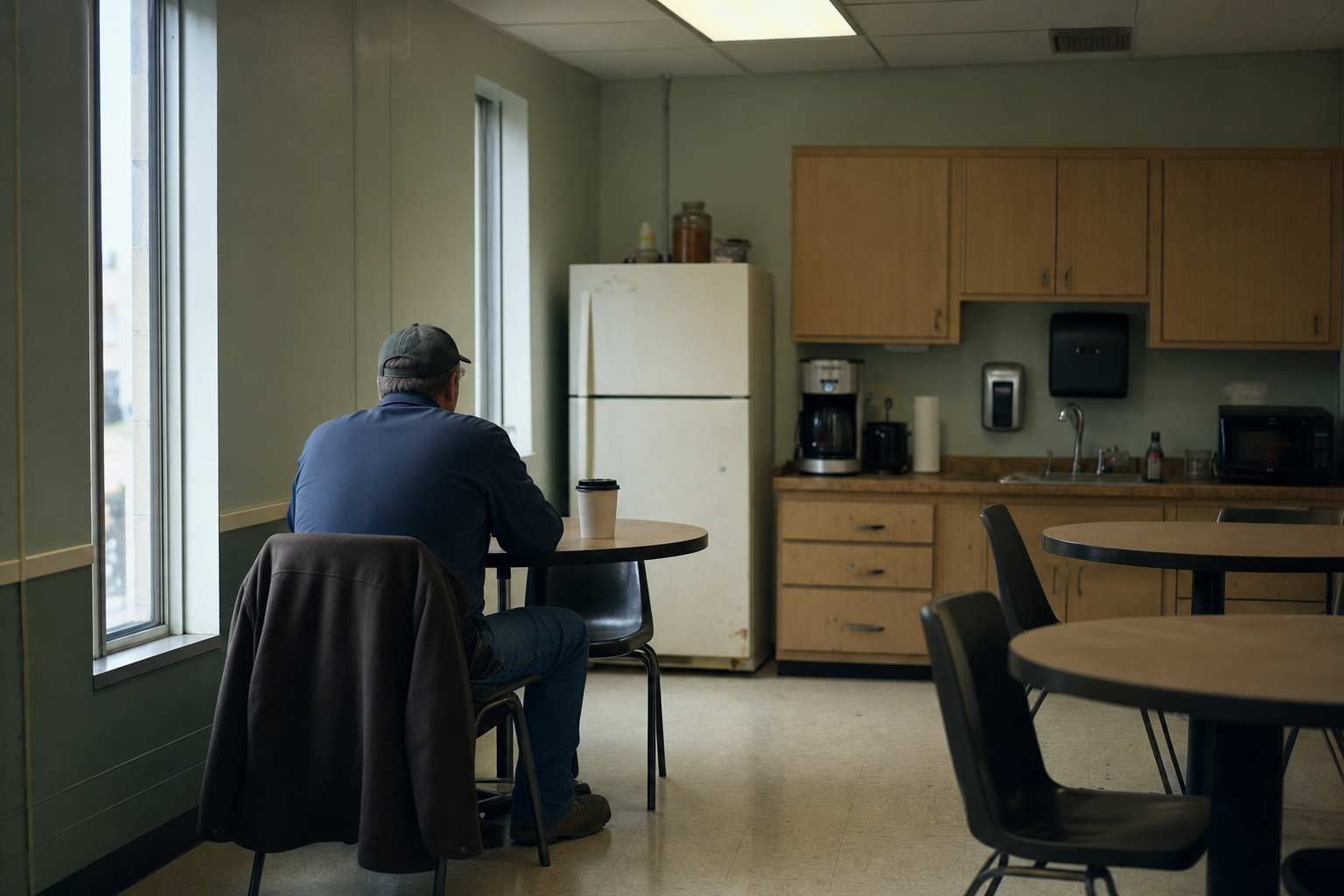
There is a strange embarrassment that comes with getting sick after you have already spent several days trying to convince yourself you are not really sick, not because anyone else is standing over you accusing you of fraud, but because there is already a suspicious little manager in your skull asking the body for documentation. The body is coughing, aching, sleeping wrong, dragging itself through the day with the energy of a wet towel left in a truck bed, and some part of the mind is still sitting behind a desk somewhere saying, “Okay, but are we sure this is real?”
That is the part I keep noticing. Not the symptoms by themselves, but the private trial that starts around them. The internal cross-examination. The weird little courtroom where the body has to prove its suffering before the mind will grant it permission to stop. I do not know exactly when I learned to do that, but I know I have practiced it for a long time. I can be half-sick, half-spinning, sleeping like the dead, waking up confused, typing like my fingers are being operated by raccoons, and still some old part of me will try to frame rest as suspicious, as if fever is a performance, as if exhaustion is trying to get away with something, as if the animal carrying me through this life woke up one morning and decided to become dramatic for attention.
I got sick for real. Not “I am bored and do not feel like doing anything” sick. Not “I need a convenient excuse to avoid responsibility” sick. Actually sick. Body-screaming sick. Brain-buffering-through-a-potato sick. Wake-up-and-not-know-what-day-it-is sick. The kind of sick where the bed stops being furniture and becomes a small medical country you keep returning to without paperwork, and the body stops making polite requests and starts issuing weather warnings. And the annoying thing, the thing I do not want to admit because it sounds like I am trying to turn congestion into a spiritual retreat, is that I think it was good for me.
I hate that sentence a little, because I do not want to romanticize being sick. I am not interested in pretending a virus showed up wearing tiny angel wings with a lesson plan, and I am not trying to spiritually decorate the fact that sometimes the body gets hit with something and it sucks, and that is the whole sermon. Sometimes the most sacred thing available is water, sleep, clean clothes, soup if you can get it, medicine if you need it, and not making the situation worse by demanding that your immune system work around your ambition. But also, this did not feel like it came out of nowhere, because even if the sickness itself arrived through whatever ordinary biological doorway sickness uses, my body had been trying to get my attention long before it got loud enough for me to finally listen.
My body had been talking through soreness. It had been talking through the heaviness behind my eyes, through the strange sleep, through the long sleep, through the wake-up-and-not-know-what-part-of-the-day-you-landed-in sleep. It had been talking through the way motivation started feeling less like fire and more like dragging a wet mattress uphill. It had been talking through the way every normal task started needing a committee meeting inside my nervous system before it could happen. It had been talking through the way my patience thinned out, my typing got worse, my thoughts started tripping over each other, and some important part of me seemed to sit down on the floor before the rest of me was willing to admit we were tired.
The body was not silent. I was busy.
That is the dangerous part, because busyness can look exactly like responsibility from the outside. Nobody questions it much when you are working hard, because work has good camouflage. Keep going. Push through. Be useful. Handle it. Be disciplined. Build the thing. Finish the page. Answer the message. Fix the site. Show up for the job. Keep the dream alive. Keep your nervous system duct-taped to the bumper and call it momentum. From the outside, that can look admirable. From the inside, if you are not careful, it can become a socially acceptable way to ignore the smoke alarm until the building finally becomes interesting.
I do believe in discipline. I want to say that clearly before I start blaming the wrong thing, because discipline has saved me more than once. I believe dreams require work. I believe purpose does not become real because you thought about it in a poetic mood at midnight. I believe in showing up when the mood is not there. I believe in ordinary effort, repeated badly at first, then slightly better, then less dramatically, until something begins to take shape. I believe in the kind of faith that still has to wash a dish, take the trash out, clock in, open the laptop, and do one clean thing in the direction of the life it claims to want. I believe slow work matters. I believe consistency matters. I believe the dream deserves hands, not just longing.
But discipline is supposed to serve the life. It is not supposed to replace the life.
There is a version of discipline that makes a person stronger, steadier, more capable of trusting themselves, and there is another version that teaches the body nobody is coming when it calls. That second version can dress very well. It can sound mature. It can use words like commitment, consistency, sacrifice, work ethic, responsibility, and purpose. It can even sound spiritual if you let it. But underneath the costume, something colder is happening. You are no longer building a life. You are proving you can abandon yourself efficiently, and because the abandonment is productive, you call it virtue.
That is the line I keep finding and stepping over.
Not because I do not care about myself. That explanation is too old and too easy, and it is not fully true anymore. I do care. I have done too much work to pretend I do not. I know how to speak to myself better than I used to. I know when shame is trying to run the meeting. I know the body is not some dumb meat machine that needs to be bullied into obedience. I know rest is not failure. I know the nervous system has its own language. I know the body stores information before the mind can make a sentence out of it. I know all of that, and still, apparently, I am capable of ignoring the obvious until the obvious puts on boots and kicks the door open.
That is the irritating part of growth. Sometimes you know a thing and still have to learn it again through your bones.
This week, my bones had notes.
I have been trying to build while sick, and not just one thing. Build the site. Build the room. Build the Field Notes. Build the newsletter. Build the books. Build the weird little bridge between spirit and machinery that keeps calling me forward even when part of me would like to be normal for one afternoon. I have been trying to carry the dream, the job, the money pressure, the illness, the loose wires, the next task, the next fix, the next little emergency wearing a hat, and eventually even the tools started tapping out before I did. Energy gone. Credits gone. Patience gone. Words coming out half-cooked. The whole system, human and digital, started saying the same thing in different languages.
Stop.
Not quit.
Stop.
There is a difference, and I need that difference written somewhere inside me where panic cannot misread it. Quitting says the dream is over. Stopping says the dream needs a living body to keep carrying it. Quitting throws the lantern in the ditch. Stopping sets the lantern down carefully, drinks some water, checks whether the animal carrying it can keep walking, and admits that the road is longer than the mood that started the journey.
The body is not an obstacle to the work. The body is the animal carrying the lantern.
If the animal collapses, nobody gets the lantern.
That is the sentence I keep coming back to, because it holds the whole lesson in a shape I can understand. I do not need to rest because the work does not matter. I need to rest because the work does matter. I do not need to slow down because I am lazy, weak, unserious, or secretly faking my own exhaustion like a con artist in sweatpants. I need to slow down because slow and steady wins the race, and I keep trying to win the race by becoming a weather event.
I know that phrase is old enough to smell like a classroom poster, but it keeps being true in ways that irritate me. Slow and steady wins because slow and steady is the only pace that remembers there is still a whole person inside the project. Not just a worker. Not just a writer. Not just a mystic with a fever and a website. Not just a man trying to prove his dream deserves oxygen. A whole person. A body. A nervous system. A heart. A tired little mammal with bills, ideas, immune responses, and a dramatic relationship with caffeine.
That is what sickness exposed. The old contract.
The contract says I earn rest by finishing enough. I earn gentleness by producing enough. I earn permission to slow down only after I have demonstrated that I am willing to destroy myself first. The contract says the body can complain after the work is done, but the work is never done, so the body learns to speak louder. First soreness. Then fog. Then the heavy eyes. Then sleep that feels less like rest and more like being dragged underwater. Then sickness, standing in the doorway with both arms crossed, saying, “Since you were not listening, I brought volume.”
That contract is trash.
Rest is not a prize for obedience. Rest is maintenance. Rest is repair. Rest is the ordinary, unglamorous mercy that keeps the whole thing from turning into wreckage. Rest is not the opposite of devotion. Sometimes rest is devotion aimed correctly. Sometimes the most spiritual thing available is not another insight, another plan, another post, another fix, another round of pushing through. Sometimes the most spiritual thing available is admitting that the body is part of the altar, and you have been treating it like a loading dock.
I do not want to fake being sick. But I also do not want to fake being well.
That might be the real Field Note, because faking wellness is still a performance. It is still a lie. It is still asking the body to smile while the basement floods. I have done enough of that. I have been the guy who says he is fine because explaining the truth takes more energy than pretending. I have been the guy who thinks needing rest is evidence against him. I have been the guy who turns every pause into a moral trial, as if a nap requires legal defense and a signed affidavit from the soul.
I am tired of putting my body on the witness stand.
Maybe I still have another week of this. Maybe I do not. I do not know. Sickness does not respect the calendar. It does not care what I meant to finish, what I planned to fix, what I promised myself I would finally get done while the momentum was hot. It arrives with its dumb little suitcase, sits in the middle of the room, starts eating crackers, and forces the whole schedule to learn humility. And maybe that is where the lesson lives, not in pretending the sickness itself is good, but in admitting that interruption can sometimes tell the truth faster than ambition can.
So the practice gets smaller.
Not smaller because I failed. Smaller because smaller is what is real today. Drink water. Eat something that resembles food. Sleep when the body asks. Do one useful thing, not twelve. Let the work move at the pace the body can afford. Stop treating every day like a final exam for my worth. Stop turning urgency into proof of purpose. Stop asking the dream to carry the fear that I am behind.
Because maybe I am behind.
Fine.
I can be behind and still be alive. I can be delayed and still be devoted. I can move slowly and still be moving. I can lose a day, or a week, or whatever this sickness demands, without turning the whole delay into evidence that the dream is doomed. The work is not saved by my panic. The work is not made more holy by my refusal to rest. The work is not asking me to bleed into it just so I can prove I meant it.
That is the Grey Zone of it. Not collapse, not force. Not “I am sick so nothing matters,” and not “nothing matters except what I can still produce while sick.” The middle The actual human place. The place where the dream stays real and the body stays included. The place where I can admit I am sick without turning it into an identity, and admit I need rest without turning rest into exile.
The dream does not need me frantic.
It needs me alive.
From The Grey Zone
The Grey Zone is the space between certainty and mystery, body and spirit, work and wonder, exhaustion and the quieter wisdom underneath it. For more of the work, reflection, and little lanterns for the walk, visit:
The Grey Zone: https://thegreyzone.xyz
Tip the Kitchen
This free piece is made with one tired mystic, a robot, and caffeine. If it fed something in you, you can help keep the Soup warm here:
Tip the Kitchen on Ko-fi: https://ko-fi.com/mastergreygray
Take what's useful. Leave what isn't.