The fish counter at the end of a shift has a particular quality to it. The ice is starting to thin. The case is down to the last few pieces. Maybe a fillet of salmon, a couple of tuna steaks, something nameless that nobody wanted all day. You've been slicing and weighing and answering questions for eight hours. Your hands are cold. The knives are in the sanitizer. You're breaking down the case, scooping ice, and you're not thinking about anything grand. You're thinking about whether the halibut smells right.
This is where I learned to tell real from not-real. Not from a book. Not from a retreat. From standing in front of things that could spoil and understanding that there is no faking it when something is actually fresh.
Fish either holds up or it doesn't. Ice either keeps the temperature or it doesn't. A knife either keeps its edge or it doesn't. There is no ambient quality of fishness that you feel in the room and allow to guide your intuition. You lean in. You smell. You press. You know.
I want to start there because the same principle turns out to apply to everything I've bought, used, or recommended in the years since I started taking tools seriously. The real ones hold up. The almost-real ones smell like the halibut nobody wanted.
The catalog problem.
Here is what actually happens when most "healing crystals" reach a shop shelf. Someone orders a lot. A bulk lot, usually from a wholesale distributor who sources from a mining operation somewhere overseas, possibly Brazil, possibly Madagascar, possibly a country where the mining laws are thin and the documentation is thinner. The stones arrive in a box. They are sorted by color. They are tumbled smooth. They are priced by how pretty they are, not by where they came from or what that location's mineral composition actually is.
The shop puts them in a bowl near the register. Somebody prints a little card that says promotes calm and clarity. The card is not wrong, exactly. The stone is real, amethyst is amethyst, quartz is quartz. But it's also not quite right. The claim on the card is the claim you'd make about any piece of amethyst on earth, from any mine, tumbled or not, named-source or anonymous lot. The card is the wholesale catalog speaking, not the stone.
I'm not trying to take the thing away from you. If that stone has been on your windowsill for three years and you reach for it when things are hard, that's real. That's your relationship with a real object, and real relationships with real objects do something. I'll come back to that.
What I'm pointing at is The Almost. The stone that is almost the right shape. Almost the thing you were reaching for. It has the form of a tool. Round, smooth, fits in the palm. But the information that would make it specifically this thing, from this place, with this composition, has been rubbed off along with the rough edges.
The Almost is the trap.
I wrote about this in a different context in the field note on the itch. The addict's tragedy isn't that he wanted the wrong thing. It's that the wrong thing was almost the right shape. Close enough that the body agreed to it. Close enough that the translation felt correct until the bill came due.
The Almost works the same way with tools. Not as destructively, usually. But the same mechanism.
You buy the crystal from the bowl near the register. You hold it. Something happens. Maybe something real, maybe the effect of holding any smooth stone in your palm, maybe the placebo doing what placebos actually do, which is not nothing. You feel okay about it. You feel like you've done the thing. And then six months later you reach for it during a genuinely hard moment and it just sits there, smooth and anonymous, and you don't know why it's not working and you wonder if any of this was ever real.
The tool wasn't the problem. The almost was the problem. You got the outline without the contents.
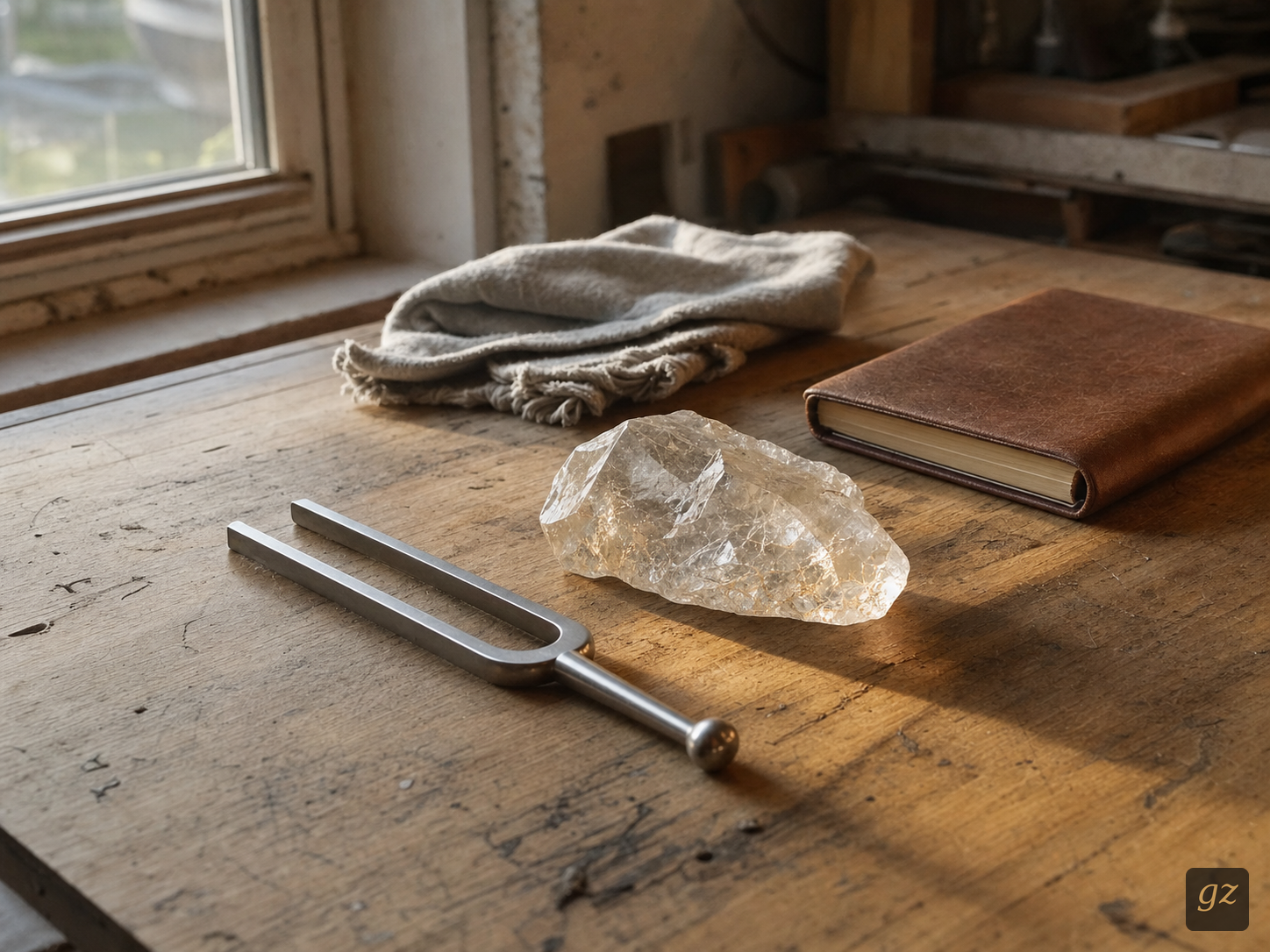
The same thing happens with tuning forks sold as "Solfeggio frequencies" without any documentation of calibration. With decks that have beautiful art but were produced fast and cheap and fall apart after a dozen readings. With anything sold on the energy of the category. crystal, fork, deck, wand. Rather than the specifics of the object.
Specifics are where real lives.
What asking specifics actually looks like.
A named mine is a specific. Not because the mine is magic. Because a named mine means someone can trace the stone back to a geology. Brandberg amethyst from Namibia has a specific silica structure. Lemurian seed quartz from the Serra do Cabral in Brazil has a specific striation pattern. These aren't spiritual claims. They're material facts. And material facts are what allow you to have a real conversation about a real object instead of a conversation about the idea of crystals.
I started asking: where is this from? Not spiritually. Geographically. The vendors who couldn't answer that question. Or who got defensive when I asked. Were selling The Almost. The ones who could tell me the mine, the region, the extraction method, sometimes the individual miners, were selling the real thing. Not always prettier. Not always cheaper. But traceable. Which means verifiable. Which means I could make an actual decision instead of a vibe decision.
A tuning fork calibrated to a specific frequency is a specific. You can check it with a tuner. If it reads 432 Hz, it reads 432 Hz. That's not a belief; that's a measurement. You can argue about whether 432 Hz does anything differently than 440 Hz. That's a real argument worth having. But you cannot argue about whether the fork is what the label says it is. Either it is or it isn't. Either it rings true or it doesn't. A cheap fork sold as "high frequency sound healing" without any documentation is not in that argument. It's just metal that vibrates approximately.
Approximately is not a tool.
A deck is a specific when it's been designed with enough care that the imagery holds up to repeated reading. Not because the art is expensive. Because the symbols are consistent. Because pulling the same card twice in a week shows you something different the second time, not because the card changed but because you did. That requires depth in the design. Depth takes time. Time costs something. The decks that fall apart. Physically and interpretively. After the third reading were made fast. Fast tools are the same as approximate tools. They give you the shape of the practice without the practice actually landing.
Both. Always both. The object matters and you matter. But the object has to be real enough to hold up its end.
What "real" turns out to mean.
Here is what I've landed on after years of buying, using, recommending, and quietly throwing away tools that didn't do what they were supposed to do.
Real means: it does one job, well, and it doesn't pretend to do more than that.
The best piece of selenite I own sits on my desk. I know where it came from. Morocco, a specific region, a vendor I've bought from three times who gives me a paperwork trail. Does it cleanse energy? I don't know. I'm not making that claim. What I know is that it's cool to the touch, it's white the way white should be, and when I pick it up I slow down for a few seconds because picking it up has been a slow-down signal long enough that my nervous system now takes the cue. That's real. That's a tool doing a job. The job is: interrupt the loop, introduce a pause, let something settle.
The job is not: fix everything, heal the wound, replace the work.
Tools that promise everything are not tools. They're The Almost in retail packaging. The real ones are honest about what they are. A calibrated fork is a piece of steel that holds a frequency. A quality deck is a set of images designed to provoke a thought you needed to have. A named-source stone is a piece of geological time that happens to fit in your hand. None of them are magic. All of them can work. The distinction matters because if you expect magic and get physics, you'll throw out a real tool because it didn't perform a miracle.
Presence is the only tool that never lies. I've written that before. What I'd add here: presence is what activates all the other tools. The fork doesn't do anything if you don't listen. The stone doesn't do anything if you don't slow down to hold it. The deck doesn't do anything if you don't sit with the card long enough for it to have a conversation. The tool extends your reach. You still have to do the reaching.
How I learned to spot the difference.
Working a seafood counter teaches you a few things about fraud. Nobody at the counter is trying to be philosophical about it. The smoked salmon either lists the smokehouse or it doesn't. The oysters have a tag with the harvest date or they don't. The "fresh" label on the pre-packaged shrimp is legal as long as it was never frozen by the store. What happened before it got to the store is a different conversation entirely, one the label is not having with you.
After enough time, you learn to read what a label is not saying.
The same reading applies to product copy in the spiritual tools space. High-vibrational stone, hand-selected for energy work. Read that and ask: who selected it, from what, and what does high-vibrational mean in a way that could be verified by anyone other than the person selling it? If the answer is nothing, you're reading catalog copy dressed up as information. The label is not lying, exactly. It's just not saying anything. It is the verbal equivalent of the tumbled lot.
What the real vendors say sounds less exciting. Madagascan labradorite, extracted 2023, direct trade with cooperative. Calibrated to 528 Hz, tested, comes with frequency certification. Third printing of this deck, updated the imagery in ten cards based on reader feedback. Boring. Specific. Verifiable. Real.
The boring-and-specific things are almost always the ones that hold up.
The real ones don't need to convince you.
There's a thing the best tools have in common. They don't perform. They just sit there being what they are, and if you're paying attention, you notice.
The knife I've been using for three years doesn't announce itself. It's heavy in the right place, holds its edge longer than it should for the price, and when I pick it up my hand knows where to go. That's it. That's the whole review. It does one job. It does it every time. I don't think about it when I'm using it, which is the highest compliment a tool can receive.
The best spiritual tools work the same way. The fork rings and the ring lingers and the body responds to the ring. The card comes up and something in the image catches and doesn't let go. The stone is in the hand and the hand slows. No announcement. No promise. No catalog copy. Just the thing doing its thing, and you present enough to receive it.
This is not easy to find. Most of what's sold in this space is sold on promise, not on performance. The promise is The Almost. This will help you, heal you, guide you, protect you. Maybe. But only if it's actually a thing. Only if someone made it with enough care that it has something to give. Only if you're present enough to take it.
The Tough Spot. Whatever yours is right now. Doesn't need The Almost. It needs a real tool doing a real job, and you behind it, paying attention.
Take what holds up.
I put together a Gadgets page on this site. It's not a store. It's a list of things I've used long enough to know they're real. Named sources where I know them. Calibration data where it exists. Honest notes about what a thing does and what it doesn't. I'm not going to tell you that a piece of labradorite will change your life. I'm going to tell you where it's from, what it feels like in the hand, and what I use it for. You can decide from there.
That's the whole framework. Not faith in the category. Faith in the specific object, earned by using it until you know.
The fake door looks exactly like the real one until you try to walk through it. The almost-right shape fits in the hand exactly like the right shape until you're in The Tough Spot and you reach for it and it has nothing to give.
The real ones hold up. That's all they do. That's enough.
A tool that does one job well is worth more than a catalog of promises. Find the one job. Verify it holds. Everything else is noise.
The recovery thread referenced here runs through Spiritual Homesickness (forthcoming) and the field note The Itch You Can't Reach. Both books are on the My Books page.