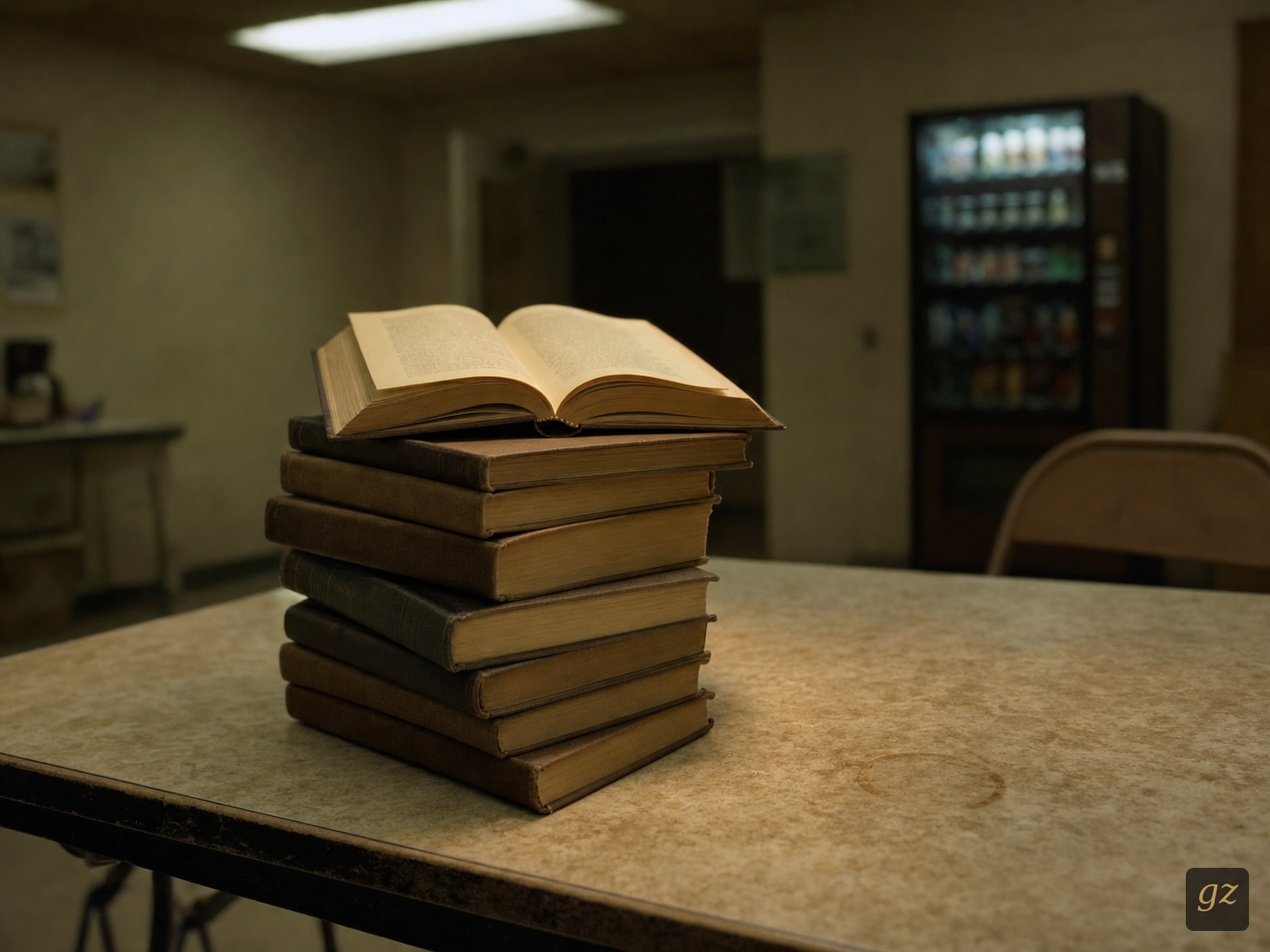
There is a feeling that comes from reading the same self-help book in twelve different jackets. You finish the third one and start to suspect they all came from the same source. You finish the fifth and you stop suspecting and start knowing. By the eighth or ninth, you can finish the sentences in your head before they appear on the page. And what you start wanting is not another book in the genre. You start wanting whatever the genre came from. The thing the bestsellers are quietly translating.
That thing exists. It is mostly out of print, mostly in the public domain, mostly written before 1950, and mostly waiting for you in a library or on the free reading shelf of this site. The books on this list are not secrets. They are simply unfashionable. They are the buried canon. Buried not because anyone hid them, but because the modern self-help market repackaged the surface layer and let the source go quiet.
This is not an exhaustive list. These are the twelve I keep going back to. Take what's useful. Leave what isn't.
1. The Kybalion Three Initiates, 1908.
Seven principles. Mentalism, correspondence, vibration, polarity, rhythm, cause and effect, gender. Every modern occultist quotes it whether they admit it or not. Read it once for the principles. Read it again for the prose, which is older than it sounds and clearer than it has any right to be. We host it free in the Library.
2. Tao Te Ching Lao Tzu, 6th c. BCE.
Eighty-one short verses on water, weakness, and the way the soft beats the hard. The Mitchell translation reads beautifully and is a little loose. The Feng / English is closer. Read both. The book changes shape every time you come back to it because you have changed shape since the last reading.
3. Meditations Marcus Aurelius, ca. 170 CE.
The notebook of an emperor talking to himself. Not written for publication. Which is exactly why it lands. The whole modern Stoic-content industry runs on five paragraphs of this book. Read the actual book. The remaining ninety-five percent is where the work is.
4. The Secret Teachings of All Ages Manly P. Hall, 1928.
Qabbala, alchemy, tarot, ceremonial magic. The reference book. Hall was twenty-seven when he wrote it, which is either inspiring or annoying depending on the day. Treat it like an encyclopedia. Open it to a chapter that scares you a little.
5. The Emerald Tablet attrib. Hermes Trismegistus, ancient.
Fourteen lines. The single most quoted line in Western esotericism. that which is above is like that which is below. Comes from here. Read the whole text. It takes ninety seconds. Sit with it for an hour.
6. The Gospel of Thomas ca. 1st, 2nd c., recovered 1945.
One hundred and fourteen sayings of Jesus that didn't make it into the New Testament. Drier, stranger, and more demanding than the canonical gospels. Less narrative, more koan. The Nag Hammadi find of 1945 changed what was possible to argue about early Christianity. Worth reading slowly.
7. The Cloud of Unknowing Anonymous, 14th c.
A medieval English handbook on contemplative prayer, written by a monk who refused to put his name on it. The "cloud" is the gap between the seeker and the divine. And the instruction is to enter the cloud rather than try to think your way out of it. The whole modern centering-prayer revival is downstream of this book.
8. The Varieties of Religious Experience William James, 1902.
The first time anyone tried to study religious and mystical experience the way one studies anything else. By collecting accounts, comparing them, and refusing to flatter or dismiss either side. James is the patron saint of both, always both. Read the chapter on conversion. Read the chapter on saintliness. Argue with him.
9. The I Ching ancient, Wilhelm/Baynes ed. 1950.
A divination system older than tarot by two thousand years. Sixty-four hexagrams. The Wilhelm/Baynes edition is the one with the Carl Jung foreword and the better English. Throw the coins. Read the hexagram. Sit with the change-line. Don't ask it questions you already know the answer to. It can tell.
10. The Way of a Pilgrim Anonymous Russian, 19th c.
An anonymous peasant walks across nineteenth-century Russia trying to learn how to pray without ceasing. Discovers the Jesus Prayer. Becomes a small, quiet, devastating book. If you grew up Christian and lost the thread, this book is the way back in that doesn't require you to undo anything you correctly stopped believing.
11. The Tibetan Book of the Dead Bardo Thodol, 8th c.
A guide for the dying and the dead. Read it as that. Read it also as a guide for any transition. Divorce, sobriety, the hour after a job ends. The bardos are not just for after death. They are for every threshold.
12. The Imitation of Christ Thomas à Kempis, 15th c.
If you can stomach the religious vocabulary, this book is one of the most useful psychological texts ever written. It is also one of the harshest. Kempis does not flatter you. He does not inform you that your inner child is fine. He tells you, gently, that pride is the root of most of your problems and humility is the only ground to build on. He is, mostly, right.
What this list is not.
This is not the canon. It is a canon. There are obvious omissions. The Bhagavad Gita is missing because I have not yet read it well enough to recommend it honestly. The Sufi poets are missing because they deserve their own list. Plato is missing because Plato is the air we breathe and you have already read him without knowing it. The list will grow.
What this list is is the dozen books I would put in a small box and hand to someone who has finished their twelfth self-help paperback and is starting to suspect there's a layer underneath. There is. This is the door.
Take what's useful. Leave what isn't. The buried canon will still be there next year, and the year after, and the year after that. It has nowhere to go.
Many of these texts will be hosted in full in the Library as I get them keyed. If you want to know when each one goes up, the dispatch sends a note when it lands.